
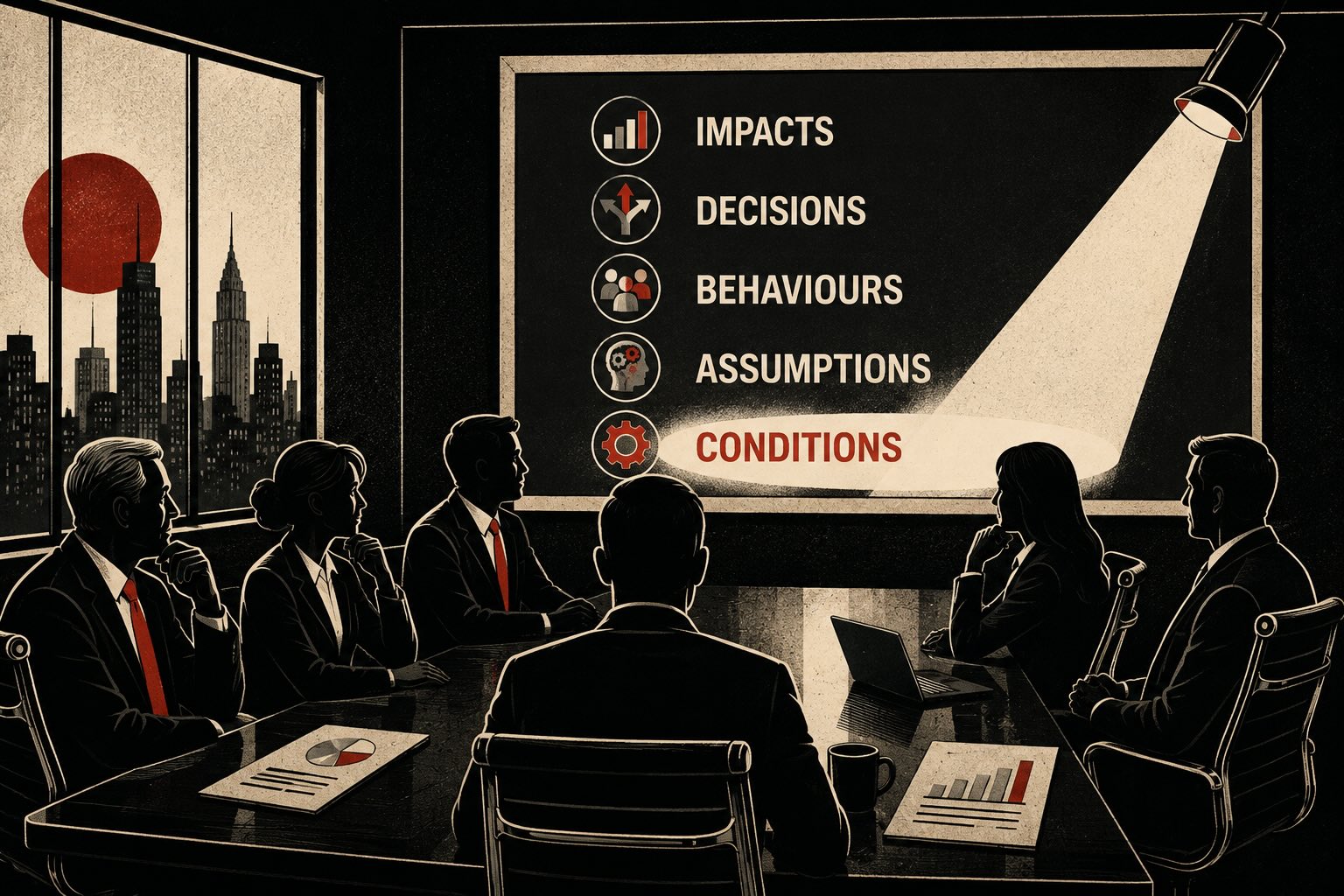
Recurring problems are rarely caused by a shortage of capable people
Karamawari helps CEOs and leadership teams understand why costly problems keep returning after capable people have already tried reasonable fixes.
When the same problem survives multiple responses, the natural reaction is to try harder: another process, restructure, technology investment, consultant or transformation. But recurrence is a signal that the current explanation is incomplete or something important remains unchanged.
We work alongside the people who understand the organisation best to connect evidence, history and experience that may sit in different parts of the business. Together, we build a clearer explanation of why the problem persists and what any successful response must change.
The aim is to reduce avoidable cost, recover capacity and improve performance while leaving the organisation more capable, not more dependent on us.
Karamawari's Vision
A world where organisations stop paying for the same problems twice.
Karamawari's Mission
To help leaders and their people understand why costly problems keep returning, change what keeps recreating them and build the capability to sustain better outcomes.
Karamawari's Values
Curiosity before certainty
We resist the pressure to reach an answer before we understand the problem. We question what appears obvious, distinguish evidence from assumption and remain willing to discover that our first explanation was wrong.
Respect for capability
We know the people closest to the problem are capable and possess knowledge outsiders don't. Our role isn't to replace their expertise but to help reveal what has been difficult to see from inside the system.
Courage over comfort
Persistent problems sometimes survive because important things are difficult to say, challenge or change. We surface uncomfortable evidence respectfully and are prepared to challenge assumptions, including our own.
Evidence over opinion
Plausible explanations aren't enough. We test important claims against evidence, distinguish what is known from what is assumed and make uncertainty visible before significant decisions are made.
Simplicity from complexity
Organisations are complicated enough. We look for the smallest number of meaningful changes capable of altering the pattern rather than adding unnecessary process, governance or bureaucracy.
Capability over dependency
Success isn't making our clients dependent on Karamawari. We work alongside their people, transfer understanding and capability, and leave the organisation better able to solve difficult problems itself.
Karamawari's Beliefs
- Capable people rarely set out to make bad decisions.
- Decisions make sense inside a context.
- When a material problem keeps returning, the accepted explanation deserves to be tested.
- Symptoms deserve attention. Recurrence deserves deeper investigation.
- Assumptions should be tested against evidence, not strengthened by repetition.
- Another solution is premature when the problem itself is not yet well understood.
- Complexity should be reduced, not added to.
- Our involvement should make the organisation more capable, not more dependent.
- Organisations should stop paying repeatedly for the same problem.
Frequently Asked Questions
What does the name Karamawari mean?
The name comes from the Japanese word karamawari (空回り), commonly used for spinning or turning without gaining traction.
In a business context, it captures the frustration of repeated effort that creates activity without resolving the underlying problem. We chose it because that is the pattern Karamawari exists to help organisations break.
What kind of problems do you help with?
Karamawari works with CEOs, boards and leadership teams on material problems that keep returning after reasonable attempts to solve them. They may show up as rising cost, recurring operational failure, stalled transformation, persistent risk, customer friction, underperformance or repeated rescue work.
What matters is not the category of problem. It is that the organisation has already acted, the outcome keeps returning and the cost of recurrence is significant.
How do I know whether we have a recurring problem or simply a difficult problem?
A difficult problem may take considerable effort to solve once. A recurring problem has a history: the organisation has responded reasonably, improvement may have occurred, yet substantially the same outcome returns. The important evidence is not simply that the problem is difficult, but that previous action has failed to change the pattern sustainably. That history makes recurrence something worth diagnosing in its own right.
Is Karamawari a consulting or coaching firm?
Neither. Consultants typically bring expertise and recommend what an organisation should do. Coaches typically help individuals develop their own thinking and capability.
Karamawari does something different. We work alongside your people to investigate why a costly problem keeps returning despite previous attempts to solve it. We bring the diagnostic approach; your people bring the organisational knowledge.
Together, we uncover the conditions, assumptions, behaviours and decisions that keep recreating the problem, so your organisation can address what is actually sustaining it rather than becoming dependent on an external adviser.
How are you different from a typical consulting firm?
Most consulting engagements begin with a problem definition and move relatively quickly toward a solution. Karamawari starts by testing whether the accepted problem definition is complete.
We ask why the issue survived previous fixes and what those attempts may have left unchanged. That makes us most relevant when more activity is no longer the answer and leadership needs a better diagnosis before committing again.
How do you avoid becoming another consulting exercise?
We keep the work anchored to one practical question: what would leadership need to understand differently for the next response to have a better chance of working?
Every activity must contribute evidence, resolve a material uncertainty or improve the quality of the decision. If it does not, it does not belong in the engagement. The aim is not more activity. It is traction.
Why have we struggled to solve this ourselves?
Often because much of the relevant knowledge already exists inside the organisation but is fragmented across teams, data, history and lived experience. Each part can be locally correct while the full pattern remains difficult to see.
Karamawari helps connect those perspectives and test the accepted explanation without replacing your team’s judgement.
Will this make my team feel blamed or exposed?
The work is designed to reduce blame, not create it. We examine why decisions and behaviours made sense in context, what information and pressures shaped them, and what the organisation can learn from the pattern.
Where individual conduct is material, it cannot simply be ignored. But the purpose of the diagnosis is to understand recurrence and improve the organisation’s response, not conduct a witch hunt.
Are you saying our previous decisions were wrong?
Not necessarily. A decision can have been reasonable at the time and still contribute to an outcome that later proves unsustainable.
We look at the context in which decisions were made and ask whether the information, assumptions and constraints that supported them still hold. The purpose is to learn from the decision environment, not retrospectively label capable people as foolish.
What do you examine during Problem Diagnosis?
We look beyond the visible incident to the wider organisational context and decision patterns that may be allowing the problem to return. Depending on the problem, that can include information, incentives, authority, capability, constraints, behaviours and important assumptions.
The exact focus is determined by the evidence, not by forcing every problem through the same public checklist.
What is the first step?
How long does a typical engagement with Karamawari take?
Duration depends on the complexity, evidence and sensitivity of the problem. Problem Diagnosis typically runs over several weeks, with the scope and timing agreed before paid work begins.
Karamawari is deliberately senior-led and focused on one material recurring problem at a time. The objective is enough depth to reach a decision-useful explanation without creating an open-ended discovery program.
Do you provide recommendations or just diagnosis?
Diagnosis comes first. Karamawari identifies what any successful response needs to address, but the solution itself is developed by your organisation.
We then offer Solution Validation to independently challenge that response against the diagnosis and Solution Accountability to help keep implementation connected to what was discovered. This preserves internal ownership while providing rigorous external challenge.
How much involvement will my team need?
Enough involvement to access the evidence and perspectives required, but no more than the problem justifies. The CEO or executive sponsor and a small number of leaders are usually involved, with other people brought in where their knowledge is material.
We keep sessions focused and design the engagement around the organisation’s operating demands rather than imposing a consulting rhythm on it.
Will this slow us down when we need action now?
Diagnosis adds a small amount of deliberate effort before larger commitments are made. For a persistent problem, that can be faster overall than launching another response on the same assumptions.
The aim is to prevent wasted action, not delay necessary action. Where immediate containment is required, that can continue while the underlying recurrence is examined.
Why is it important the CEO be involved?
Persistent problems often cross functions, budgets and accountabilities, which makes executive sponsorship important. The CEO is not required to attend every conversation, but is often best placed to create permission for candour, resolve cross-functional barriers and act on findings that no single function can own.
In some organisations another executive sponsor may hold that authority. Karamawari works with that sponsor as a partner, not as a passive recipient of findings.
How do you work with the leadership team?
The leadership team is treated as a co-creator of clarity, not an audience for an external answer.
Leaders hold different pieces of knowledge about how the organisation actually works. Karamawari helps structure, connect and challenge those perspectives so the team can build a shared explanation of the problem.
What will we get at the end of the engagement?
At the end of Problem Diagnosis, leadership receives a shared, evidence-based explanation of why the problem has persisted, the material uncertainties that were resolved and what any credible response needs to address.
The value is not the report itself; it is a stronger basis for decision and action. If you proceed to Solution Validation and Solution Accountability, the organisation also receives independent challenge of its proposed response and ongoing scrutiny of whether implementation remains connected to the diagnosis.
How do you handle politically sensitive issues?
Carefully, directly and with discretion. Sensitive issues are handled by separating evidence from accusation and keeping attention on what the organisation needs to understand to reduce recurrence.
Where individual conduct is material, it is treated as evidence rather than ignored or sensationalised.
Can this be done discreetly?
Yes. Many persistent problems are sensitive. Early work can be limited to the executive sponsor and selected leaders, with wider involvement introduced only where the evidence or the problem requires it.
The appropriate level of confidentiality and participation is agreed at the start of the engagement.
What if we discover something uncomfortable?
That is possible. Persistent problems sometimes survive because important evidence has been difficult to say, see or act on.
Karamawari’s role is to make that evidence usable: understand the context, distinguish what is supported from what is assumed, and help leadership decide what to do with it deliberately rather than reactively.
What if the real issue is leadership behaviour?
Leadership behaviour can be part of the explanation, just as structure, incentives, measures, constraints or external pressures can be.
If it is material, it needs to be examinable. The work focuses on how leadership signals, expectations, reactions and priorities influence the result, with the same evidence standard applied to leadership as to any other part of the organisation.
What if the problem is cultural?
Culture can be part of the evidence, but it is rarely a sufficient diagnosis on its own.
We look at what consistently shapes the behaviours people experience as culture, including expectations, incentives, authority, consequences, trust and leadership signals, and connect those patterns to decisions and outcomes.
What if everyone already agrees on the root cause?
Agreement is useful, but it is not evidence. In fact, a widely accepted explanation can become harder to challenge because subsequent information is interpreted through it.
We test important assumptions against evidence and deliberately look for observations the prevailing explanation cannot adequately account for. If the existing diagnosis survives that challenge, confidence in it should increase. If it does not, leadership has learned something important before spending more money.
What if we already know the problem?
If the problem is still returning, the current explanation may be incomplete. Knowing what happened is not always the same as knowing why the organisation keeps producing the same result.
Karamawari helps test whether the accepted explanation is sufficient before more effort is built on top of it.
What if we have already used consultants on this?
That is often when Karamawari becomes most relevant. If previous work produced recommendations, roadmaps or initiatives but the problem persisted, leadership has new evidence: action occurred and the result survived it.
We focus on understanding that persistence before the organisation commissions another major response.
How do we know this will not just produce another report?
The report is not the product. The product is a decision-useful explanation of why the problem has persisted and what any credible response needs to address.
Written outputs exist to preserve evidence, make the reasoning challengeable and give leadership a shared basis for action.
How do you measure success?
Success measures are agreed against the specific problem. Depending on the engagement, they may include reduced recurrence, lower avoidable cost, recovered capacity, improved performance, reduced risk or evidence that critical decisions and behaviours have changed.
We do not use a generic scorecard. The measures need to show whether the problem is becoming less likely to return and whether the economics of the engagement are being realised.
How much does it cost?
Karamawari does not price from a generic day-rate model. Before a paid engagement, we establish the commercial significance of the recurring problem during the complimentary Cost Calculation Workshop and scope the work required to investigate it.
The fee is agreed upfront and considered against the value at stake, so leadership can decide whether the engagement makes commercial sense before committing. The work is deliberately senior-led and contained rather than built around a large delivery team.
Could the cost of solving the problem be greater than the cost of living with it?
Absolutely. Eliminating every recurring problem would make little commercial sense.
That is why we begin with a Cost Calculation Workshop to establish what the problem is actually costing the organisation, including costs that may be dispersed or hidden across the business. This creates a commercial baseline before committing to deeper diagnosis or further intervention.
If the likely cost, disruption or risk of eliminating the problem outweighs the value available, the rational decision may be containment or acceptance rather than elimination. Conversely, understanding the true cumulative cost of recurrence may reveal that continuing to live with the problem is considerably more expensive than it appears.
Is this only for organisations in crisis?
No. The best fit is a material recurring problem that has already survived reasonable attempts to solve it. Sometimes that problem is urgent; sometimes it is quietly consuming margin, capacity or strategic attention while the business otherwise performs well.
Karamawari is designed for recurrence, not generic first-time problem solving. The important question is whether there is a meaningful pattern, consequence and history to investigate.
What happens if you cannot find a convincing explanation?
We should not manufacture one. A credible diagnosis must distinguish what the evidence supports from what remains uncertain.
If important questions cannot be resolved with the available evidence, leadership should know exactly what remains unknown and what additional evidence would be required. An explicit uncertainty is more useful than a confident but weak explanation.
What if the problem is not solvable?
Some constraints are genuinely immovable, and not every problem can be eliminated. Part of a good diagnosis is distinguishing what can be changed from what must be managed.
If the evidence shows that a constraint is structural, outside the organisation’s authority or not economical to change, leadership should know that before spending more money on another fix.
What is the biggest risk of not doing this?
The organisation may continue spending money, capacity, credibility and management attention on responses that produce temporary relief without changing the result.
Over time, recurrence can become normalised, more expensive to unwind and harder for leadership to distinguish from ordinary operating cost.
Why now?
If a material problem has already returned, the organisation is accumulating evidence that the current explanation or response is incomplete.
The most useful time to investigate that pattern is before another major round of effort, money and executive confidence is committed on the same basis.
Will this create dependency?
The goal is the opposite. Karamawari works alongside the executive sponsor and people closest to the problem so the understanding remains inside the organisation.
A strong outcome is not simply a resolved problem. It is an organisation better able to recognise similar patterns without needing Karamawari to become part of the permanent operating model.
What makes Karamawari credible if it is not a large consulting brand?
Karamawari is deliberately senior-led and specialised. Clients work directly with experienced practitioners focused on one problem, rather than a large delivery pyramid.
A large firm may be the right choice when scale, implementation capacity or a broad transformation program is needed. Karamawari is the better fit when leadership first needs to understand why a material problem has survived previous attempts before committing to another large response.
What if the board asks why we are using Karamawari instead of a big firm?
The immediate need is not scale. It is diagnostic clarity. The organisation is facing a problem that has survived prior work, so before committing to another major program, leadership wants an independent, senior-led examination of why the problem persists and what any credible response must address.
If later implementation requires scale, that can be sourced once the organisation understands what it is actually trying to change.
When is Karamawari not the right fit?
Karamawari is unlikely to be the right fit for a straightforward first-time problem with an established solution, an engagement primarily requiring additional implementation capacity, or a problem whose commercial significance does not justify deeper investigation. We are most relevant when a material problem has survived reasonable attempts to solve it and leadership needs to understand why before committing again.

