
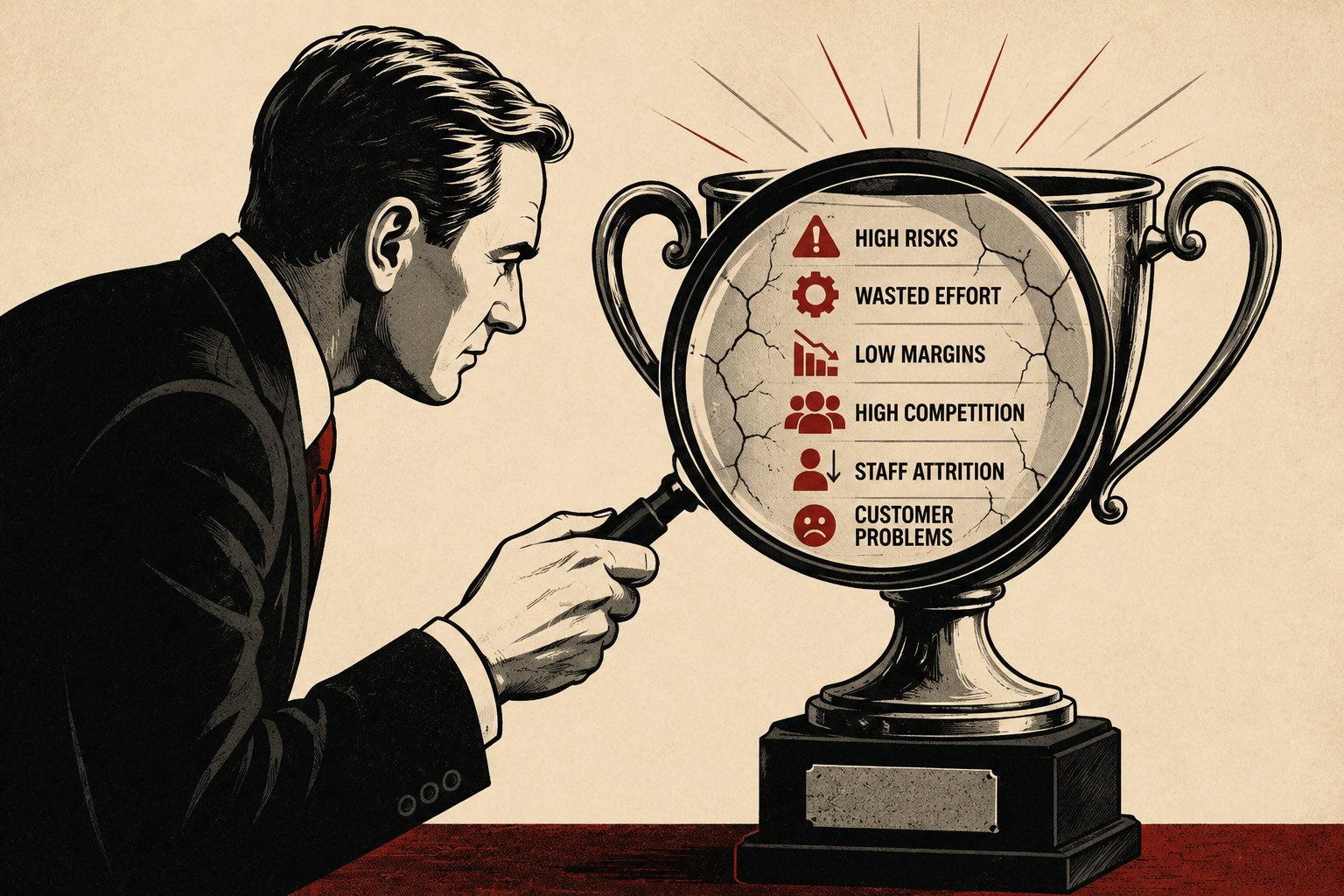
Failure attracts investigation; success often earns the organisation permission to stop asking questions.
When a major project fails, executives want to know why.
Reviews are commissioned. Decisions are examined. Assumptions are challenged. Risks are revisited. Boards ask what went wrong and what must change.
When the same project succeeds, something very different happens.
Congratulations are offered.
Results are reported.
The team moves on.
That asymmetry creates an uncomfortable leadership problem: we often investigate failure far more rigorously than success, even though both were produced by a combination of decisions, behaviours and conditions.
And sometimes the difference between them is thinner than the dashboard suggests.
A good outcome does not prove you had a good system
Imagine a critical programme delivered on time and within budget.
Excellent result.
But suppose it happened because a handful of experienced people worked extraordinary hours for three months. A senior executive personally intervened in dozens of decisions. Several risks fortunately never materialised. Another project quietly surrendered resources to keep this one moving.
The dashboard says green.
The organisation celebrates.
But what exactly succeeded?
The system?
Or the people compensating for it?
That distinction matters because the organisation may now use the successful outcome as evidence that its processes, resources and assumptions were sound.
The next programme is approved on the same basis.
Except this time the hero leaves.
Or two major projects require rescuing simultaneously.
Or the risk that didn't materialise last time does.
Suddenly, yesterday's successful operating model becomes today's inexplicable failure.
Sometimes success means the conditions were forgiving
Leadership teams naturally associate outcomes with the quality of their decisions.
Good decision. Good result.
Bad decision. Bad result.
Reality is less accommodating.
A poor decision can produce an excellent outcome when conditions are favourable. An excellent decision can produce a disappointing outcome when conditions turn hostile.
Consider a company carrying too little inventory.
If supply remains stable, the decision may produce lower working capital and better margins. Management congratulates itself on improved efficiency.
Then supply is disrupted.
What suddenly looks like a bad inventory strategy may actually have been fragile all along.
The earlier success didn't prove resilience.
It merely meant resilience hadn't yet been tested.
Heroic effort can make fragility look like capability
This is particularly important for CEOs dealing with recurring problems.
Capable people are extraordinarily good at compensating for weak organisational conditions.
They chase missing information.
Circumvent cumbersome processes.
Resolve unclear accountabilities through personal relationships.
Escalate decisions.
Work longer.
Carry institutional knowledge in their heads.
Protect customers from problems they should never experience.
And because they succeed, the weakness they compensated for remains invisible.
Ironically, your best people can therefore make your organisation look healthier than it actually is.
Their competence becomes camouflage.
Eventually, what should have been an exceptional intervention becomes part of the unofficial operating model.
“We always find a way.”
Perhaps.
But leadership should be interested in why finding the way requires so much effort.
Luck rarely appears on the board dashboard
There is another uncomfortable ingredient in organisational success: conditions that simply didn't test you.
The major customer didn't leave.
The supplier didn't fail.
The regulator didn't intervene.
The experienced employee didn't resign.
Demand didn't exceed capacity.
The competitor didn't cut prices.
The cyber incident didn't occur.
None of these outcomes necessarily demonstrates that the organisation was prepared for them.
They demonstrate only that the conditions didn't arise.
This distinction becomes especially important when organisations extrapolate from past success.
“We've always done it this way.”
“We've never had a problem.”
“Our controls have worked.”
Those statements can describe a robust system.
They can also describe a fragile system that hasn't encountered the condition capable of exposing it.
Success can create its own form of Karamawari
The Japanese concept 空回り (karamawari) describes effort that creates motion without sufficient progress.
We usually recognise it when results are poor.
But there is a subtler version.
An organisation can repeatedly achieve acceptable results through excessive intervention, workarounds, additional effort and favourable circumstances while never strengthening the conditions underneath them.
The numbers look respectable.
The machinery underneath is spinning furiously.
The danger is that leadership mistakes successful compensation for organisational capability.
Then, when circumstances become less forgiving, the recurring problems suddenly become visible again.
Conduct a post-mortem on success
CEOs and boards should therefore examine important successes with some of the curiosity normally reserved for failures.
After a significant success, don't ask only:
“What did we do well?”
Ask what nearly went wrong.
What required extraordinary intervention?
Which assumptions turned out to be true through judgement, and which through luck?
Where did people compensate for weaknesses in the system?
Which risks didn't materialise?
What would have happened if conditions had been slightly different?
And most importantly:
Could we reproduce this result without relying on the same exceptional effort?
That final question separates repeatable capability from fortunate achievement.
Failure tells you where the organisation broke.
Success can tell you where it almost broke.
But only if somebody is curious enough to look.
For CEOs fed up with recurring problems, that may be one of the richest sources of information available. Don't wait for the next failure to reveal the conditions already visible inside today's success.
If your organisation achieved exactly the same result next year, but your heroes weren't available and circumstances were less forgiving, would you still call your system successful?


0 Comments