
Some recurring problems become so embedded that eventually nobody asks why they still exist. They simply budget for the inconvenience.
Australia’s railway gauges are a remarkable example.
For generations, passengers, freight operators, governments and businesses paid the price of decisions made when Australia’s railways were still separate colonial projects.
The original decisions were understandable.
The consequences lasted far longer than anyone making them could reasonably have imagined.
That is precisely what makes the story relevant to CEOs dealing with recurring problems today.
One Country, Three Railway Gauges
Australia did not begin with a national railway system.
In the nineteenth century, the separate colonies developed their own networks.
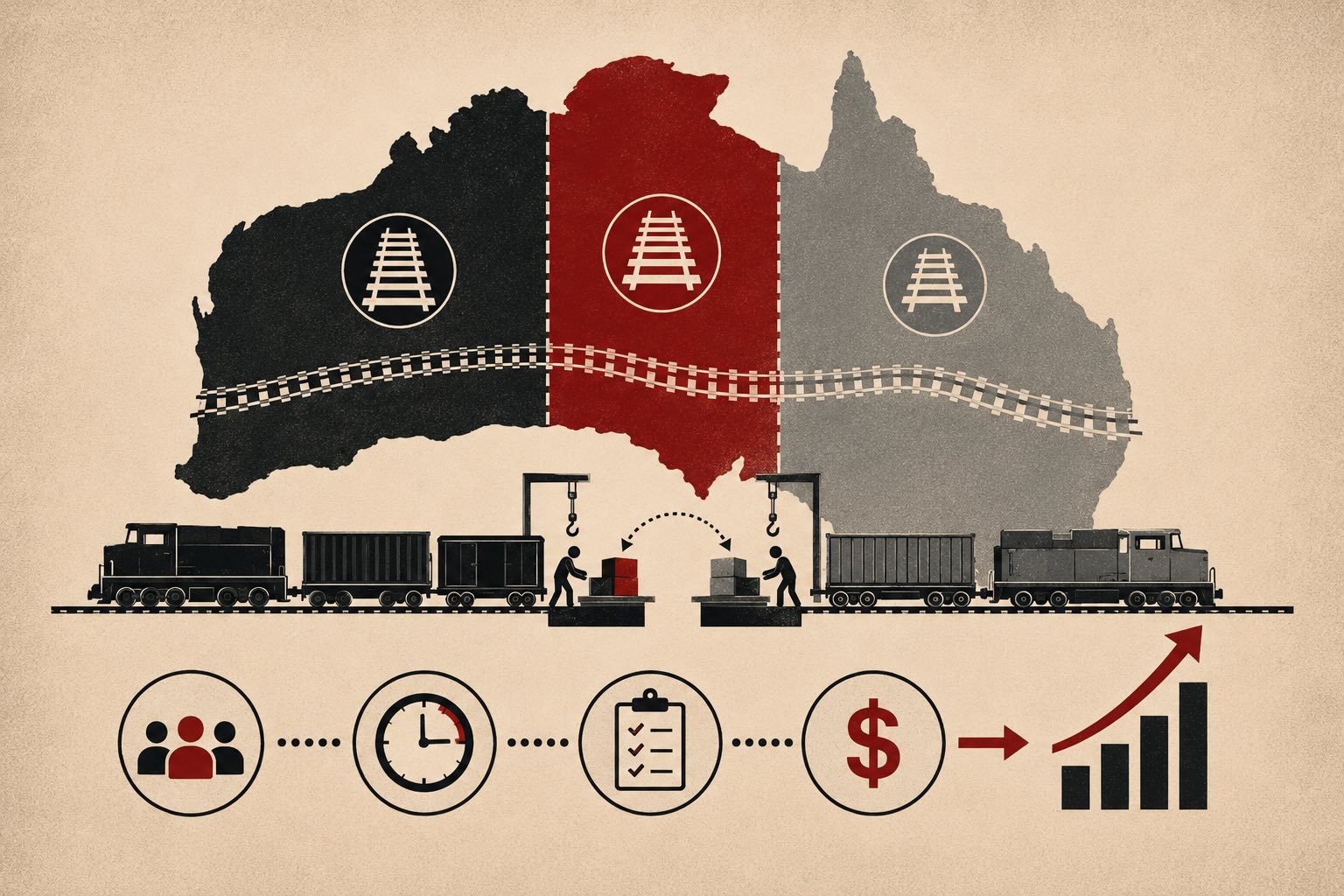
New South Wales ultimately adopted standard gauge, 1,435 mm (4 ft 8½ in) between the rails. Victoria adopted broad gauge, 1,600 mm (5 ft 3 in). Queensland, and later substantial networks elsewhere, adopted narrow gauge, 1,067 mm (3 ft 6 in).
The result was three major gauges across what eventually became one country.
Initially, this did not necessarily look disastrous. Railways were being developed primarily to serve the needs of individual colonies.
The underlying assumption was effectively local:
We are building our railway.
Federation transformed the context.
Trade expanded. Interstate passenger travel mattered. Defence became a national concern. Australia increasingly needed a transport network rather than a collection of railway systems.
But the infrastructure already embodied the assumptions under which it had been created.
That distinction became enormously expensive.
The Problem Was Where the Systems Met
A train designed for one gauge generally cannot simply continue onto track of another.
So Australia developed break-of-gauge locations.
Passengers had to change trains.
Freight had to be unloaded from one train and loaded onto another.
Rolling stock could not move seamlessly between networks.
Journeys slowed.
Logistics became more complex.
And every interface created additional labour, delay and cost.
The striking part is that each railway could function perfectly well within its own boundaries while the overall system performed badly at the places where those systems met.
There is an important lesson here for CEOs.
A system does not have to be broken for the organisation to experience a systemic problem.
Sales can work.
Operations can work.
Finance can work.
Technology can work.
Yet customers, information, decisions and work can still repeatedly encounter friction at the boundaries between them.
Everyone can be doing their job correctly while the organisation continues paying for the gaps.
The Cost Did Not End With the Original Decision
Australia eventually spent enormous effort progressively standardising important routes and improving interoperability.
But standardisation becomes much harder after thousands of kilometres of railway, stations, rolling stock, maintenance facilities and operating practices already exist.
What began as different technical choices became embedded infrastructure.
And embedded infrastructure creates dependencies.
That is how recurring organisational problems compound.
A condition creates an assumption.
The assumption influences decisions.
Those decisions create processes, structures, technology, incentives and behaviours.
Those structures then become new conditions influencing the next generation of decisions.
Eventually the organisation is not merely living with the original problem.
It has built around it.
This Is Karamawari at National Scale
空回り, karamawari, describes effort that fails to translate into meaningful forward movement.
Australia did not ignore the railway problem.
People engineered workarounds.
They transferred passengers.
They transferred freight.
They coordinated timetables.
They operated multiple fleets.
They developed dual-gauge track.
They progressively converted important routes.
Each intervention could be perfectly rational.
But for decades, substantial effort was required simply to overcome a condition inherited from earlier decisions.
That is the organisational equivalent of teams manually reconciling incompatible systems every month.
Managers repeatedly intervening between departments.
Executives escalating the same customer failures.
People maintaining spreadsheets because systems do not communicate.
Transformation programmes repeatedly compensating for structural problems nobody removes.
Every workaround makes today’s problem more manageable.
Some also make tomorrow’s organisation more dependent on the workaround.
The Most Dangerous Problems Become Normal
Australia now has a far more interoperable interstate rail network than it once did, particularly across major freight corridors.
But the historical legacy remains visible.
Broad, standard and narrow gauge networks still exist.
The original problem has been reduced substantially, but not erased.
That is another uncomfortable characteristic of persistent problems.
Eventually they can become normal.
People joining the organisation inherit them without knowing why they exist.
“We’ve always needed that reconciliation.”
“That handoff has always been difficult.”
“Those systems have never talked properly.”
“You just need to know who to call.”
The workaround becomes part of institutional knowledge.
Soon the organisation becomes remarkably good at operating around a problem it should be questioning.
What Gauge Has Your Organisation Inherited?
CEOs understandably focus on today’s visible impacts: cost overruns, customer complaints, margin leakage, delays, duplicated work or repeated escalations.
But sometimes today’s problem is merely the latest break-of-gauge.
The deeper issue may be an old condition, assumption or decision that has survived long after the circumstances that originally made it sensible disappeared.
And each new workaround can add another layer of cost around it.
Australia’s railway gauges remind us that capable people can spend generations efficiently managing the consequences of decisions that once made perfect sense.
What recurring problem is your organisation becoming increasingly sophisticated at working around, when the real question should be why it still exists at all?


0 Comments