
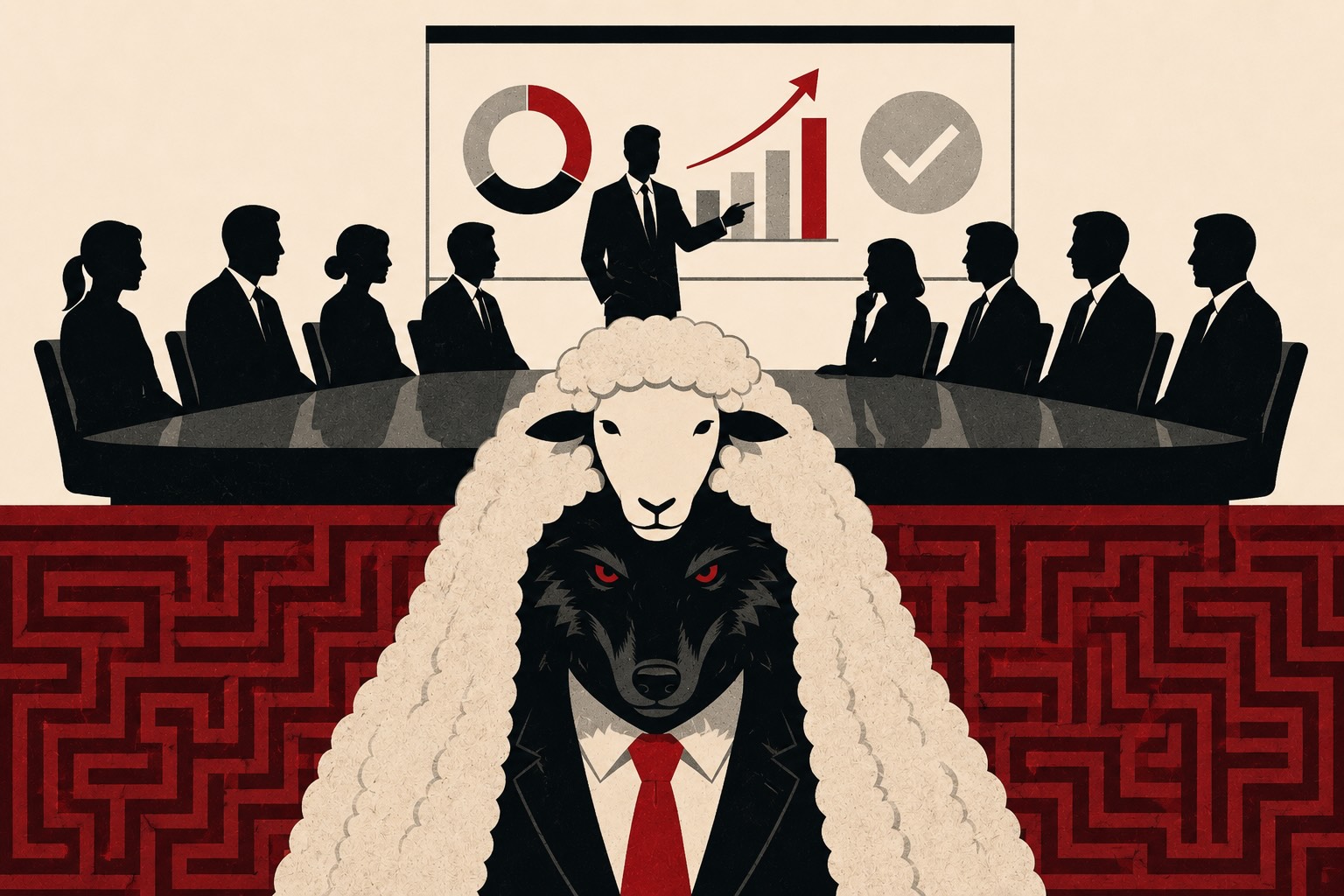
The most dangerous problem in your organisation may be the one currently reassuring everyone that things are getting better.
We are conditioned to look for danger in obvious places.
A red dashboard.
An angry customer.
A missed target.
An executive conflict.
A transformation falling behind.
But persistent problems are rarely considerate enough to announce themselves so clearly.
Sometimes the warning signs look remarkably positive.
The programme is green.
The leadership team agrees.
The presentation is polished.
The milestones are being achieved.
Everyone appears confident.
And somewhere underneath all that apparent progress, the original problem is quietly surviving.
Wolves Rarely Announce Themselves
The familiar story of the wolf in sheep's clothing works because appearance creates expectation.
We see the sheep and assume safety.
Organisations make similar judgements.
We see activity and infer progress.
We see agreement and infer alignment.
We see confidence and infer competence.
We see green dashboards and infer control.
We see completed milestones and infer successful transformation.
Sometimes those conclusions are justified.
Sometimes they are simply the sheep's clothing.
The organisational "wolf" does not have to be a dishonest person deliberately concealing something.
It can be something far more ordinary.
A bad assumption disguised as certainty.
A workaround disguised as a solution.
A failing system disguised as acceptable performance.
Repeated effort disguised as traction.
Green Can Hide a Lot of Red
Consider a transformation programme.
Every major milestone is green.
Technology has been implemented.
Training is complete.
Processes have been redesigned.
Governance is operating.
The board receives reassuring reports.
By conventional measures, the programme is succeeding.
But what was it supposed to change?
If customer complaints remain stubbornly high, employees still manually reconcile systems, decisions still require repeated escalation and managers continue intervening to keep processes functioning, something important has been missed.
The organisation may have successfully delivered the programme without successfully solving the problem.
That distinction is enormous.
Yet once a programme is labelled successful, challenging it becomes increasingly difficult.
The sheep's clothing has acquired institutional credibility.
This Is Where Karamawari Appears
空回り, karamawari, describes wheels spinning without traction.
People are busy.
Meetings are full.
Reports are produced.
Actions are allocated.
Projects are delivered.
Money is spent.
Yet the organisation is not achieving meaningful forward movement.
The dangerous part is that activity produces evidence that something is happening.
That evidence can reassure leadership.
The organisation sees motion and assumes progress.
Then the original problem returns.
Another initiative begins.
More effort follows.
Another temporary improvement appears.
And another recurrence.
The wolf has survived another costume change.
Success Needs to Be Interrogated Too
CEOs understandably spend enormous amounts of time examining failure.
What went wrong?
Who was accountable?
Why was the target missed?
What needs to change?
But apparent success deserves scrutiny too.
Ask:
What is this result hiding?
What assumptions have to be true for this success to be real?
Where is effort increasing faster than output?
What workarounds are required to maintain the result?
What problem keeps returning despite apparently successful interventions?
And perhaps the most uncomfortable question:
Who benefits from the current story remaining believable?
Not because people are necessarily acting dishonestly.
People naturally become invested in explanations that validate their decisions, programmes, budgets and professional reputations.
That makes independent challenge essential.
Cooperation Can Conceal Problems
Boards often worry about conflict.
They should occasionally worry about its absence.
A leadership team that agrees quickly can appear highly aligned.
But agreement can arise from many conditions.
People may genuinely agree.
They may also believe the decision has effectively already been made.
They may have learned that challenging certain assumptions is career-limiting.
They may think raising another concern will simply create more work.
Or they may have stopped believing their objection will change anything.
Silence can therefore look remarkably similar to alignment.
That is why appearance alone is such a poor measure of organisational health.
Look Beneath the Clothing
Good governance is not about distrusting everyone.
Nor should CEOs become cynical about every green dashboard, successful programme or confident executive.
The objective is curiosity.
Look beneath the visible result.
Ask what conditions produced it.
Separate sustainable improvement from heroic effort.
Separate genuine resolution from containment.
Separate output from activity.
Separate confidence from evidence.
Most importantly, examine what happened to the original problem.
Did it disappear?
Did its probability of recurrence materially decline?
Or did the organisation simply become better at managing its consequences?
Those questions move leadership beyond appearances and towards reality.
Because the most expensive recurring problems are not always the ones screaming for attention.
Sometimes they are sitting quietly inside successful programmes, cooperative teams and reassuring dashboards while the organisation continues paying for them.
What if the recurring problem your board is waiting to see turn red is already sitting in front of you, dressed convincingly in green?


0 Comments