
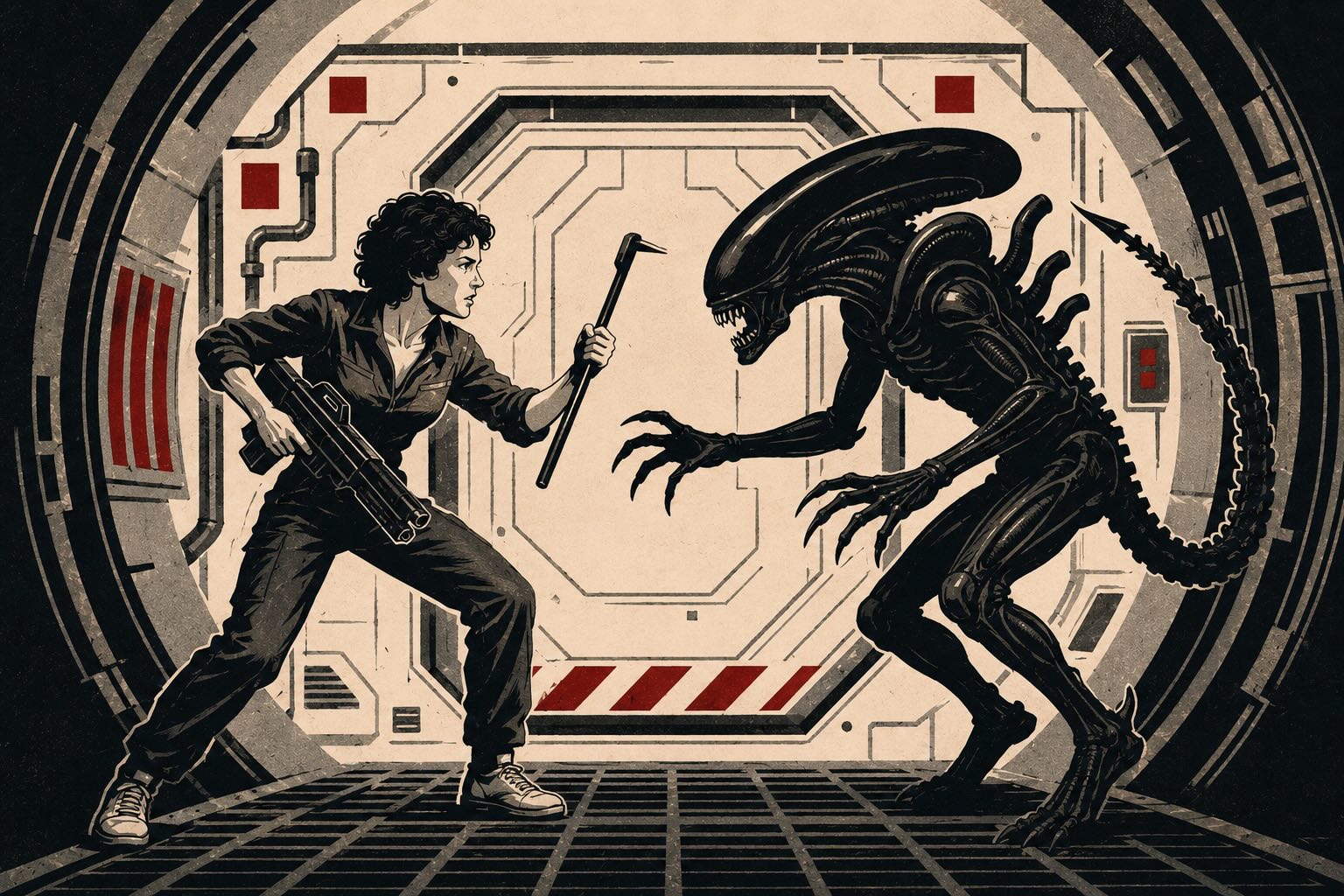
The most expensive recurring problems are often the ones leadership keeps fighting at the point where they finally become visible.
Ridley Scott's 1979 film Alien is remembered as a story about a terrifying creature loose aboard the commercial spaceship Nostromo.
But viewed through the lens of recurring organisational problems, the alien is almost the least interesting part.
The crew repeatedly confronts the immediate threat. They investigate. They improvise. They contain. They fight. They sacrifice.
Yet underneath all that activity sits something more consequential: the conditions that allowed the threat to enter, survive and repeatedly overwhelm them.
That is where Alien becomes a useful lesson in karamawari.
The problem arrives disguised as an incident
The Nostromo crew encounters a distress signal and investigates.
What follows initially looks like an unfortunate sequence of events. Kane encounters the facehugger. The organism enters the ship. The chestburster emerges. The creature grows. The crew responds.
From their perspective, the problem keeps changing.
First it is an injured colleague.
Then it is contamination.
Then it is a dangerous organism.
Then it is a containment problem.
Then it is a survival problem.
Organisations experience recurring problems in much the same way.
This month's customer complaint looks different from last month's operational failure. A project delay appears unrelated to a previous capacity problem. Another control breach is explained by another exceptional circumstance.
Each event receives its own explanation.
But changing manifestations can obscure an unchanged condition.
Sometimes the rule you break is the most important evidence
One of the pivotal moments occurs when Dallas brings Kane back to the ship.
Ripley refuses to open the airlock because quarantine procedures require the returning crew members to remain outside.
She is following the rule designed for precisely this situation.
Ash overrides her by opening the door.
It seems compassionate and practical. Someone is in danger. Action feels necessary.
But the decision removes the barrier protecting everyone else.
For CEOs dealing with recurring problems, there is an uncomfortable lesson here.
When pressure rises, organisations frequently suspend the very conditions designed to protect them.
A major customer needs an exception.
A deadline cannot move.
A revenue commitment has already been made.
A senior executive wants something accelerated.
So the organisation works around its own controls.
Nothing disastrous may happen.
That becomes evidence that the workaround was acceptable.
Then the exception becomes easier next time.
The organisation may be optimising for something you cannot see
Eventually the crew discovers something far more disturbing.
Ash has been operating under secret instructions from the company. The organism is considered valuable. Bringing it back takes priority over the crew's survival.
Suddenly, apparently irrational events become much more understandable.
The system was producing outcomes according to objectives the crew did not know existed.
This happens in less sinister forms inside organisations constantly.
Leadership says safety matters, but rewards schedule.
It says collaboration matters, but rewards individual business-unit performance.
It says problems should be escalated early, but reacts badly when bad news arrives.
It says quality matters, but makes missing the quarterly number career limiting.
Then leaders become frustrated when undesirable behaviours keep returning.
But behaviours frequently make sense when viewed against the conditions producing them.
Before asking why people keep making the wrong decisions, ask what makes those decisions rational inside the organisation they actually inhabit.
Killing the alien does not remove the conditions
This is where Alien provides perhaps its strongest lesson about recurring problems.
Imagine the crew successfully killed the creature much earlier.
Problem solved?
Operationally, yes.
Systemically, no.
The hidden directive would still exist.
The conflicting priorities would still exist.
The ability to override quarantine would still exist.
The information asymmetry would still exist.
Another encounter could therefore produce another version of the same catastrophe.
That distinction matters enormously for CEOs.
Organisations frequently celebrate removing the visible problem while preserving everything capable of recreating it.
The troublesome executive leaves.
The failed system is replaced.
The customer receives compensation.
The project is rescued.
The control is strengthened.
The consultant delivers the remediation programme.
Everyone moves on.
Then something remarkably similar happens eighteen months later.
Another solution follows.
More money is spent.
More management attention disappears.
This is 空回り, karamawari: enormous effort without corresponding forward progress.
Recurrence is evidence
When a costly problem returns despite competent attempts to solve it, frustration naturally increases.
So does the temptation to escalate the previous solution.
More governance.
More accountability.
More technology.
More training.
More scrutiny.
More resources.
But recurrence contains information.
It tells you something survived.
The most useful investigation may therefore begin by placing previous attempts beside one another and asking what each changed and, critically, what every one of them left untouched.
Perhaps the recurring condition sits in incentives.
Perhaps it is an assumption nobody has challenged.
Perhaps decision rights encourage exceptions.
Perhaps information cannot reach leadership without being filtered.
Perhaps commitments are routinely made before operational capacity is understood.
The visible incident changes. The generating condition survives.
Stop hunting aliens
Ripley ultimately survives because she increasingly understands that the situation is not what it first appeared to be.
CEOs facing persistent problems need the same shift in perspective.
After the second or third recurrence, the question should no longer simply be, "How do we solve this problem?"
It should become, "What is this recurrence trying to tell us about the organisation that our previous solutions have failed to change?"
Because the problem consuming your attention today may simply be the creature you can see.
What if the real threat is the condition inside your organisation that keeps letting it aboard?


0 Comments