
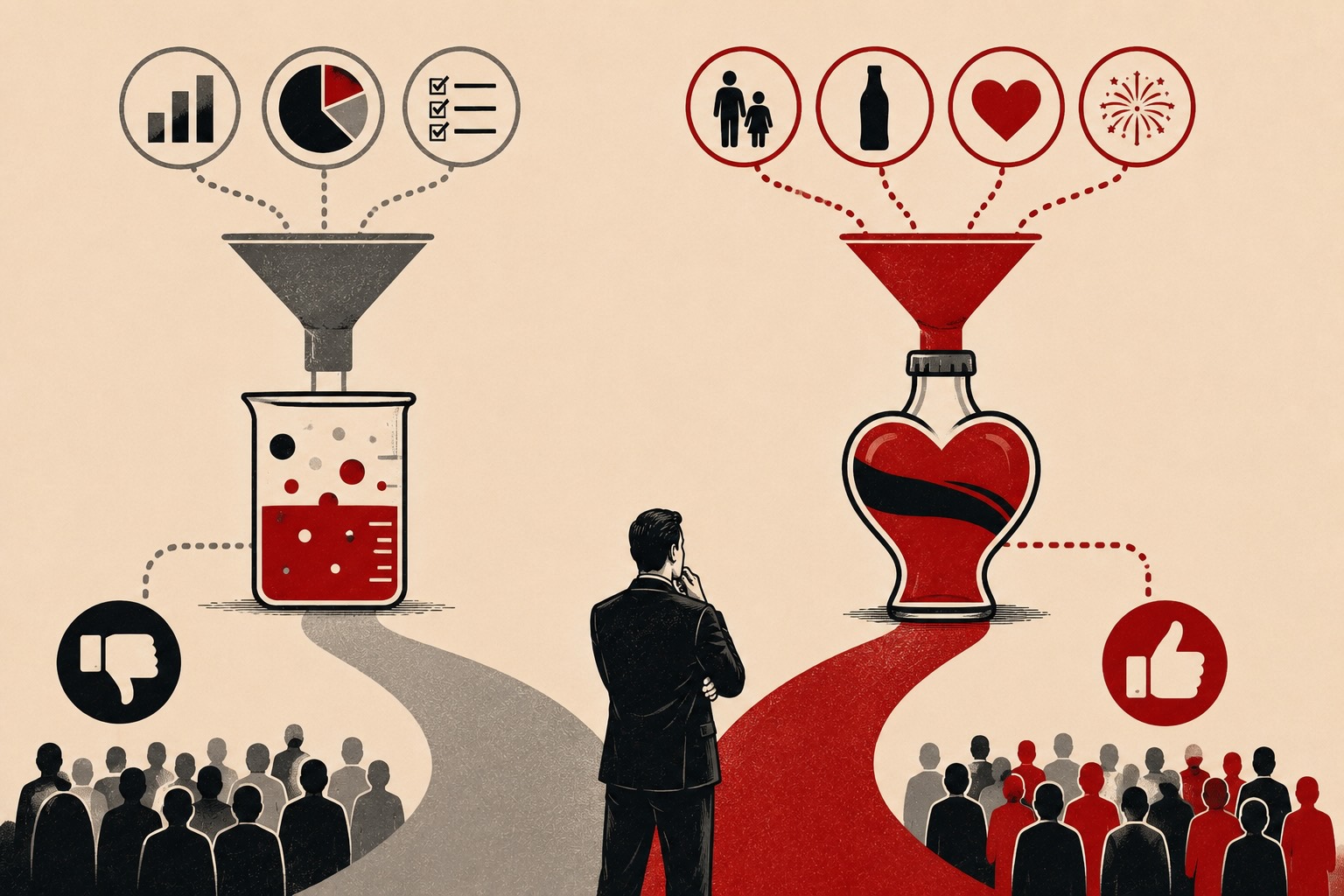
One of the most dangerous problems in business begins when leadership gets a perfectly accurate answer to the wrong question.
In 1985, Coca-Cola faced a problem that looked increasingly difficult to ignore.
Its flagship product had been losing ground. Pepsi had successfully used the Pepsi Challenge to promote evidence that consumers preferred Pepsi in blind taste tests. Coca-Cola conducted extensive testing of its own reformulated product and found encouraging results.
The evidence pointed towards an apparently logical conclusion:
If consumers prefer the competitor's taste, improve the taste.
Coca-Cola did exactly that.
And created one of the most famous consumer rebellions in corporate history.
The lesson for CEOs is much bigger than New Coke.
It is about what happens when organisations confuse what they can measure with what actually matters.
The diagnosis looked compelling
This was not a case of executives ignoring evidence.
That is precisely why New Coke is so interesting.
There was a genuine commercial problem. Coca-Cola's share lead over its principal competitor had been declining. Consumer preference and awareness were also slipping.
Then there was the taste-test evidence.
Put two unidentified drinks in front of consumers. Ask which they prefer. If Pepsi wins, taste appears to be an obvious competitive variable.
So Coca-Cola attacked the variable.
The problem was that consumers do not encounter Coca-Cola as an unidentified liquid in an anonymous cup.
They encounter Coca-Cola.
And that changes everything.
What the test removed was part of the product
A blind taste test deliberately removes information.
That is its purpose.
Brand disappears. Packaging disappears. History disappears. Expectations disappear. Context disappears.
That makes the test excellent at answering one question:
Which liquid does someone prefer under these particular conditions?
But Coca-Cola needed to answer a much larger question:
Why do people choose Coca-Cola?
Those are not remotely the same thing.
The research failed to capture sufficiently the emotional attachment consumers had developed towards the existing product. Memories, familiarity, identity and loyalty were part of what people valued.
The measurement had isolated taste so effectively that it had removed some of the very things determining behaviour.
The measurable variable becomes the problem
This pattern appears constantly inside organisations.
Customer satisfaction falls, so leadership focuses on call-handling times.
Projects run late, so project reporting increases.
Costs rise, so headcount is reduced.
Quality deteriorates, so more controls are introduced.
Sales decline, so incentives increase.
Employee engagement falls, so another engagement programme begins.
None of these responses is inherently foolish.
There may even be compelling data supporting every one of them.
But the crucial question is whether the measured variable is causing the outcome or merely associated with the outcome.
Once leadership mistakes the former for the latter, an organisation can become exceptionally good at improving something that does not solve its real problem.
This is how Karamawari begins
Karamawari (空回り) describes substantial effort that produces little corresponding forward movement.
Recurring problems frequently develop this way.
The organisation observes an impact.
It identifies something measurable near that impact.
It intervenes.
The metric improves.
Everyone experiences relief.
Then the original problem returns.
Instead of questioning the diagnosis, leadership often intensifies the intervention.
More technology.
More controls.
More training.
More restructuring.
More accountability.
More money.
The organisation is not inactive. Quite the opposite.
It is working extremely hard on the variable it has mistaken for the problem.
New Coke produced a remarkable signal
When New Coke launched, consumers reacted dramatically.
The original formula returned after just 79 days.
But the backlash revealed something the taste tests had not.
Consumers were not merely purchasing a flavour.
Coca-Cola had become entangled with memory, identity, continuity and familiarity.
Ironically, changing the product exposed the real source of some of its value.
The failed solution became diagnostic evidence.
That is an enormously useful idea for CEOs dealing with recurring problems.
Your failed solutions contain information
When a recurring problem survives several competent attempts to eliminate it, do not simply catalogue what went wrong.
Compare the interventions.
Ask what assumption they shared.
Perhaps every customer-service initiative assumed the problem was employee capability.
Perhaps every transformation assumed technology was the constraint.
Perhaps every cost programme assumed expenditure rather than complexity was the problem.
Perhaps every restructure assumed accountability was unclear.
The repeated failure may be telling you that the variable you keep changing is not the variable determining the outcome.
That is when recurrence becomes valuable evidence rather than merely another source of frustration.
Measure the problem, not merely what is measurable
CEOs need data.
But data becomes dangerous when precision creates unwarranted confidence in the framing around it.
The lesson from New Coke is not that research cannot be trusted.
It is almost the opposite.
Before trusting an answer, understand exactly what question your measurement was capable of answering.
Coca-Cola's taste tests could tell the company something important about taste preference.
They could not fully explain why people chose Coca-Cola.
Your dashboards may have exactly the same limitation.
And if your organisation has spent millions repeatedly improving something measurable while the problem keeps returning, perhaps the next question should not be, "How do we improve this metric?"
What if the variable you have been measuring most precisely is not the variable driving the problem at all?


0 Comments