
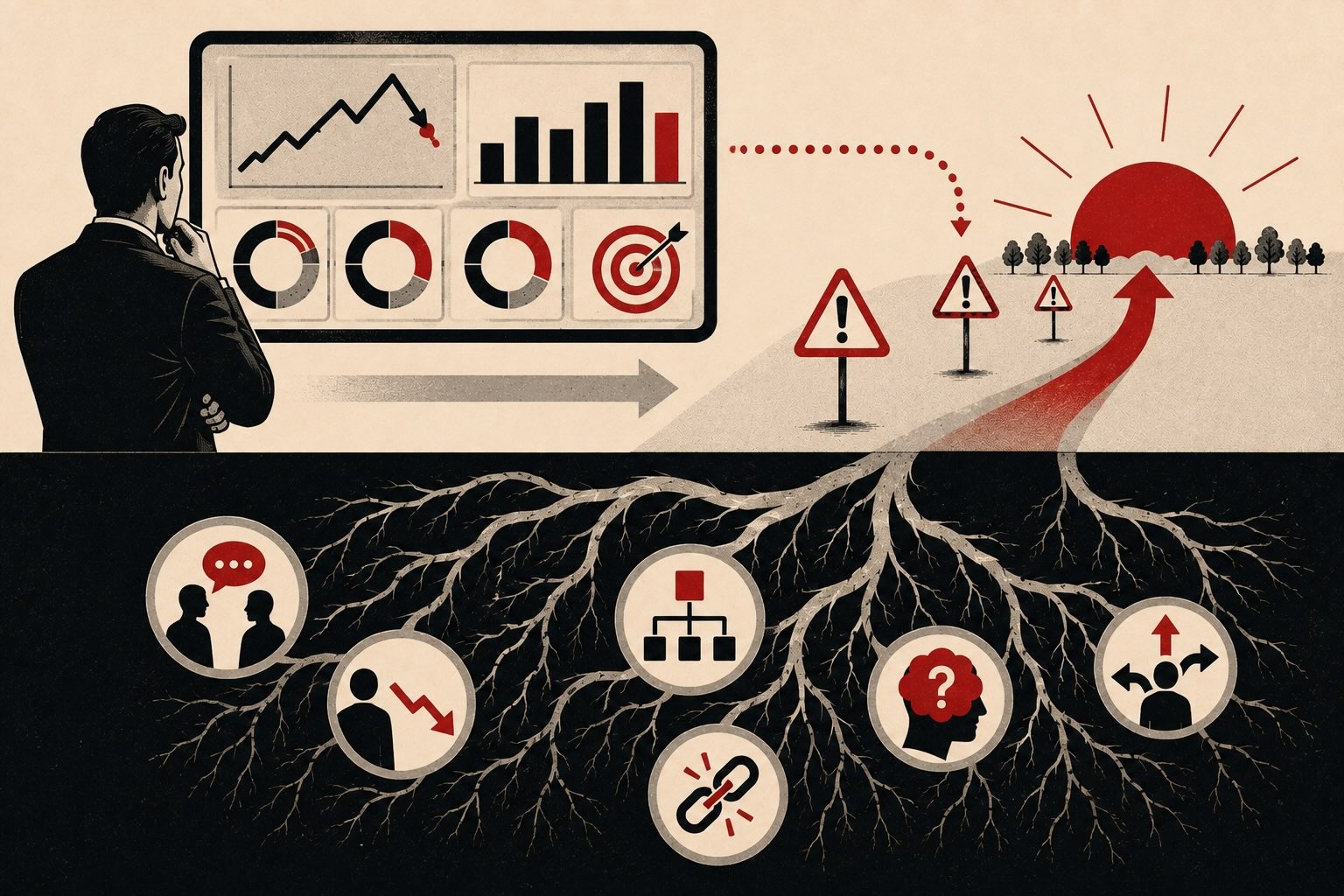
If your leadership team first discovers a serious problem when a KPI turns red, the problem did not just arrive. Your organisation arrived late.
Most organisations rely heavily on KPIs and OKRs to understand performance.
KPIs, or Key Performance Indicators, measure important aspects of organisational performance.
OKRs, or Objectives and Key Results, connect defined objectives with measurable results intended to show whether those objectives are being achieved.
Revenue growth. Margin. Customer acquisition. Employee turnover. Project delivery. Operational efficiency. Customer satisfaction.
Dashboards update. Leadership teams review them. Boards scrutinise them. Actions follow when performance moves outside acceptable parameters.
These mechanisms are valuable.
But there is a dangerous mistake organisations can make with both.
They confuse measurement of performance with prediction of performance.
Your dashboard is mostly looking backwards
Imagine driving a car while relying predominantly on the rear-view mirror.
The information in the mirror is accurate.
It is useful.
It simply tells you where you have been.
Many organisational dashboards have the same limitation.
Revenue tells you what customers have already bought.
Employee turnover tells you who has already left.
Customer complaints tell you where expectations have already been disappointed.
Project delays tell you schedules have already slipped.
Margin deterioration tells you economics have already changed.
By the time these outcomes become sufficiently significant to attract executive attention, the forces producing them may have been developing for months.
The KPI did not detect the beginning of the problem. It detected the consequences.
Results have histories
This matters enormously when dealing with recurring problems.
Results rarely materialise spontaneously.
They emerge from decisions.
Those decisions are influenced by behaviours.
Those behaviours make sense because of assumptions people hold.
And those assumptions are shaped by the conditions surrounding them.
Conditions → Assumptions → Behaviours → Decisions → Impacts
A declining customer satisfaction score might appear on the executive dashboard this quarter.
But perhaps six months earlier, employees had begun quietly bypassing an increasingly cumbersome process.
Before that, managers had started prioritising throughput over customer outcomes.
Before that, pressure to meet efficiency targets had changed what people believed leadership really valued.
The customer satisfaction KPI eventually turns red.
Leadership sees the result.
The system has been producing it for months.
This is why problems appear to come from nowhere
CEOs often hear variations of the same frustrating question:
"How did we not see this coming?"
Usually, somebody did.
The organisation simply was not measuring what they were seeing.
A salesperson noticed customers asking different questions.
A frontline employee noticed exceptions becoming normal.
A project manager noticed people becoming reluctant to escalate bad news.
A middle manager noticed teams quietly creating workarounds.
A finance executive noticed increasingly optimistic assumptions being required to make business cases work.
Individually, these signals may appear insignificant.
Collectively, they can reveal something far more important than a KPI:
the system is beginning to behave differently.
That is where tomorrow's results are being created.
Leading indicators need to go deeper
Organisations often respond by creating "leading KPIs".
That can help, but it does not necessarily solve the problem.
A metric can occur earlier in the sequence and still measure an outcome.
The deeper opportunity is to identify changes in the conditions, assumptions and behaviours that precede decisions.
Consider a recurring problem with late project escalation.
Measuring the number of projects reported red is useful.
But what happens before a project becomes red?
Perhaps people increasingly describe problems as "manageable".
Difficult conversations move outside formal meetings.
Reported confidence remains high while contingency is consumed.
Executives challenge pessimistic forecasts more aggressively than optimistic ones.
Teams begin solving problems quietly rather than escalating them.
Those are signals.
And they may become visible long before schedule performance deteriorates.
Recurring problems make this even more important
When a problem has already occurred several times, leadership possesses something incredibly valuable:
history.
Yet organisations frequently use that history only to examine the impact.
What did it cost?
Who was responsible?
What failed?
What remediation was implemented?
There is another question worth asking:
What changed before the problem became visible?
Look across previous occurrences.
What behaviours appeared repeatedly?
What assumptions were being made?
What information was ignored or discounted?
Where did people begin creating exceptions?
When did challenge disappear?
What pressures intensified?
What became normal that previously would have attracted attention?
These patterns can become your real early-warning system.
Otherwise, Karamawari becomes inevitable
This is where organisations drift into 空回り (karamawari), significant effort without corresponding forward movement.
The organisation waits for an outcome metric to deteriorate.
Leadership responds.
Resources are mobilised.
The metric improves.
Attention moves elsewhere.
But if the conditions producing the behaviour remain intact, the underlying system gradually begins recreating the problem.
Eventually another KPI turns red.
Leadership responds again.
More meetings. More controls. More investment. Another transformation.
The organisation becomes extremely proficient at detecting recurring problems after they have become expensive.
Keep the dashboard, but look underneath it
The answer is not abandoning KPIs or OKRs.
CEOs and boards need them.
But they should understand what those tools can and cannot tell them.
KPIs and OKRs help answer:
What results are we producing?
A stronger early-warning capability asks:
What is happening inside our organisation today that will produce tomorrow's results?
That requires leaders to examine more than numbers.
It means understanding changes in behaviour, incentives, assumptions, decision patterns, workarounds, exceptions, escalation and silence.
Your financial results may be quarterly.
Your customer metrics may be monthly.
Your strategic objectives may be annual.
But the conditions shaping those outcomes are operating every day.
And for a CEO exhausted by recurring problems, that creates a very different leadership challenge.
Do not wait for the dashboard to tell you the problem has returned.
By then, you may already be paying for it.
If your KPIs tell you where your organisation has arrived, what are you watching today that tells you where it is already heading?


0 Comments