
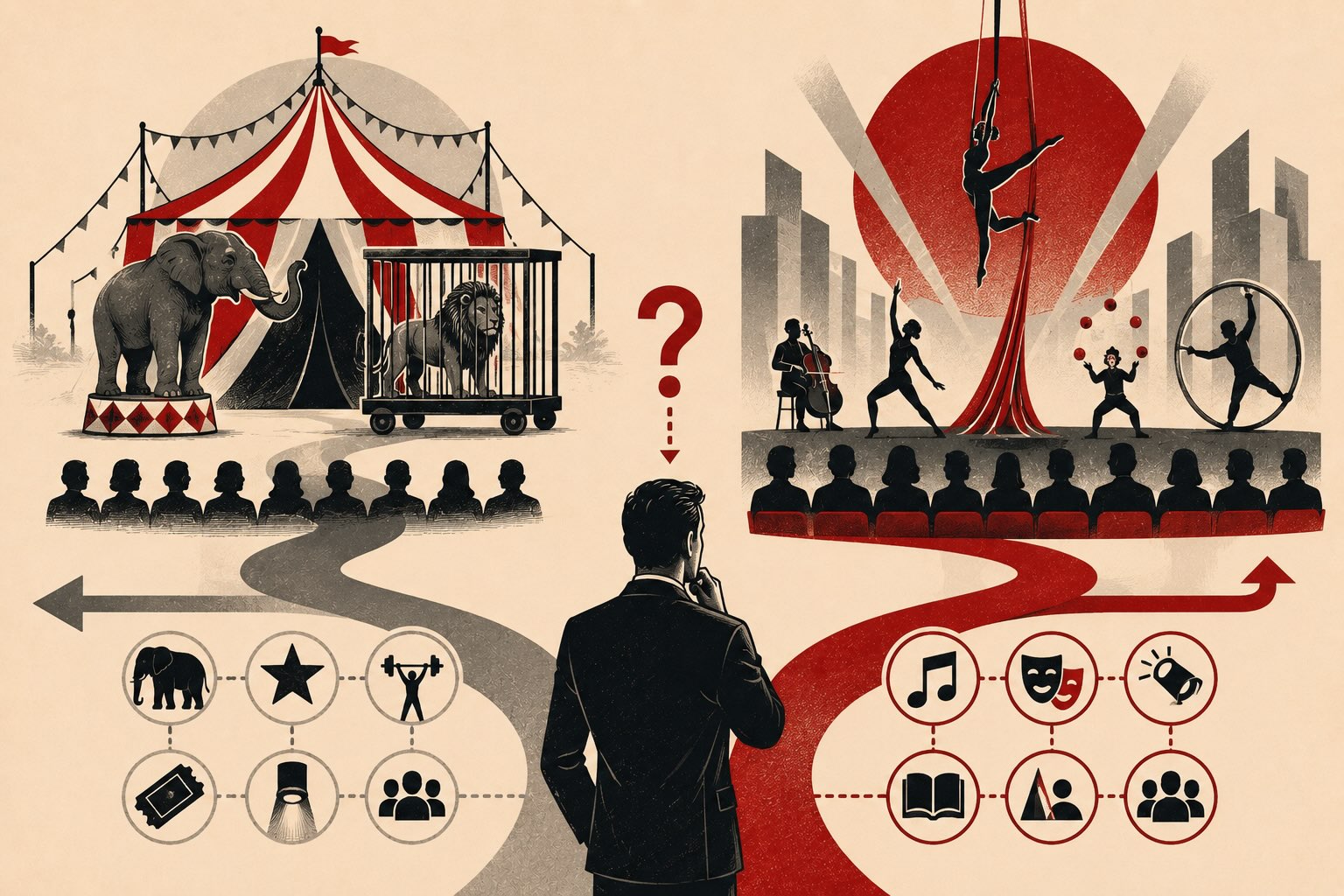
Some of the biggest strategic breakthroughs happen when leaders stop asking how to solve the existing problem better and start asking whether it is the right problem to solve at all.
For decades, the circus industry had a reasonably clear competitive formula.
Get better performers. Add more spectacle. Attract bigger stars. Introduce more exotic animals. Create more excitement. Keep ticket prices accessible enough to fill the tent.
If you were running a circus, the obvious strategic question was:
How do we build a better circus than the other circuses?
It sounds sensible.
And that is precisely why questions like this can be dangerous.
The question quietly determines the answer
Once a leadership team accepts a particular definition of the problem, enormous amounts of organisational activity can follow.
If the problem is "we need a better circus", then investment naturally flows towards improving the existing ingredients of a circus.
You recruit better acts.
You increase the spectacle.
You improve marketing.
You find efficiencies.
You negotiate harder with suppliers.
You study competitors.
You optimise pricing.
You work incredibly hard.
And you may still find yourself competing for customers in an industry whose economics are becoming increasingly unattractive.
This is one of the subtler forms of karamawari, 空回り: tremendous effort that produces surprisingly little forward movement.
The problem is not necessarily poor execution.
The problem may be that everyone is executing brilliantly against an assumption nobody has thought to challenge.
Cirque du Soleil changed the question
Cirque du Soleil approached the market differently.
Rather than concentrating exclusively on how to create a better traditional circus, it effectively asked something closer to:
How do we make live circus-style entertainment valuable to adults willing to pay theatre-level prices?
That is a fundamentally different problem.
Change the problem and suddenly different solutions become possible.
Elements traditionally associated with circus could be reduced or removed. Other elements associated with theatre could become much more important.
Acrobatics could combine with music.
Performance could combine with storytelling.
Costumes, lighting, choreography and design could become integral parts of the experience.
The audience could change.
The economics could change.
Even the basis on which customers evaluated the experience could change.
Cirque du Soleil was no longer required to win every comparison with the traditional circus because it had changed what customers were being invited to compare.
Better is not always the answer
This matters enormously when dealing with recurring organisational problems.
When a problem returns, the natural response is usually to improve the previous solution.
Customer complaints continue?
Improve customer service.
Costs remain high?
Launch another efficiency programme.
Projects keep overrunning?
Strengthen project governance.
Functions struggle to collaborate?
Introduce another collaboration initiative.
Decisions remain slow?
Streamline the approval process.
None of these responses is inherently unreasonable.
But notice what they have in common.
They accept the existing definition of the problem.
And once that definition becomes embedded, every recurrence tends to generate another attempt to solve essentially the same problem more effectively.
Eventually the organisation becomes extremely sophisticated at solving something that may never have been the real problem.
Recurrence should challenge the frame
This is where persistent problems become useful information.
If an organisation has attempted several credible solutions and the problem continues returning, perhaps the next question should not be:
How do we make the solution better?
Perhaps it should be:
What if we have defined the problem incorrectly?
That question changes the conversation.
Repeated customer complaints may not fundamentally be a customer service problem. They might originate in promises made during sales.
Persistent cost overruns may not primarily be an efficiency problem. They could result from complexity embedded in the operating model.
Slow decisions may not be a process problem. They may reflect unclear authority, fear of consequences or conflicting incentives.
Poor collaboration may not be a teamwork problem. It might be the perfectly rational consequence of performance measures rewarding functions for protecting their own outcomes.
The visible problem tells you where the impact appeared.
It does not necessarily tell you where the problem began.
The expensive assumption nobody can see
The longer an organisation operates within a particular frame, the less visible that frame becomes.
Assumptions quietly turn into facts.
"We need more features."
"Customers expect this."
"This function must own that."
"We have to compete on price."
"That approval is necessary."
"This is simply how our industry works."
Eventually competitors can reinforce the same assumptions because everybody is solving similar problems in similar ways.
That creates an intriguing strategic trap.
A CEO can look across the industry, see competitors doing exactly the same things and conclude that the organisation must be focusing on the right problem.
But sometimes an entire industry can be competing inside the same frame.
Cirque du Soleil's insight was not simply that it could execute circus differently.
It questioned what the circus experience needed to be.
Before spending another dollar
This becomes particularly important when recurring problems are compounding in cost.
After the third or fourth failed intervention, another solution should not automatically be commissioned.
There is a question worth answering first:
If we solved the problem exactly as we have defined it, would the business outcome we actually care about necessarily improve?
If the answer is uncertain, investing more money in the existing problem definition may simply create more expensive karamawari.
Sometimes the organisation needs better execution.
Sometimes it genuinely needs a better solution.
But occasionally the breakthrough comes from recognising that the choice between Solution A, Solution B and Solution C is itself misleading.
There may be a Solution D that only becomes visible when the organisation stops accepting the original question.
Cirque du Soleil offers CEOs a powerful reminder: competitive advantage does not always come from winning the race everyone else is running.
If your organisation has spent years getting better and better at solving the same recurring problem, what would become possible if you stopped asking how to solve it better and asked why you are solving that problem in the first place?


0 Comments