
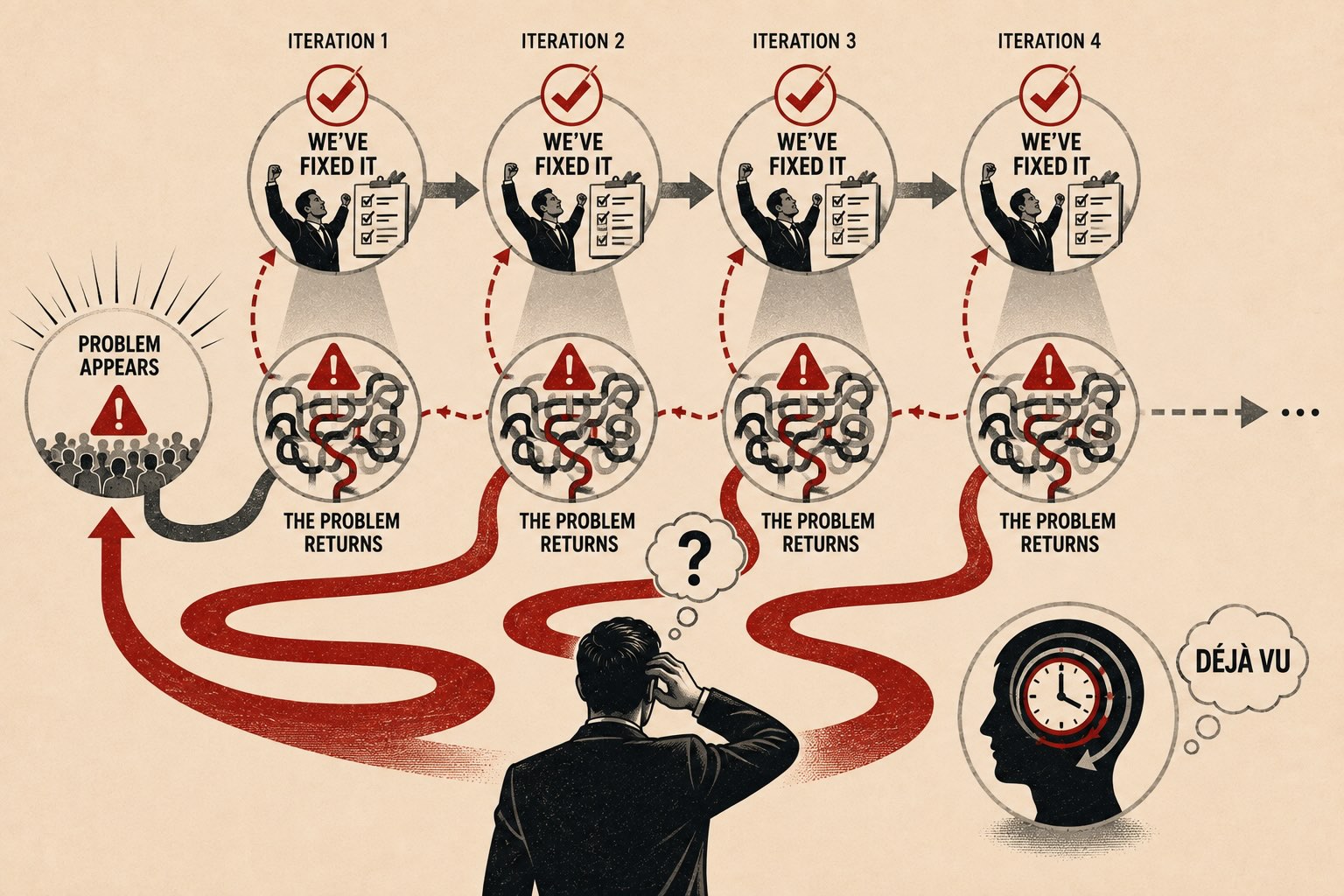
A recurring problem is often at its most dangerous just after everyone becomes convinced it has been solved.
The complaints have stopped.
The numbers have recovered.
The backlog has disappeared.
The project is back on track.
The incidents have fallen.
Management attention moves elsewhere, the steering committee winds down and the intervention is declared successful.
“We’ve fixed it.”
For a CEO exhausted by a problem that has already consumed too much money and attention, those words are enormously appealing.
They can also be dangerously premature.
Because there is an important difference between the disappearance of a problem and the disappearance of what creates it.
Silence is not evidence of elimination
Most organisations naturally measure interventions through changes in visible outcomes.
If customer complaints fall after a service improvement programme, the programme appears successful.
If costs fall after a restructure, the restructure appears successful.
If project overruns decline after introducing stronger governance, the governance appears successful.
And perhaps they were.
The difficulty is that the same evidence can support another explanation:
The problem has become dormant.
The conditions capable of recreating it may still be sitting quietly underneath the improved result.
Demand may have temporarily fallen.
A highly capable manager may be compensating for a broken process.
Employees may be working extraordinary hours.
A major customer may simply not have encountered the failure yet.
An experienced executive may be personally intervening before problems become visible.
The symptom disappears, but the organisation remains vulnerable to its return.
We measure the intervention, not the conditions
This is where recurring problems become particularly expensive.
Organisations often ask:
Did complaints decrease?
Did costs fall?
Did incidents decline?
Did delivery improve?
Those are reasonable questions. But they primarily measure whether something changed after the intervention.
They do not necessarily establish why it changed.
A more demanding test examines the chain underneath the outcome:
Conditions → Assumptions → Behaviours → Decisions → Impacts
Suppose a recurring project problem was caused partly by unrealistic deadlines.
Leadership introduces additional project controls. Reporting improves. Escalations decrease. Deadlines are met.
Success?
Possibly.
But what if the underlying conditions remain unchanged?
Perhaps executives still punish people who challenge deadlines. Project managers still believe raising concerns will make them appear incapable. Teams still quietly absorb impossible commitments. Senior managers still rescue projects personally when delivery becomes threatened.
The project might look healthier because everyone is compensating more effectively.
The organisation has not eliminated the problem.
It has improved its ability to suppress the symptoms.
Dormancy can look remarkably like success
This creates an uncomfortable paradox.
Some interventions can make a recurring problem less visible without making the organisation less vulnerable to it.
That distinction matters enormously.
Imagine a leaking pipe hidden inside a wall.
You notice water on the floor and repeatedly mop it up. Eventually somebody installs a larger drain.
The floor is now dry.
The KPI has improved.
But the pipe is still leaking.
In organisations, the equivalent drain might be another control, another meeting, additional headcount, a spreadsheet, a consultant, a new system or a heroic manager who catches failures before customers see them.
Each can reduce the visible impact.
Each can also make leadership more confident that the underlying problem has disappeared.
That confidence may be precisely what allows the conditions to survive.
The cost returns with interest
When the problem eventually reappears, organisations frequently treat it as a new failure.
Another investigation begins.
Another solution is commissioned.
Another budget is approved.
Another team is mobilised.
But recurrence is telling leadership something important:
Something survived the previous solution.
That something may be an incentive, assumption, decision right, cultural norm, conflicting objective, capability gap, structural weakness or operating condition.
If nobody identifies it, every apparent resolution can simply reset the clock.
And the costs compound.
There is the direct cost of repeated interventions, but also management attention, rework, customer recovery, delayed investment, lost capacity and growing organisational cynicism.
Eventually employees stop believing the latest initiative will work because they have seen several previous declarations of victory.
“We’ve fixed it” becomes less reassuring every time it is repeated.
Ask for evidence of irreversibility
For CEOs, the more useful question after an intervention may therefore be less celebratory:
What has changed that makes the previous problem significantly less capable of being recreated?
That shifts attention from symptoms to generating conditions.
If poor decisions were previously driven by distorted incentives, have those incentives changed?
If problems were hidden because bad news was punished, has leadership behaviour changed sufficiently that early escalation is now rational?
If functions repeatedly failed at handovers, has ownership of the interface changed?
If heroic managers compensated for weak systems, could performance now survive without those heroes?
If demand returned, pressure increased, key people left or market conditions deteriorated, would the problem remain solved?
That is a much tougher standard than showing an improving graph.
It is also far more valuable.
Resolution requires a different burden of proof
A falling incident rate can tell you the problem is occurring less frequently.
It cannot, by itself, tell you why.
A quiet month tells you there were no visible symptoms.
It cannot tell you whether the machinery capable of producing them still exists.
This is why the period immediately following apparent success deserves scrutiny rather than relief alone.
Celebrate the improvement, certainly.
But then investigate it.
Look for the conditions that previously made the unwanted behaviours and decisions sensible. Test whether those conditions have genuinely changed. Remove the extraordinary effort that may be masking weakness. Apply pressure deliberately and watch what happens.
Because the objective is not merely to create a period in which the problem does not occur.
It is to create an organisation in which the problem becomes materially harder to recreate.
So before declaring your most expensive recurring problem finally solved, what evidence would convince you that it has actually been eliminated rather than simply gone quiet?


0 Comments