
CEOs can waste extraordinary amounts of money solving problems that would have been cheaper to keep.
That sounds almost heretical.
Leadership culture celebrates problem solving. Persistent problems are things to eliminate. Root causes are things to find. Recurrence is evidence that somebody has failed to finish the job.
Usually, that instinct is useful.
But it can also become an ideology.
Because once you genuinely understand a recurring problem, its causes and the conditions sustaining it, you may discover something uncomfortable:
The economically rational decision is to leave it alone.
That is not surrender.
It may be considerably better leadership than spending another $10 million trying to make a $2 million problem disappear.
The problem has a price
Recurring problems are deceptive because their costs rarely arrive on one invoice.
There is the obvious cost of each recurrence: remediation, customer compensation, lost productivity, rework or operational disruption.
Then there are less visible costs.
Management attention.
Employee capacity.
Customer friction.
Delayed strategic initiatives.
Workarounds.
Additional controls.
Risk exposure.
Lost opportunities.
The first task is therefore not to ask, "How much will it cost to fix this?"
It is to establish:
What does continuing to have this problem actually cost us?
Suppose a recurring operational problem costs an organisation $1.5 million each year.
That number matters.
But by itself, it tells you almost nothing about whether the problem should be eliminated.
Elimination has a price too
Imagine the organisation has attempted to solve the problem several times.
Processes have been redesigned. Technology has been introduced. People have been trained. Governance has been strengthened.
The problem keeps returning.
A deeper diagnosis finally discovers why.
Perhaps eliminating it requires replacing a core technology platform.
Perhaps incentives across several business units need to change.
Perhaps responsibilities must move.
Perhaps a profitable product needs redesigning.
Perhaps greater standardisation would require sacrificing local autonomy.
Perhaps an acquisition created incompatible operating models that would be enormously disruptive to integrate.
Now the real choice becomes visible.
The organisation is not deciding whether a $1.5 million problem is undesirable.
Of course it is undesirable.
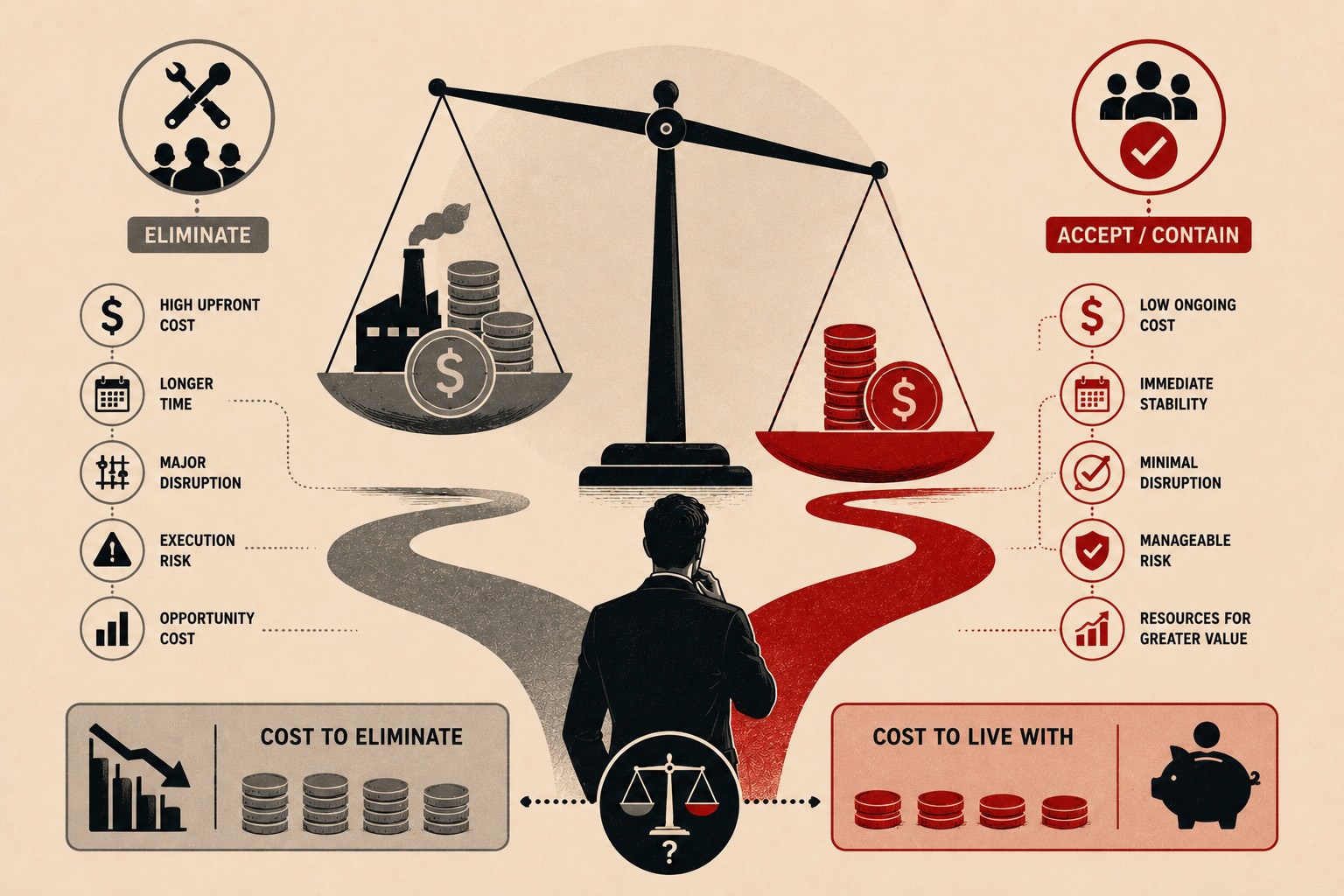
It is deciding whether eliminating a $1.5 million annual problem justifies $20 million of investment, three years of disruption, significant execution risk and opportunity costs elsewhere.
That is a completely different decision.
There are more choices than fix or fail
This is where problem-solving language can become limiting.
Leaders often implicitly divide outcomes into two categories:
Solved.
Not solved.
Commercially, there are more possibilities.
A problem can be eliminated.
It can be reduced.
It can be contained.
It can be transferred.
Its consequences can be mitigated.
Its frequency can be lowered.
Or it can be consciously accepted.
The appropriate objective is not necessarily zero recurrence.
It is the best economic outcome for the organisation.
That distinction matters enormously.
Acceptance and helplessness are not the same thing
There is a profound difference between an organisation saying:
"We've learned to live with it because nothing we've tried has worked."
And saying:
"We understand why this problem occurs, what it costs us, what would be required to eliminate it, and we have consciously decided that containment creates greater value."
From the outside, both organisations may appear to have the same recurring problem.
Internally, they are in completely different positions.
The first is trapped.
The second has made a decision.
The trapped organisation keeps reacting every time the problem returns. Another meeting is called. Another initiative begins. Another executive promises to finally solve it.
Money continues disappearing into Karamawari: repeated effort that produces little lasting progress.
The second organisation has stopped pretending.
It knows what it is buying by accepting the problem.
But make sure you calculate the whole cost
There is an obvious danger here.
"Too expensive to fix" can become a wonderfully convenient excuse for avoiding difficult change.
That is why the economics need to include more than the visible remediation bill.
If a problem costs $2 million annually in direct losses but also consumes executive attention, delays growth, damages customers, increases regulatory exposure and requires expensive workarounds, its true recurring cost may be substantially higher.
Frequency matters too.
So does trajectory.
A $2 million annual problem that is growing 20 per cent each year is economically different from one whose cost is stable.
And risk matters.
A recurring problem with modest average losses but a small probability of catastrophic consequences cannot sensibly be assessed using averages alone.
The comparison must therefore be credible:
Cost of recurrence versus cost, disruption, risk and opportunity cost of elimination.
Only then does leadership have a genuine choice.
Diagnosis should improve the investment decision
This is one reason understanding the real causes of a persistent problem matters even when you ultimately decide not to eliminate it.
Diagnosis is not valuable merely because it leads to a solution.
It reduces uncertainty.
Once leadership understands the conditions recreating the problem, it can determine which interventions would actually change them, what those interventions would cost and how much recurrence they would realistically remove.
Sometimes that creates a compelling investment case for elimination.
Sometimes it reveals a cheaper intervention capable of reducing the problem sufficiently.
And occasionally it tells leadership to stop spending money trying to fix it.
That can be an extremely valuable finding.
Stop solving problems on principle
CEOs do not have unlimited capital, capacity or management attention.
Every dollar committed to eliminating one problem is unavailable somewhere else.
Every transformation consumes organisational bandwidth.
Every major intervention creates its own risks.
The objective therefore cannot be to eliminate every imperfection in the organisation.
The objective is to allocate scarce resources where they create the greatest value.
Sometimes that means finally eliminating the recurring problem everyone is tired of seeing.
Sometimes it means containing it intelligently and putting the money somewhere more valuable.
The important thing is knowing which decision you are making.
Because unconsciously tolerating a problem you cannot solve is very different from consciously accepting one you have decided is not worth solving.
If you finally understood exactly what your most frustrating recurring problem costs, and exactly what eliminating it would require, are you certain that solving it would still be the smartest investment?


0 Comments