
Some of the most expensive recurring problems survive because the organisation has become exceptionally good at dealing with them.
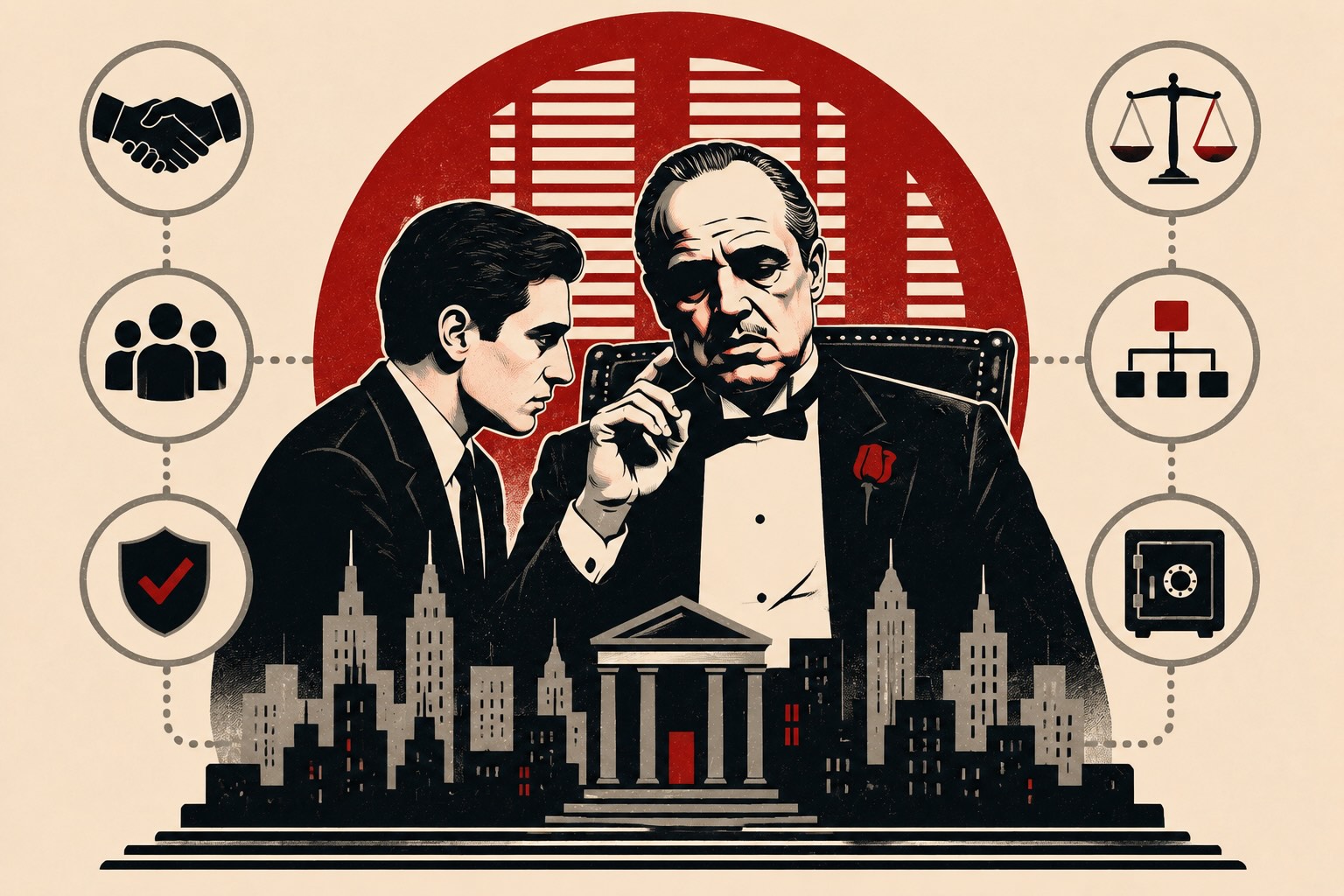
That is one of the more uncomfortable leadership lessons hiding inside The Godfather.
On the surface, Francis Ford Coppola's 1972 film is about power, family, loyalty and organised crime. But viewed through the lens of karamawari, it is also a story about an organisation repeatedly confronting crises without changing the conditions that generate them.
Threat appears. Someone responds. The immediate problem is resolved.
Then another threat appears.
The Corleone family is extraordinarily capable at solving problems. The tragedy is that many of those solutions strengthen the very system that guarantees there will be another one.
For CEOs tired of paying for recurring problems, that distinction matters.
Competence Can Keep a Bad System Alive
The Corleone organisation does not suffer from a shortage of capable people.
It has intelligence, relationships, resources, influence, decisive leadership and an extraordinary ability to respond when something goes wrong.
That capability is precisely what makes the underlying problem harder to see.
When Sollozzo threatens the family's position, they respond. When Vito Corleone is attacked, they respond. When Michael is threatened, they respond. When rival families move against them, they respond.
Each intervention can be understood rationally within the circumstances.
Yet step back from the individual incidents and a different pattern becomes visible.
The organisation is repeatedly solving manifestations of a system it continues to preserve.
Businesses do this too.
A major customer complains, so an executive intervenes.
A project slips, so a recovery team is assembled.
Costs blow out, so another efficiency programme begins.
A key employee resigns, so a counteroffer is made.
A control fails, so another approval is introduced.
Each response may work.
That does not mean the problem has been solved.
Michael Solves Problems Brilliantly
Michael Corleone's transformation is particularly interesting from a leadership perspective.
He becomes increasingly effective.
He anticipates threats. He makes difficult decisions. He consolidates authority. He removes opponents. He protects the organisation.
Measured transaction by transaction, Michael can look like an increasingly accomplished leader.
Measured systemically, something else is happening.
Every successful intervention makes the next intervention more necessary.
That is karamawari.
Activity produces results, but the results do not create escape from the underlying cycle.
This happens inside companies when the organisation becomes dependent upon executive intervention.
The CEO resolves conflicts nobody else can resolve.
The CFO repeatedly finds another round of savings.
Operations performs another heroic recovery.
Technology patches another fragile interface.
Sales rescues another strategically important account.
Everyone becomes better at firefighting.
And because the fires keep being extinguished, leadership can mistake recovery capability for organisational health.
Ask Why the Decision Made Sense
One of the easiest mistakes when examining recurring problems is to blame the person who made the latest bad decision.
The Godfather offers a more useful perspective.
Many decisions that ultimately produce terrible consequences make sense within the conditions surrounding the decision-maker.
Consider the chain:
Conditions → Assumptions → Behaviours → Decisions → Impacts
If your environment teaches you that vulnerability will be exploited, secrecy becomes rational.
If loyalty determines survival, dissent becomes dangerous.
If retaliation prevents future attacks, escalation can appear prudent.
If power protects the organisation, accumulating power feels responsible.
The resulting decisions may be destructive, but simply telling people to make better decisions misses what generated them.
CEOs should apply the same logic inside their organisations.
If managers continually hide problems, what conditions make transparency dangerous?
If departments protect themselves, what makes collaboration costly?
If people escalate decisions upward, what makes independent judgment risky?
If short-term numbers repeatedly defeat long-term priorities, what makes that trade-off rational?
Behaviour that looks dysfunctional from the boardroom may be perfectly rational from somewhere else in the system.
Today's Solution Becomes Tomorrow's Condition
This is perhaps the most important lesson.
Solutions do not disappear after implementation. They change the environment in which future decisions are made.
Every additional control changes behaviour.
Every restructure changes relationships.
Every exception creates precedent.
Every executive intervention changes expectations.
Every workaround makes the workaround slightly more normal.
Yesterday's solution can quietly become today's condition.
And today's condition shapes tomorrow's assumptions and decisions.
This is how recurring problems compound.
The organisation is not simply experiencing the original problem repeatedly. It is accumulating layers of responses to previous occurrences.
Eventually, leadership inherits an operating environment partly constructed from yesterday's fixes.
That is why the fifth attempt at solving something can be considerably harder and more expensive than the first.
The Cost Is Bigger Than the Latest Incident
Michael ultimately gains enormous control.
But look at what has been consumed along the way.
Relationships. Trust. Family. Freedom. Identity.
There is a commercial parallel.
A recurring organisational problem rarely costs only what appears beside it in the accounts.
There is the remediation cost.
Then the management attention.
Then the additional controls.
Then the consultants.
Then the system changes.
Then the customer recovery.
Then the employee fatigue.
Then the opportunity cost of executives spending another quarter discussing something supposedly fixed two years ago.
The dangerous question is:
"How much did this incident cost?"
The better question is:
"How much has this problem cost us across every attempt to manage, contain and solve it?"
That number can be startling.
Stop Winning the Same Battle
The lesson from The Godfather is not that leaders should become less decisive.
It is that decisiveness and diagnosis are different capabilities.
There comes a point when repeatedly defeating the latest manifestation of a problem is evidence that you are not defeating the problem at all.
The executive team may deserve credit for saving the customer again.
Operations may deserve congratulations for recovering the project again.
Finance may genuinely have found another $10 million.
But the word again should bother you.
Because recurrence is information.
It tells you that something survived the previous solution.
And sometimes the greatest risk is having leaders so capable at managing the consequences that the organisation never feels enough pressure to confront what keeps creating them.
If your leadership team keeps winning the same battle, when will you ask why your organisation keeps creating the war?


0 Comments