
Some of the most expensive recurring problems survive because the organisation has become exceptionally good at living with them.
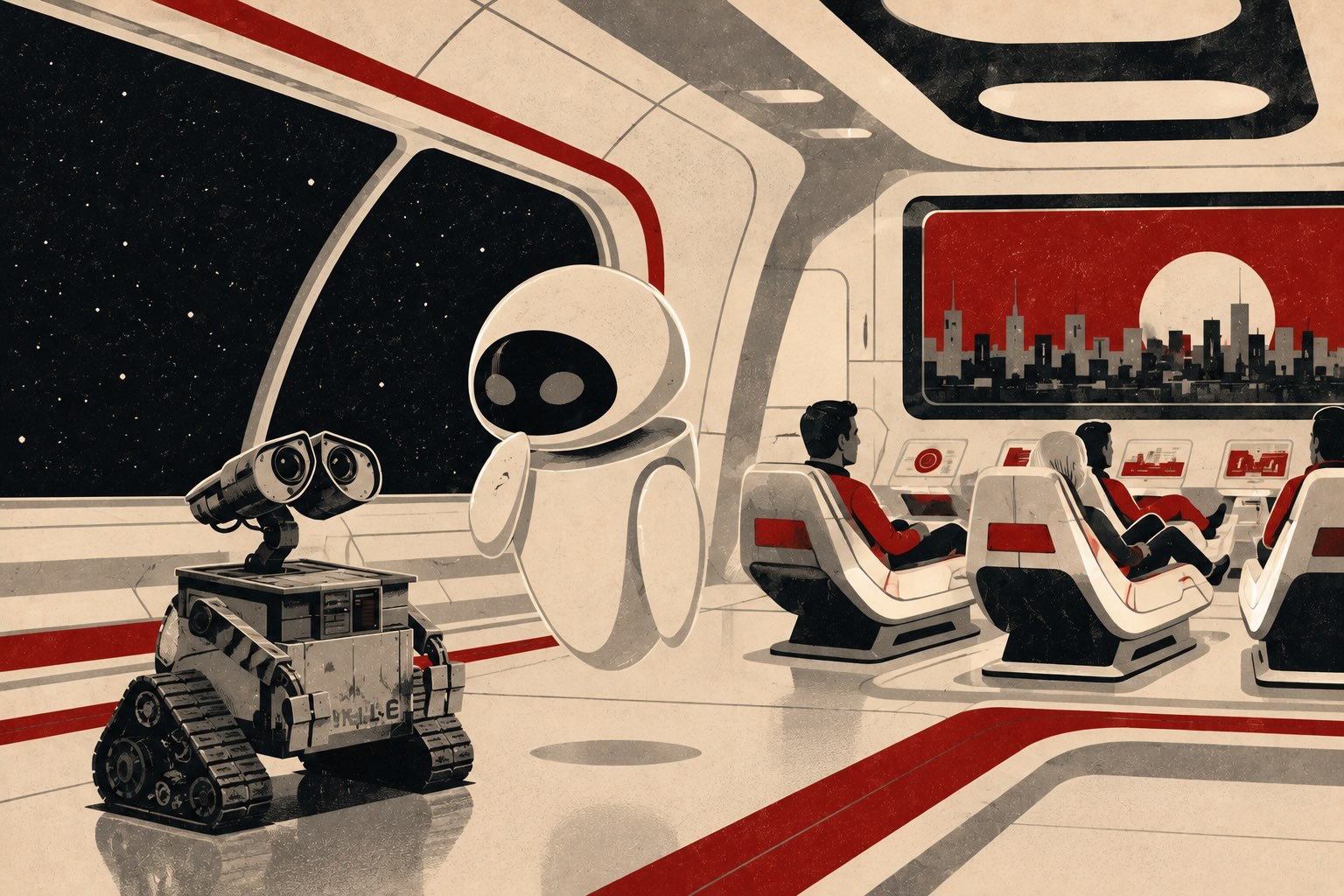
That is one of the more uncomfortable lessons hidden inside Pixar’s WALL-E.
On the surface, it is a story about a small waste-compacting robot left behind on an abandoned Earth. But for CEOs dealing with problems that keep returning despite years of fixes, programs and investment, there is another story worth noticing.
Humanity has not really solved its problem.
It has built an extraordinary system for avoiding it.
And that distinction sits at the heart of karamawari.
The original problem disappeared behind the response
Earth has become overwhelmed by waste and environmental degradation. Humanity’s response is enormous in scale: leave the planet while robots clean it up.
It sounds like a solution.
But centuries later, WALL-E is still compacting rubbish.
The temporary response has effectively become permanent.
This happens inside organisations more often than leaders might realise.
A problem emerges. A workaround is introduced. Extra people are assigned. A new control is created. Another approval is required. A reconciliation process is established. A specialist team is formed.
The immediate pain reduces.
Eventually, the workaround becomes part of normal operations.
Nobody asks why it is still necessary.
The organisation starts measuring how efficiently it manages the problem rather than whether the problem should still exist.
Symptoms can create entire industries
One of the striking things about WALL-E is the sheer infrastructure humanity has created around its failure.
There is an enormous spacecraft, sophisticated automation, robots performing countless functions and an entire society designed around remaining away from Earth.
Think about the economics of that.
The original problem has generated a vast secondary system whose purpose is essentially to accommodate the consequences of the original problem.
Businesses do this too.
A recurring billing problem creates a reconciliation team.
Poor data creates manual checking.
Weak decision rights create governance committees.
Customer failures create remediation teams.
Unreliable processes create experienced employees whose unofficial job is rescuing them.
Eventually, the organisation can be spending millions managing something it still describes as a problem it intends to fix.
That is a particularly expensive form of karamawari: the cost of the problem becomes embedded in the operating model.
A workaround can become a condition
The passengers aboard the Axiom are no longer simply waiting for Earth to become habitable.
Their entire way of life has adapted to being aboard the ship.
That matters.
Temporary responses have a habit of creating new conditions.
Those conditions influence assumptions.
Assumptions influence behaviours.
Behaviours influence decisions.
Decisions create impacts.
A temporary workaround introduced during a crisis can eventually teach employees, “This is simply how things work here.”
Once that happens, removing the workaround becomes harder because the organisation has reorganised itself around it.
Systems depend upon it. Roles depend upon it. Budgets contain it. KPIs measure it. People have learned how to operate within it.
The solution has become part of the problem.
Automation can make karamawari harder to see
The Axiom is astonishingly efficient.
That is precisely the problem.
Technology has made an unsustainable situation remarkably comfortable.
There is an important warning here for CEOs investing heavily in automation and AI.
Automation does not necessarily eliminate a recurring problem.
Sometimes it simply makes the recurring problem cheaper, faster and less visible.
Automate a badly designed process and you may get a faster badly designed process.
Apply AI to unnecessary work and you may dramatically improve the productivity of work that should not exist.
Digitise a workaround and you may transform an obvious inefficiency into invisible infrastructure.
Efficiency is valuable, but only after asking whether the activity itself deserves to survive.
The directive has outlived the conditions that created it
Perhaps the most interesting leadership lesson comes from AUTO, the ship’s autopilot.
AUTO is following an old directive that humanity should not return to Earth.
Within the conditions in which that directive was created, it made sense.
But conditions have changed.
Evidence has changed.
The directive has not.
Organisations accumulate similar instructions.
Never take that risk.
Always obtain this approval.
Keep this inventory buffer.
Never deal directly with that customer segment.
Run this report every week.
Maintain this control.
What began as a sensible response to yesterday’s conditions becomes an unquestioned constraint on tomorrow’s decisions.
Recurring problems can survive because organisations keep obeying answers to questions nobody has asked for years.
WALL-E brings evidence, not another strategy
The tiny plant WALL-E discovers is important because it changes the diagnosis.
Earth is not necessarily the place everyone believes it to be.
New evidence challenges an old assumption.
That is often the breakthrough with persistent problems.
The breakthrough is not necessarily another solution.
It is evidence that causes leadership to reconsider what it believes about the problem.
That requires something surprisingly difficult from senior leaders: being willing to reopen questions the organisation believes it has already answered.
But not every recurring problem should be eliminated
There is another lesson worth adding.
Returning to Earth is enormously disruptive.
That raises the commercial question every CEO should ask before attacking recurrence:
Is eliminating this problem actually cheaper than continuing to manage it?
Some recurring problems should be tolerated.
If a problem costs $500,000 annually to contain but requires a $20 million transformation to eliminate, containment may be entirely rational.
The mistake is not choosing containment.
The mistake is repeatedly funding containment while pretending elimination remains the objective.
That is why the economics of recurrence matter. Leaders need to understand the cumulative cost of remediation, workarounds, management attention, lost capacity, customer friction and opportunity cost, then compare it with the genuine cost and risk of permanent resolution.
Sometimes fixing the problem is the right answer.
Sometimes living with it is.
But that should be a conscious economic decision.
The uncomfortable WALL-E question
The deepest lesson of WALL-E is not that organisations fail to solve problems.
It is that they can become so sophisticated at accommodating them that the original failure almost disappears from view.
The workaround becomes infrastructure.
The infrastructure becomes normal.
And normal stops being questioned.
So if your organisation has spent years becoming better at managing the same recurring problem, have you actually decided that living with it is cheaper than eliminating it, or have you simply stopped calculating what living with it is costing you?


0 Comments