
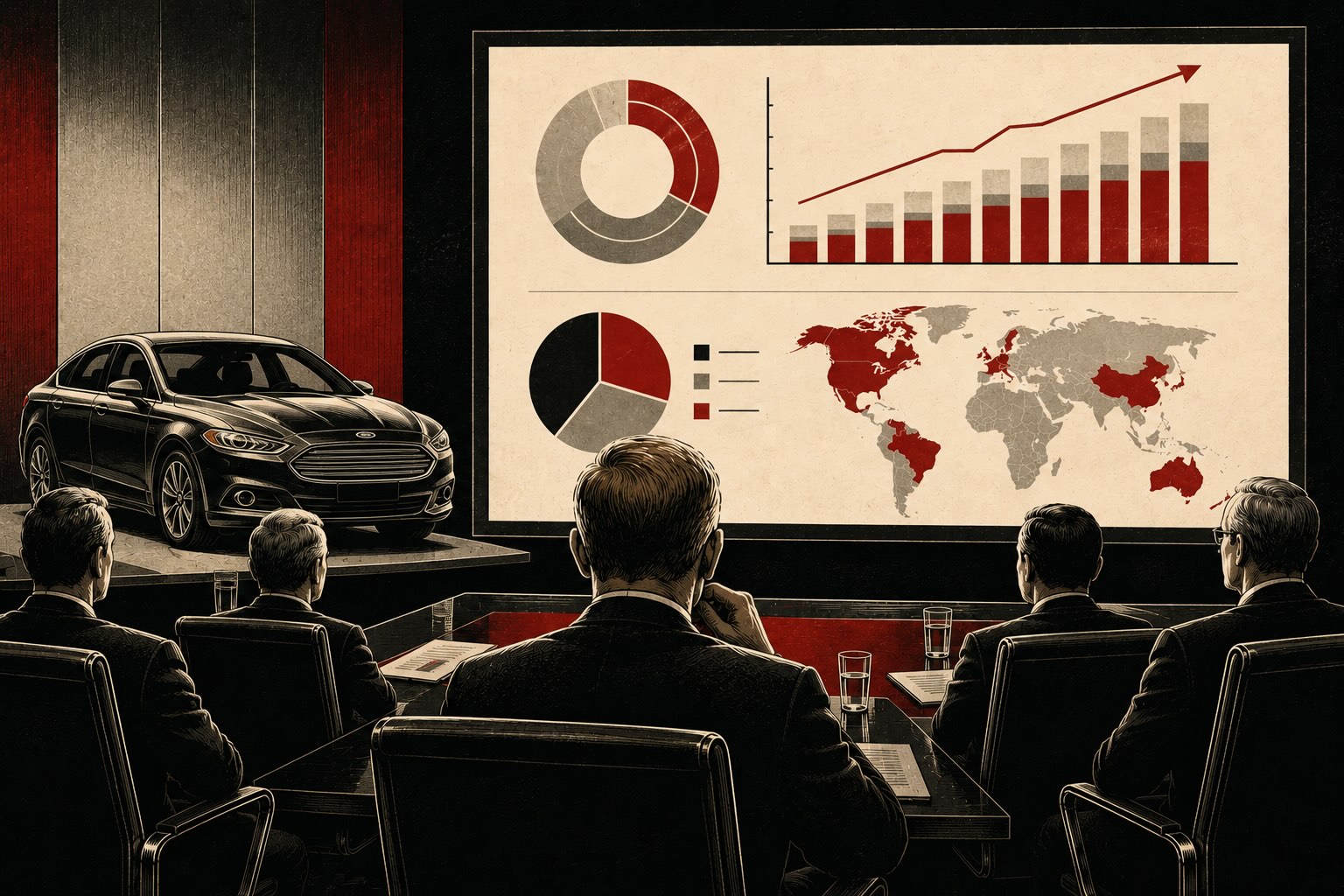
When Alan Mulally arrived at Ford in 2006, one of his most important discoveries was not that Ford lacked capable people; it was that the organisation had become remarkably good at preventing those capable people from confronting reality together.
Ford was in deep trouble. It was heading towards an extraordinary loss. Harvard Business School’s case on the turnaround says the company anticipated losing $17 billion in 2006. Product quality and design had deteriorated, sales were declining, complexity had accumulated, and the culture had become dysfunctional and ego-driven.
Ford had tried turning itself around before.
That matters.
Because Mulally was not confronting a company that had done nothing. He was confronting something much more familiar to CEOs dealing with persistent problems:
an organisation expending enormous effort without generating sufficient traction.
In other words, 空回り(Karamawari).
The problem underneath the problems
Mulally could have treated Ford's difficulties as a collection of separate problems.
Cut costs.
Improve quality.
Launch better vehicles.
Restructure operations.
Replace executives.
Instead, he began changing the conditions under which Ford's leadership team operated.
One of the most important mechanisms was the weekly Business Plan Review.
Senior leaders came together around the same plan and the same information. Performance was exposed rather than protected inside organisational fiefdoms. Problems could no longer remain comfortably somebody else's problem.
That sounds almost mundane.
It wasn't.
Ford's culture had become characterised by internal divisions and false optimism. The turnaround required shifting towards collaboration and confronting reality.
And therein lies an important lesson about recurring problems.
Sometimes the problem survives because the organisation has created conditions under which telling the truth about it is more dangerous than allowing it to continue.
When red became useful
One of the famous stories from Mulally's tenure concerned executives reporting their programmes using traffic-light colours.
For week after week, the reports were overwhelmingly green despite Ford being in enormous difficulty.
Think about the contradiction.
The company was losing billions, yet inside the management system everything appeared to be going rather well.
That is not primarily a reporting problem.
It is a conditions problem.
If leaders believe red attracts punishment, scrutiny or career damage, rational people learn to manufacture green.
Mulally worked to make problems discussable rather than punishable.
That changed the meaning of bad news.
Instead of:
Red = somebody has failed
the organisation could increasingly interpret it as:
Red = something needs our collective attention.
That seemingly small shift matters enormously because recurring problems feed on distorted information.
One Ford attacked fragmentation
Mulally also introduced the philosophy that became known as One Ford — bringing people across the global enterprise around a common culture, shared objectives and coordinated strategy. Ford describes the approach as treating people throughout the enterprise as one team rather than disconnected operations.
Again, the deeper significance wasn't the slogan.
It was the condition being changed.
Different regions, functions and executives could no longer optimise quite so comfortably around their own worlds while Ford collectively suffered.
Mulally simplified the portfolio, reduced organisational complexity and strengthened accountability around a common plan.
He wasn't merely solving individual problems.
He was changing some of the organisational machinery capable of recreating them.
The turnaround before the crisis
There was another consequential decision.
Ford raised nearly $24 billion as Mulally began putting the turnaround into motion.
That happened before the global financial crisis reached its worst point.
When the crisis subsequently devastated the American automotive industry, Ford was the only one of the major American automakers to avoid a government bailout loan.
By the time Mulally's retirement was announced in 2014, Ford reported that it had achieved 19 consecutive profitable quarters under the One Ford strategy.
The financial turnaround was remarkable.
But the leadership lesson may be more valuable.
Stop fixing what the system keeps recreating
CEOs facing recurring problems are often presented with another solution.
Another transformation.
Another restructure.
Another technology investment.
Another consultant.
Another improvement programme.
Each may be perfectly sensible.
But Mulally's Ford experience suggests a harder question:
What if the organisation's conditions keep recreating the problem faster than its solutions can eliminate it?
If executives cannot expose bad news safely, problems remain hidden.
If functions protect themselves, problems become fragmented.
If information is filtered upwards, decisions are made against an artificial reality.
If accountability means blame, people manage appearances.
And if every recurrence produces another isolated intervention, enormous effort can coexist with remarkably little progress.
That is karamawari.
Mulally's great achievement wasn't simply finding better answers to Ford's problems. He helped create an organisation increasingly capable of seeing those problems, discussing them honestly and working on them collectively.
For CEOs tired of solving the same problem repeatedly, perhaps the most important question isn't “What should we try next?” but “What inside our organisation keeps making the old problem possible?”


0 Comments