
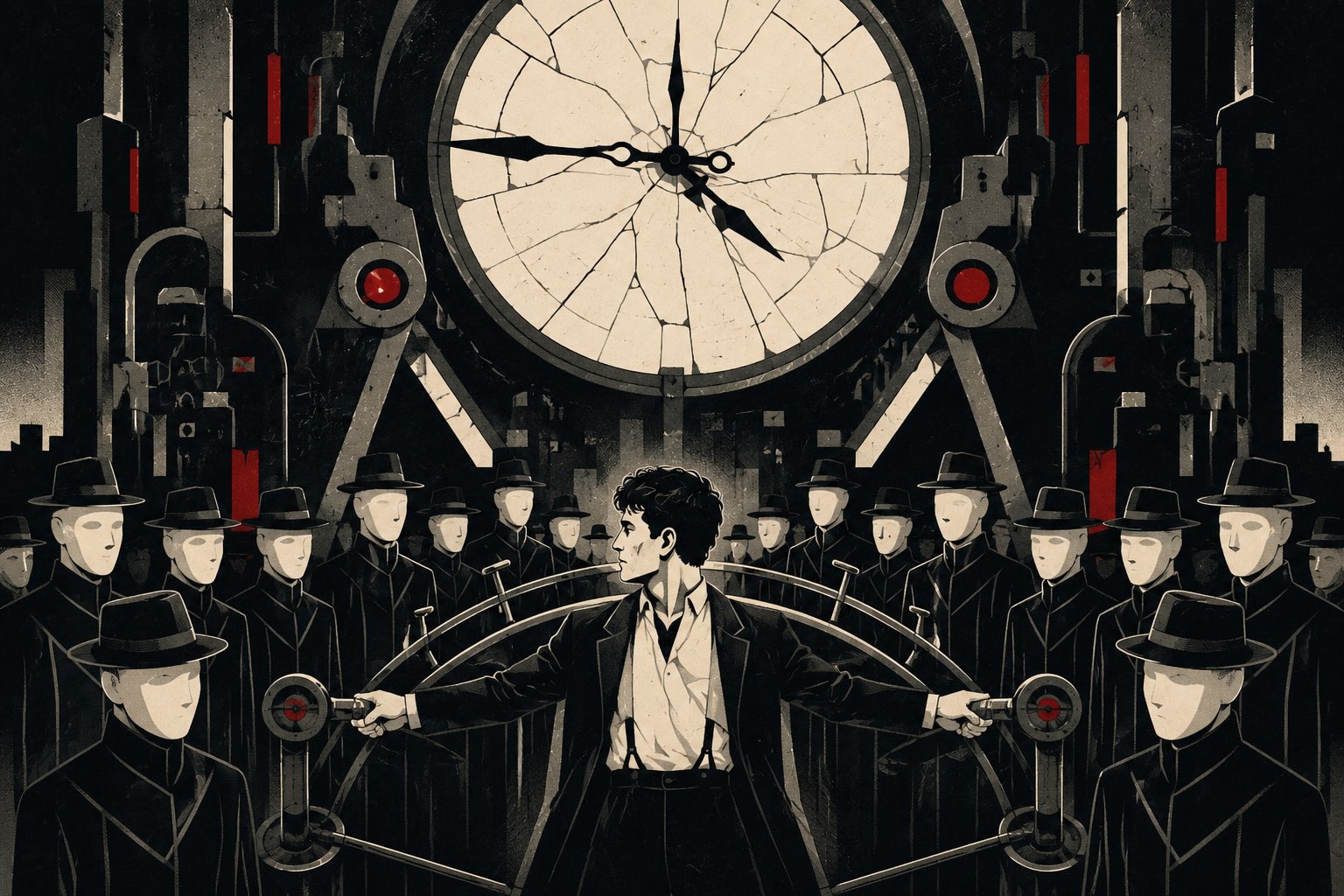
The hardest recurring problem for a CEO to solve may be the one the organisation has lived with for so long that nobody can remember what normal looked like before it.
Alex Proyas' 1998 film Dark City is ostensibly science fiction.
But underneath its noir atmosphere is a remarkably useful metaphor for persistent organisational problems.
The city's inhabitants live inside an environment they do not understand. Their memories are manipulated. Their circumstances are rearranged. Their identities appear stable, yet much of what they believe about themselves has been constructed for them.
Most importantly, almost nobody questions the system itself.
They simply wake up and operate within it.
For CEOs confronting costly problems that survive repeated fixes, that should feel uncomfortably familiar.
People Behave Rationally Inside the Reality They Are Given
One of Dark City's most interesting ideas is that people's behaviour is influenced by the realities constructed around them.
That matters enormously in organisations.
When something repeatedly goes wrong, leaders naturally look at behaviour.
Why didn't they escalate?
Why did Sales make that commitment?
Why didn't Operations challenge it?
Why did the project team hide the delay?
Why wasn't the risk raised earlier?
Behaviour becomes the visible problem.
But behaviour has context.
If people have repeatedly seen early escalation punished, silence can become rational.
If revenue is rewarded more strongly than deliverability, optimistic commitments can become rational.
If challenging senior leaders carries consequences, agreement can become rational.
The behaviour may be undesirable.
But within the conditions, it can make perfect sense.
The City Changes. The System Survives.
Every night in Dark City, the physical environment can be altered.
Buildings change.
Lives change.
Circumstances change.
Yet the deeper machinery controlling the city remains.
There is an extraordinary parallel with organisational transformation.
A company restructures.
Reporting lines change.
A new executive arrives.
Technology is replaced.
Processes are redesigned.
Governance is strengthened.
Job titles change.
From the outside, enormous transformation has occurred.
Yet twelve months later, the same customer failures, delivery problems, cost overruns or escalations return.
The organisational skyline changed.
The machinery underneath it did not.
That is Karamawari.
空回り describes wheels spinning without traction. There can be enormous movement without meaningful forward progress.
Organisations Have Manufactured Memories Too
Dark City also raises an intriguing question about memory.
What happens when people accept an invented history as truth?
Organisations develop something similar, although far less sinister.
They create stories.
"We tried decentralisation and it failed."
"Customers only care about price."
"Operations always resists change."
"The board won't tolerate that."
"We need stronger accountability."
"That problem is unavoidable in our industry."
These statements often originate in genuine experience.
But experience becomes interpretation.
Interpretation becomes organisational memory.
Organisational memory eventually becomes assumption.
Then new decisions are made within its boundaries.
The dangerous question is rarely whether the story contains truth.
It usually does.
The question is whether the explanation attached to that history was ever complete.
Recurring Problems Need Someone to Notice the Pattern
John Murdoch's advantage in Dark City is not simply that he becomes powerful.
He begins questioning the reality everyone else accepts.
That is exactly what persistent organisational problems require.
Not another person rushing towards the latest incident.
Someone needs to stand outside the sequence and notice the pattern.
Why does this keep happening?
What changes each time?
What remains unchanged?
Why did the previous solution make sense?
What assumptions did it preserve?
What conditions keep producing those assumptions?
This is where the history of attempted fixes becomes valuable.
If five different interventions have failed, do not merely conclude that the problem is difficult.
Ask what the problem survived.
Perhaps five restructures preserved the same incentives.
Three technology programmes preserved the same decision rights.
Multiple leadership changes preserved the same commercial pressures.
Different solutions can repeatedly fail for the same reason.
Beware the Dr Schreber Problem
Dr Schreber offers another interesting leadership parallel.
He understands far more about how the system works than the people living inside it, yet he is also operating within constraints imposed by that system.
Organisations frequently contain people like this.
Long-serving employees know where the real dependencies sit.
Operations knows which workaround actually keeps customers moving.
Finance knows where the recurring cost appears.
Technology knows which supposedly temporary integration became permanent eight years ago.
Risk knows which exception keeps returning.
But knowledge and authority often sit in different places.
Those who understand the machinery may not have permission to change it.
Those with authority may receive only dashboards describing its outputs.
That separation helps recurring problems survive.
Find Shell Beach
Perhaps the film's most powerful metaphor is Shell Beach.
Characters remember it. They can describe it. Yet reaching it proves strangely difficult.
Organisations have their own Shell Beaches.
The permanently promised future state.
"When the transformation finishes..."
"Once the new platform is implemented..."
"After the restructure settles..."
"When we finally recruit the right people..."
Everyone knows where the organisation is supposedly heading.
Yet somehow it never quite arrives.
When that happens repeatedly, CEOs should stop asking how much further there is to travel.
They should question the map.
Persistent problems survive when organisations repeatedly modify what is visible while leaving untouched the conditions generating what they see.
That is the deeper lesson of Dark City.
You cannot reliably escape a system by becoming increasingly competent at operating within its assumptions.
Sometimes leadership must question the reality the organisation has learned to accept.
What if your most expensive recurring problem keeps returning not because your people cannot solve it, but because every attempted solution begins inside the same version of reality that created it?


0 Comments