
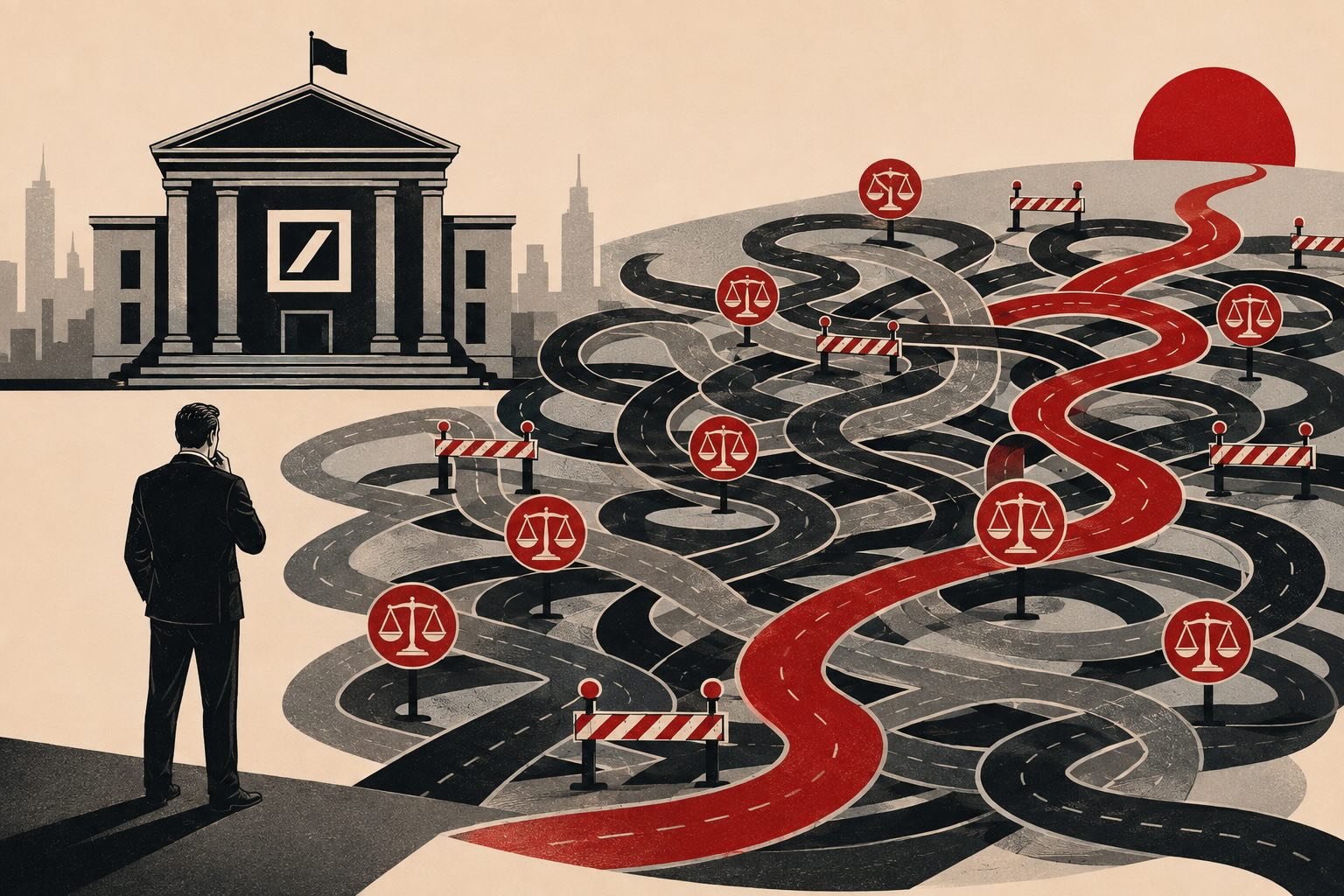
When an organisation has spent years fixing itself yet regulators keep finding reasons to return, the recurring problem may no longer be the individual failures. It may be the conditions that keep producing them.
Deutsche Bank provides a fascinating case for CEOs confronting persistent problems.
Over many years, the bank has faced regulatory actions involving anti-money-laundering controls, sanctions compliance, foreign-exchange trading, benchmark manipulation, governance, risk management and internal controls.
And Deutsche Bank has repeatedly responded.
Management teams changed. Controls were strengthened. Compliance resources increased. Businesses were exited. Technology was upgraded. Restructuring programmes were launched. The organisation invested heavily in remediation and transformation.
There has also been genuine progress. Deutsche Bank's 2025 reporting points to significant improvements in controls and regulatory remediation.
Yet the longer history raises a much more interesting leadership question:
Why can an organisation repeatedly fix serious problems without completely escaping the conditions that created them?
The individual problems were real
It would be easy to look retrospectively at Deutsche Bank's regulatory history and treat it as one enormous problem.
It wasn't.
Different incidents occurred at different times, involved different activities and required different responses.
That distinction matters.
But recurring problems become interesting when you stop looking only at what makes each incident different and start looking for what they have in common.
In 2017, the Federal Reserve required Deutsche Bank to improve senior management oversight and controls around anti-money-laundering compliance.
Six years later, the Federal Reserve imposed another $186 million penalty. Importantly, part of the regulator's concern was insufficient progress addressing requirements from earlier orders. It also identified broader deficiencies involving governance, risk management and controls.
That is a very different signal from discovering a new isolated failure.
The remediation itself has entered the story.
When fixing becomes part of the problem
This is where CEOs should pay attention.
The natural response to a control failure is another control.
A governance problem produces additional governance.
A compliance problem produces more compliance resources.
A reporting weakness produces additional reporting.
Each response may be entirely appropriate.
But eventually something uncomfortable can happen.
The organisation becomes extraordinarily busy managing the consequences of its complexity while simultaneously adding more complexity to manage those consequences.
More systems interact with legacy systems.
More controls interact with existing controls.
More reporting requirements create additional processes.
More remediation programmes compete for specialist resources.
More transformation initiatives introduce dependencies between transformations.
The organisation is moving.
But movement and progress are not necessarily the same thing.
Complexity has memory
Deutsche Bank itself continues to acknowledge challenges associated with legacy technology, fragmented data, manual processes, system integration and structural complexity, even while reporting considerable progress in addressing them.
That should interest any CEO running a large established organisation.
Complexity accumulates.
An acquisition made fifteen years ago can leave systems behind.
A regulatory response creates controls.
A restructuring changes responsibilities.
A new strategy changes priorities.
A technology transformation changes processes.
Another regulation adds requirements.
Eventually, nobody deliberately designed the organisation that now exists.
It emerged.
And every attempt to change one part must operate inside conditions created by everything that came before it.
That can make recurring problems extraordinarily resistant to conventional solutions.
Karamawari can look like transformation
This is where 空回り (karamawari) becomes relevant.
Karamawari describes significant effort that produces insufficient forward movement.
In organisations, it does not necessarily look like incompetence.
Sometimes it looks extremely impressive.
Large programmes.
Senior steering committees.
Thousands of remediation actions.
Technology investments.
External advisers.
New executives.
Revised operating models.
Detailed dashboards.
Everybody can be working exceptionally hard.
The danger is assuming the scale of the response proves the underlying problem is being removed.
A transformation can successfully deliver hundreds of initiatives while leaving important conditions largely intact.
That is one of the most expensive forms of Karamawari.
Recurrence should change the question
After the first serious failure, asking "What went wrong?" makes sense.
After the second, leadership should begin asking something else.
After the fifth, it becomes essential.
"What keeps making different versions of this problem possible?"
That question moves the investigation deeper.
Perhaps incentives are creating undesirable behaviours.
Perhaps organisational complexity makes accountability ambiguous.
Perhaps information is fragmented across systems.
Perhaps commercial pressure changes how controls operate in practice.
Perhaps decision rights allow local optimisation to override enterprise objectives.
Perhaps successive remediation programmes are treating manifestations that share deeper conditions.
The important point is not that any particular one of these explains Deutsche Bank's history.
It is that repeated problems should cause leaders to stop treating each occurrence as entirely independent.
Failed fixes are evidence
There is another valuable lesson here.
Every previous remediation attempt contains information.
If a problem returns after a restructure, ask what the restructure did not change.
If it survives new technology, ask what existed independently of the technology.
If it survives leadership changes, question whether leadership capability was ever the primary cause.
If additional controls do not eliminate recurrence, examine the conditions determining how those controls operate.
The more solutions that have been attempted, the more revealing the common denominator becomes.
For CEOs exhausted by recurring problems, that is potentially good news.
You are not necessarily starting again.
Your organisation's history of failed or incomplete solutions may contain some of the best evidence available about where the real problem is hiding.
Stop funding another recurrence
Deutsche Bank's story is still evolving, and its recent reporting indicates substantial progress in its transformation and control environment.
But the broader lesson extends far beyond banking.
Recurring problems become extraordinarily expensive when each occurrence receives its own diagnosis, budget, programme and solution.
Eventually leadership needs to examine the system connecting them.
Because the greatest cost is not another fine, failed project, customer complaint, control breakdown or restructuring.
It is years of organisational capacity consumed solving different manifestations of something deeper that nobody has yet removed.
So when the next version of a familiar problem reaches your executive table, perhaps the most important question is not, "How do we fix this one?"
What if the fact that you have had to fix it so many times is the strongest evidence that you still haven't found the problem?


0 Comments