
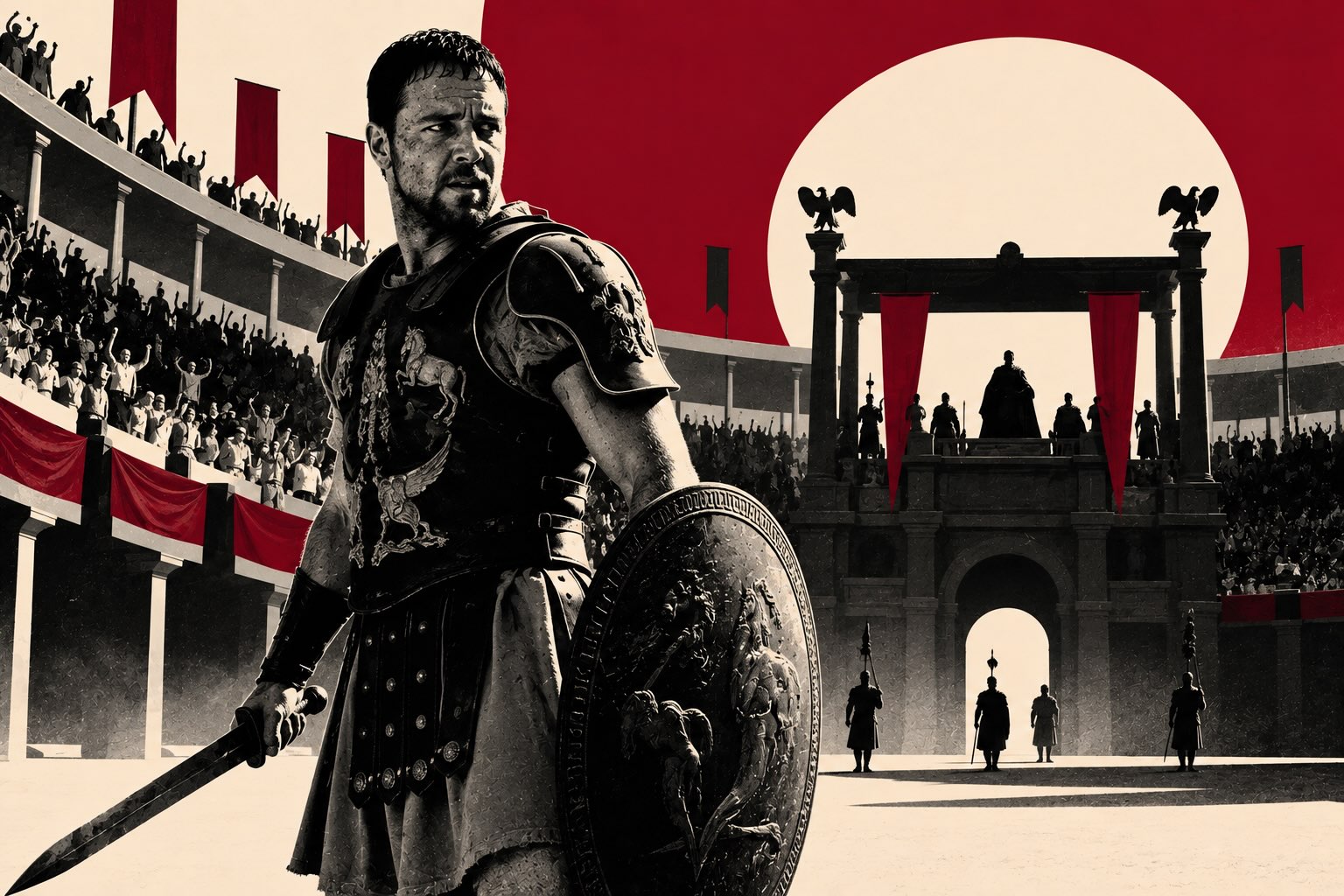
Your organisation can win every battle against a recurring problem and still lose the war against what keeps creating it.
Ridley Scott’s Gladiator is a story of power, loyalty, revenge and survival. But beneath the spectacle sits a lesson that should feel uncomfortable to any CEO watching the same expensive problems return.
Rome has enormous capability.
Armies. Institutions. Hierarchies. Rules. Resources. Authority.
And yet capability does not guarantee that the system produces the outcomes it was supposedly designed to produce.
That is where Gladiator meets karamawari (空回り): enormous effort without equivalent traction.
Organisations experience the same thing when they become increasingly accomplished at fighting recurring problems without changing the conditions that keep generating them.
Winning the battle is not winning the war
The film opens with Maximus leading Rome to victory in Germania.
It is decisive. Disciplined. Impressive.
But winning a battle does not resolve the deeper struggle over Rome itself.
Businesses make this mistake constantly.
A customer crisis is resolved.
A troubled project is recovered.
An audit finding is closed.
A technology outage is fixed.
Employee turnover falls.
The dashboard turns green.
Victory.
Except six months later, something remarkably similar happens again.
Leadership celebrates the quality of the response without asking why another response became necessary.
The organisation is measuring its ability to win battles rather than its ability to stop fighting the same war.
Commodus teaches us something about conditions
Commodus provides a more interesting organisational lesson than simply “bad leadership”.
His behaviour changes the conditions around everyone else.
People learn what is rewarded.
They learn what is dangerous to say.
They learn where power actually resides.
They learn whether disagreement is safe.
They adapt accordingly.
That is how organisations work too.
Imagine a CEO frustrated that executives never challenge them.
They introduce workshops on courageous conversations.
But everyone remembers what happened to the last executive who strongly disagreed.
The visible problem is insufficient challenge.
The underlying condition is that challenge carries consequences.
No amount of training fixes that.
People are not necessarily behaving irrationally. They may be responding perfectly rationally to the environment leadership has created.
The arena can hide the system
The Colosseum is perhaps the film’s strongest metaphor for organisational karamawari.
It produces visible action.
Drama.
Heroes.
Victories.
Defeats.
Crowds become absorbed in what is happening inside the arena.
Meanwhile, the deeper questions about Rome remain unresolved.
Organisations create their own arenas.
War rooms.
Steering committees.
Remediation programmes.
Transformation offices.
Incident-management teams.
Executive escalations.
They create tremendous activity around a problem.
And activity is reassuring because it demonstrates that something is being done.
But the danger is subtle.
The better your organisation becomes at responding dramatically to problems, the easier it becomes to mistake response capability for problem resolution.
You can build an extraordinary arena for fighting problems without ever questioning why those problems keep entering the arena.
Your heroes may be hiding the problem
Maximus repeatedly succeeds where others cannot.
Every organisation has its Maximus.
The operations leader who always rescues the quarter.
The technology specialist who knows every workaround.
The executive who personally resolves customer escalations.
The programme director who somehow drags troubled initiatives across the line.
These people are valuable.
But they can also conceal fragility.
If the same individuals repeatedly intervene to prevent consequences, leadership may never experience the full cost of the conditions requiring their intervention.
Heroics become institutionalised.
Dependency becomes capability.
The organisation concludes the system works because talented people continually prevent everyone from discovering that it does not.
A powerful test is therefore simple:
What would happen if your organisational heroes disappeared for three months?
Whatever immediately starts failing deserves attention.
Recurrence is telling you what survived
When a recurring problem returns, leaders naturally ask what went wrong with the previous solution.
A better question is:
What remained unchanged?
Perhaps the process changed but the incentives survived.
Perhaps the technology changed but the information bottleneck survived.
Perhaps the organisational chart changed but decision rights remained unclear.
Perhaps the manager changed but employees still learned that escalating was safer than deciding.
Perhaps another control was introduced but circumventing it remained the fastest way to serve the customer.
Something survived.
Recurrence is evidence of its survival.
That makes a returning problem diagnostically valuable, even if commercially frustrating.
Stop asking who should fight harder
By the end of Gladiator, the central struggle cannot be resolved simply by becoming better at combat.
The problem is bigger than the next opponent.
That matters for CEOs.
When something repeatedly fails, leadership often increases force.
More accountability.
More governance.
More resources.
More reporting.
More executive attention.
More urgency.
Sometimes that is exactly what is required.
But when repeated increases in effort produce repeated versions of the same outcome, effort itself deserves examination.
That is karamawari.
The wheel is spinning faster.
Everyone is exhausted.
Money is disappearing.
Yet traction remains stubbornly elusive.
The leadership challenge is no longer to fight the recurring problem more effectively.
It is to step outside the arena long enough to understand why the organisation keeps producing opponents for its people to fight.
So if your organisation keeps celebrating the heroes who defeat the same recurring problem, what would change if you stopped rewarding victory in the arena and started asking why the arena still needs to exist?


0 Comments