
Some recurring problems become so expensive that eventually the organisation exists to manage the problem rather than achieve its purpose.
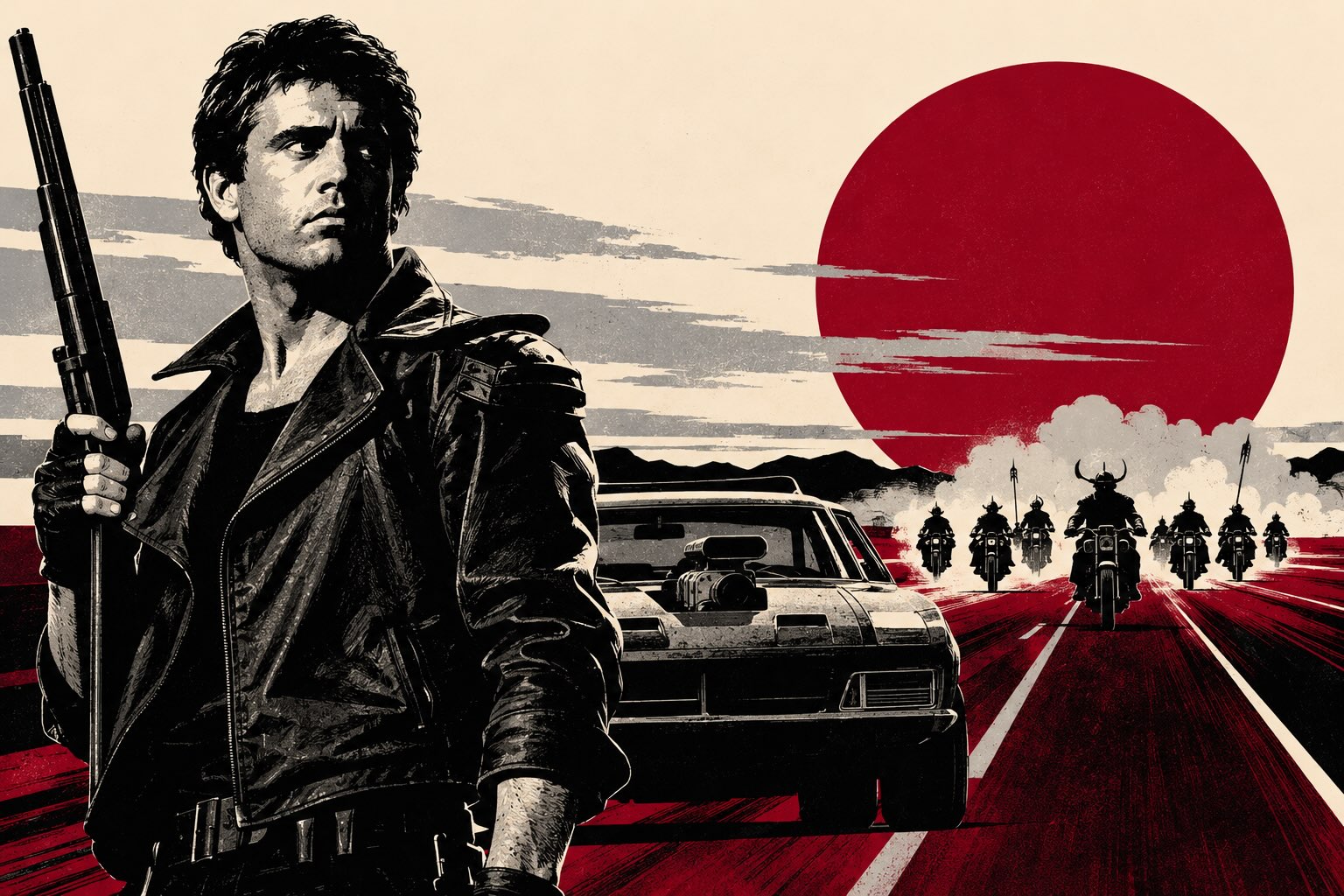
The original 1979 Mad Max is remembered for roaring engines, desolate roads and escalating violence.
But beneath the pursuit is something CEOs wrestling with recurring organisational problems will recognise.
The institutions in Max Rockatansky’s world are still functioning. The Main Force Patrol still has vehicles, officers, procedures and authority. People are still turning up and doing their jobs.
Yet the environment around them is deteriorating faster than the system can respond.
They are working.
They are just no longer winning.
That is remarkably close to karamawari (空回り): effort without traction.
The system can keep operating after it stops working
One of the most interesting things about Mad Max is that society has not completely collapsed.
That makes it more useful as a leadership metaphor.
The machinery still exists.
The police pursue offenders. Cars are repaired. Rules are enforced. Incidents are investigated.
But each response seems increasingly inadequate against the conditions surrounding it.
Organisations can reach the same point.
A recurring operational failure triggers remediation.
Another customer issue triggers another review.
A control failure produces another control.
A delayed programme gets another governance forum.
Nothing looks irrational individually.
But collectively, the organisation may be spending extraordinary amounts of money keeping a deteriorating system operational.
There is a dangerous difference between a system that continues to function and a system that is still fit for purpose.
Heroics can hide deterioration
Max is highly capable.
That is part of the problem.
When systems weaken, exceptional people often compensate.
They work longer. Escalate faster. Remember undocumented dependencies. Circumvent cumbersome processes. Call the right person. Fix the issue before the customer notices.
Leadership sees resilience.
But what it may actually be seeing is human compensation for structural weakness.
This is particularly dangerous with recurring problems because the better your people become at rescuing the organisation, the less visible the underlying fragility becomes.
The incident is resolved.
The customer is retained.
The deadline is recovered.
The dashboard returns to green.
And the conditions that made the rescue necessary remain.
If your organisation repeatedly needs exceptional people to produce ordinary outcomes, heroism may no longer be evidence of capability.
It may be evidence of dependency.
Escalation changes the conditions
Throughout Mad Max, each confrontation contributes to the next.
Action produces reaction. Reaction produces escalation. Escalation changes behaviour.
There is an organisational equivalent.
A problem occurs, so leadership introduces tighter oversight.
Employees experience slower decisions, so they find workarounds.
Leadership discovers the workarounds and introduces stronger controls.
People become more reluctant to exercise judgment.
More decisions move upwards.
Executives become bottlenecks.
Problems take longer to resolve.
Leadership concludes that accountability is deteriorating.
So oversight increases again.
The organisation is now trapped inside a feedback loop.
Its solution is helping create the conditions that make the next version of the problem more likely.
That is karamawari at its most expensive.
Recurrence changes the economics
A recurring problem rarely costs the same amount each time.
The first occurrence might cost $100,000.
The second might also appear to cost $100,000.
But underneath, something else is accumulating.
Management attention.
Additional controls.
Workarounds.
Technical debt.
Customer frustration.
Employee fatigue.
Governance overhead.
Lost confidence.
Deferred strategic work.
Eventually, the visible incident may be the smallest part of the economic impact.
This is why CEOs should be careful about evaluating recurring problems incident by incident.
A $100,000 problem occurring ten times is not necessarily a $1 million problem.
It may be a $5 million problem once the machinery required to repeatedly detect, contain, explain and recover from it is included.
Recurrence compounds infrastructure around failure.
Ask what survived the last fix
When a familiar problem returns, the instinctive question is usually:
“What should we do differently this time?”
There is a better one:
“What survived everything we did last time?”
Perhaps the technology changed but the incentives survived.
Perhaps the process changed but unclear authority survived.
Perhaps the structure changed but information still travels through the same bottleneck.
Perhaps people changed but the assumptions shaping their decisions remained.
Perhaps another control was introduced while the reason employees circumvent the process remained perfectly rational.
Recurrence is not simply evidence that something failed.
It is evidence that something persisted.
Finding that persistent condition is often more valuable than designing the next intervention.
Know when more effort is the wrong answer
Max eventually confronts a brutal reality: continuing to operate within the same deteriorating environment extracts an increasingly personal price.
CEOs face a less cinematic but commercially important version of that choice.
There comes a point where responding harder is no longer leadership.
Another remediation programme may not help.
Another restructure may not help.
Another system may not help.
Another heroic executive may not help.
The organisation has to stop asking how to become better at fighting the recurring problem and start asking why it keeps having a fight in the first place.
That is the shift from containment to diagnosis.
From activity to traction.
From karamawari to change.
If your organisation has become extraordinarily good at repeatedly rescuing itself from the same problem, what would you discover if you stopped measuring the quality of the rescue and started investigating why rescue is still necessary?


0 Comments