
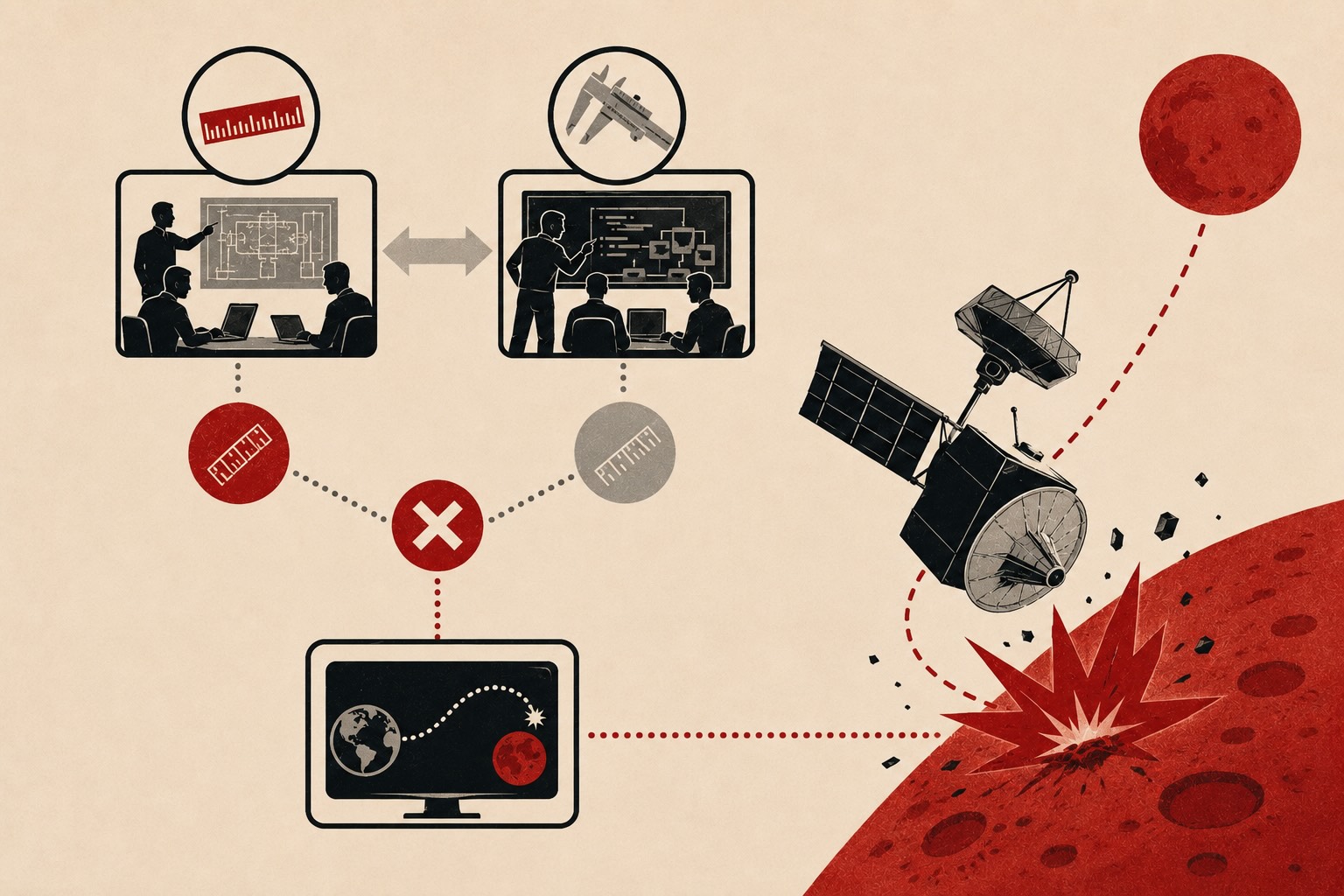
One of the most dangerous failures a CEO can face is when every team can demonstrate that its part worked correctly, yet the organisation still produces a catastrophic result.
In 1999, NASA lost the Mars Climate Orbiter as it approached Mars.
The spacecraft had travelled hundreds of millions of kilometres. The technology was sophisticated. The engineering teams involved were highly capable.
Yet the mission was lost because of something astonishingly mundane.
One part of the system produced data using imperial units. Another expected metric units.
The problem was not simply that somebody made a conversion mistake.
The more interesting lesson for CEOs is that two internally functioning systems met at an interface that did not function correctly.
That is where many recurring organisational problems live.
Organisations are designed in boxes
Look at almost any organisation chart and you will see boxes.
Sales.
Operations.
Finance.
Technology.
Risk.
Marketing.
Human Resources.
Each has leadership, processes, objectives, systems, measures and responsibilities.
Management naturally focuses on whether each box is performing.
Is Sales hitting its number?
Is Operations meeting service levels?
Is Finance closing accurately?
Is Technology delivering?
Is Risk operating its controls?
But customers, products, decisions and information do not remain neatly inside those boxes.
They travel between them.
And that is where things become interesting.
The Mars Climate Orbiter problem was between systems
The Mars Climate Orbiter was not lost because imperial measurements are inherently wrong.
Metric measurements were not the problem either.
The problem was incompatibility.
Software associated with one team generated thruster information using pound-force seconds. Another part of the navigation process expected newton-seconds.
Each convention worked perfectly well within its own context.
The failure emerged when information crossed the boundary.
That distinction matters enormously.
A system can be locally correct and collectively disastrous.
Businesses reproduce this pattern constantly.
Sales promises something Operations interprets differently.
Finance defines a customer differently from Marketing.
Risk assumes a control is owned by Technology while Technology assumes it belongs to the business.
Head office designs a policy that regional teams interpret differently.
One system records a transaction one way while another system expects something else.
Nobody necessarily fails inside their own domain.
The organisation fails between domains.
Interfaces are easy to overlook
There is a structural reason these problems persist.
We assign accountability to things more easily than we assign accountability to relationships between things.
Someone owns Sales.
Someone owns Operations.
Someone owns Finance.
But who owns the integrity of the handoff between Sales and Operations?
Who owns whether the assumptions embedded in one system remain valid when information reaches another?
Who owns the complete journey rather than an individual stage?
Often, the answer becomes everyone.
Which can quietly mean nobody.
The interface becomes organisational white space.
This is fertile ground for Karamawari
Now imagine the same interface problem repeatedly causing failures.
Sales receives additional training.
Operations gets a new process.
Technology implements another control.
Finance adds reconciliation.
Risk introduces another governance checkpoint.
Each intervention may improve its respective function.
But the interface remains unchanged.
The problem eventually returns.
More remediation follows.
This is 空回り (karamawari): considerable effort without corresponding forward movement.
The organisation keeps strengthening the individual components while leaving the incompatibility between them intact.
Eventually leadership becomes frustrated.
"We have fixed this three times."
Perhaps.
But perhaps you have fixed three manifestations of an interface problem without fixing the interface.
Recurrence is telling you where to look
This is why recurring problems deserve a different diagnostic approach.
If the same failure survives new people, new processes, new technology and additional controls, stop looking exclusively inside the functions where the symptoms appear.
Look between them.
Ask what crosses the boundary.
Information?
Authority?
Accountability?
Customer commitments?
Data?
Risk?
Assumptions?
Decisions?
Then ask whether both sides understand those things in exactly the same way.
Mars Climate Orbiter offers an almost absurdly clear example.
One side effectively said "this number means this."
The other side effectively said "this number means something different."
The number crossed the boundary.
The disagreement did not.
Local optimisation can make this worse
There is an uncomfortable implication for CEOs.
You can improve every function and make the enterprise worse.
Imagine Sales being incentivised to maximise revenue while Operations is incentivised to minimise cost.
Both teams become better at achieving their objectives.
Sales sells increasingly customised solutions.
Operations standardises increasingly aggressively.
Both dashboards improve.
The conflict at their interface intensifies.
Leadership then sees customer dissatisfaction, margin leakage, rework and internal friction.
Those appear to be separate problems.
They may actually be consequences of two successful functions operating according to incompatible assumptions.
Functional excellence does not guarantee enterprise effectiveness.
Sometimes it actively works against it.
Stop inspecting only the boxes
CEOs dealing with expensive recurring problems should therefore add another dimension to diagnosis.
Do not ask only:
Which function failed?
Which process broke?
Who was accountable?
Which control was missing?
Also ask:
What had to pass between two parts of our organisation for this outcome to occur?
Then examine the interface as rigorously as you would examine either function.
Look at definitions, assumptions, incentives, decision rights, information, timing, ownership and expectations.
Because the failure may belong to neither side.
It may exist entirely in the relationship between them.
The Mars Climate Orbiter travelled an extraordinary distance before that incompatibility became catastrophic.
Organisations can do the same.
Small misunderstandings can survive unnoticed for years because capable people compensate for them with workarounds, reconciliations, meetings and heroic effort.
Until one day they cannot.
And when that happens, leadership may discover that everybody did their job.
So if your organisation keeps experiencing failures despite capable teams performing well, what if the problem is not inside any of the boxes on your organisation chart, but in the invisible space between them?


0 Comments