
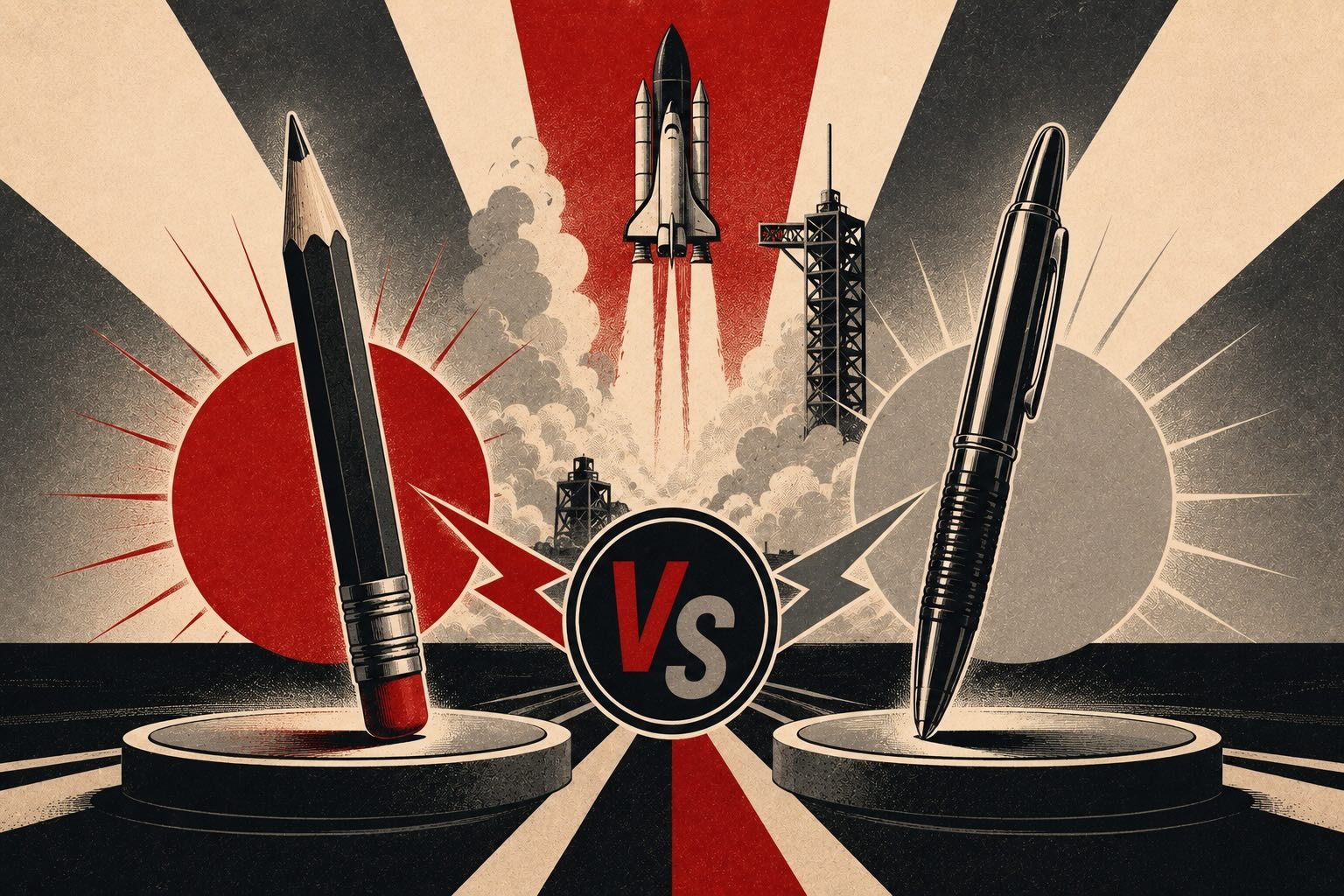
Some of the most expensive mistakes in business begin with a solution that looks so obvious nobody bothers asking whether it can survive the conditions in which it must work.
Few stories illustrate this better than the famous tale of NASA, the Russians and the space pen.
You have probably heard it.
NASA supposedly spent millions developing a pen capable of writing in zero gravity. Meanwhile, the Soviet space program avoided all that complexity with an elegantly simple solution:
Use a pencil.
It is a wonderful story about bureaucracy, overengineering and the virtue of simplicity.
There is just one problem.
It isn't what happened.
The Pencil Was Already There
Both American astronauts and Soviet cosmonauts initially used pencils.
And that matters because the popular story assumes NASA's engineers somehow overlooked the obvious alternative.
They hadn't.
They had already tried it.
The difficulty was not finding something that could make marks in zero gravity. The difficulty was finding something suitable for the conditions inside a spacecraft.
Pencils presented problems.
Graphite could break and float around the cabin. In an environment containing sensitive electronics, floating conductive material was hardly ideal. Wooden pencils and other materials also presented fire concerns in an environment where controlling ignition risks mattered considerably more than it does at an office desk.
Suddenly, "just use a pencil" becomes less clever.
The solution hasn't changed.
Our understanding of the problem has.
NASA Didn't Spend Millions Developing the Pen
The other part of the story is equally revealing.
NASA did not pour millions of taxpayer dollars into inventing the Fisher Space Pen.
Paul Fisher and his company developed a pressurised pen largely using their own money. The pen was designed to operate in conditions where an ordinary gravity-fed ballpoint pen struggled.
NASA tested it and subsequently purchased the pens.
And here is the detail that rather ruins the punchline of the original story:
The Soviet space program adopted them too.
The supposedly foolish solution eventually became useful to both sides.
That transforms a funny story about waste into a much more valuable leadership lesson.
Cheap Is Only Cheap If It Works
CEOs regularly encounter their own version of the pencil.
A recurring problem is consuming money, capacity and management attention. Someone proposes a sophisticated response.
Then someone else asks:
Why don't we just do the obvious thing?
Sometimes that question is exactly what the organisation needs.
Businesses absolutely can overengineer problems. Complexity can become self-perpetuating. Consultants, technology, governance, processes and transformation programs can accumulate around something that should have been solved much more simply.
But there is another danger.
A simple solution can look brilliant when the conditions have been simplified out of the problem.
A manual workaround may look cheaper than automation until transaction volumes triple.
Reducing inventory may look efficient until supply becomes volatile.
Centralising decisions may appear to eliminate inconsistency until customers need decisions faster than headquarters can make them.
Cutting maintenance may improve this year's numbers until equipment reliability deteriorates.
Reducing headcount may lower cost until the remaining organisation becomes dependent on overtime, contractors and heroic effort.
The spreadsheet says pencil.
Reality says spacecraft.
Recurring Problems Are Often Telling You What You Missed
This becomes particularly important when a problem keeps returning.
The organisation introduces a solution.
Performance improves.
Everyone moves on.
Six months later, the problem returns.
Another intervention follows.
Then another.
Eventually leadership becomes frustrated because apparently sensible solutions keep failing.
That is 空回り (karamawari): considerable effort without corresponding forward movement.
At that point, the temptation is to search for a better solution.
But recurrence may be telling you something different.
Perhaps the solution isn't the problem.
Perhaps your understanding of the conditions is incomplete.
The pencil works perfectly well under many conditions. That does not make it suitable under every condition.
The same is true of organisational solutions.
Follow the Problem Backwards
When CEOs see an expensive recurring impact, they naturally want to act.
But the visible impact is the end of a chain, not necessarily the beginning.
Behind the impact are decisions.
Behind those decisions are behaviours.
Behind those behaviours are assumptions about customers, employees, competitors, risk, cost, priorities and what leadership expects.
And surrounding all of those are the conditions that make those assumptions and behaviours appear sensible.
Conditions → Assumptions → Behaviours → Decisions → Impacts.
If leadership intervenes only at the impact, the deeper system can remain perfectly capable of recreating it.
That is why organisations can spend millions repeatedly "fixing" something without eliminating it.
They keep replacing the pen without understanding the spacecraft.
Simplicity Still Matters
None of this is an argument for complexity.
Quite the opposite.
Simplicity is extraordinarily valuable.
The challenge is earning it.
Real simplicity comes from understanding a problem deeply enough to know what can safely be removed.
Oversimplification removes things because we have failed to recognise their importance.
Those two behaviours can look identical in a boardroom.
Both can produce a cheaper solution.
Only one produces a solution that survives contact with reality.
For CEOs exhausted by recurring problems, perhaps the most useful question before approving either another expensive transformation or another seductively simple fix is:
Are we simplifying the solution because we finally understand the problem, or because we still haven't understood the conditions that make the obvious solution fail?


0 Comments