
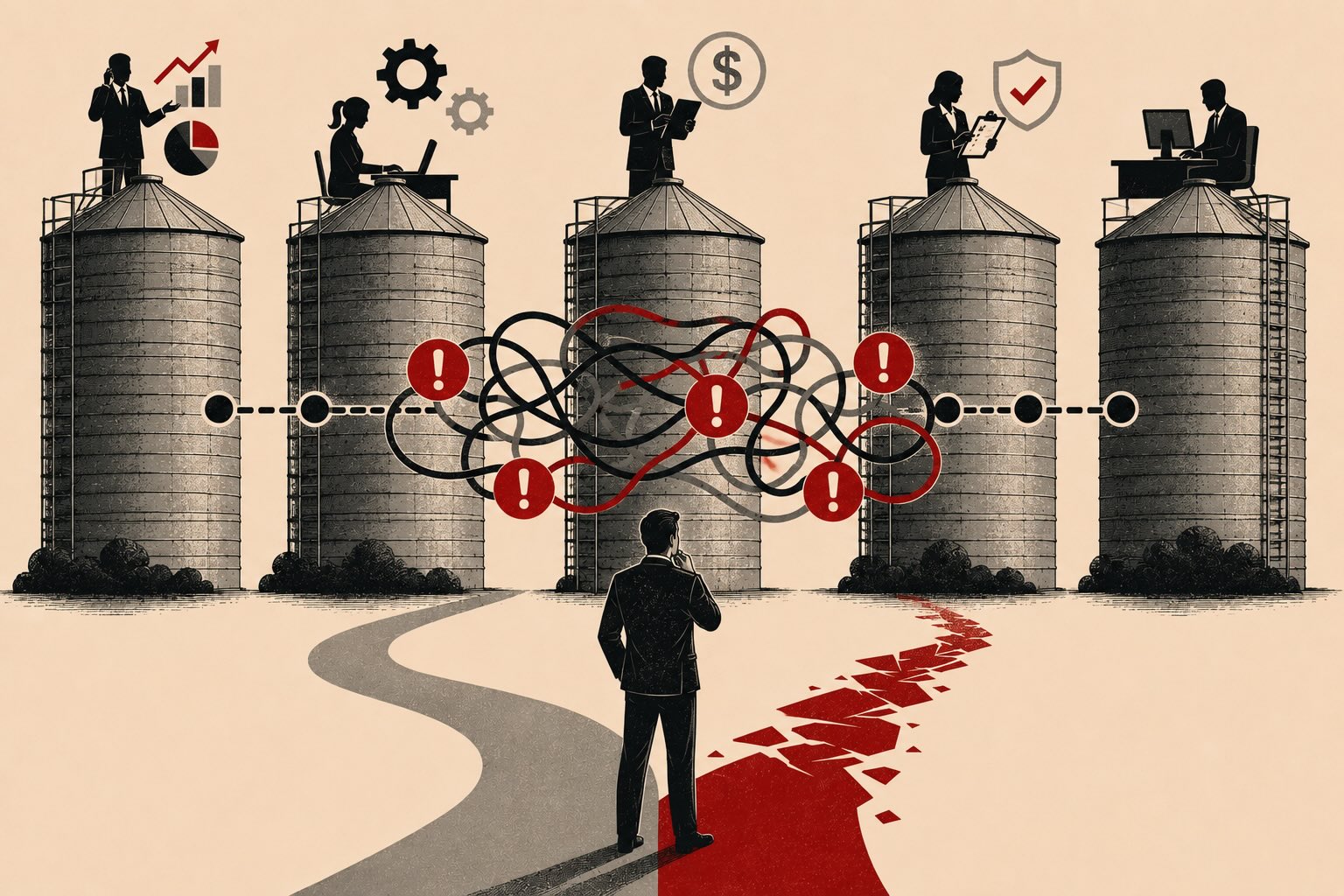
Some of the most expensive recurring problems survive because every function can prove it did its job.
That sounds contradictory.
Sales met its responsibilities. Operations followed the process. Finance applied the controls. Technology delivered the system. Risk enforced the policy.
Yet the customer was still disappointed, the project still failed, the cost still blew out, or the control still broke.
Management investigates. Each function examines its part. Improvements are made. Actions are assigned.
Then, months later, something remarkably similar happens again.
The uncomfortable possibility is that the problem was never really inside any of those functions.
It was between them.
Organisations manage vertically, but value moves horizontally
Most organisations are structured vertically.
Sales sells.
Operations delivers.
Finance controls.
Technology enables.
Risk protects.
This makes sense. Functions concentrate expertise, create clear reporting lines and allow leaders to manage specialised activities.
But customers do not experience the organisation vertically.
Neither does value.
A customer promise may begin in Sales, move through Commercial, Finance, Operations and Technology, and eventually reach Delivery.
Information crosses boundaries. Decisions cross boundaries. Accountability crosses boundaries. Resources cross boundaries.
And every crossing creates an interface.
That is where things get interesting.
Two competent teams can create one incompetent outcome
Imagine Sales commits to something unusual for an important customer.
Sales believes Operations will assess feasibility before accepting the order.
Operations assumes anything reaching them has already been approved.
Finance assumes the commercial implications were considered during contracting.
Technology believes the required capability was included in the original specification.
Everyone's assumption is individually reasonable.
Collectively, they are disastrous.
The failure does not necessarily belong to Sales, Operations, Finance or Technology.
It belongs to the relationship between their assumptions.
This is why asking "Who owns the problem?" can sometimes send the investigation in the wrong direction.
Nobody owns it completely.
And that may be precisely why it keeps returning.
The organisation fixes what it can see
When the consequence eventually appears, it usually becomes visible somewhere.
A customer complains, so Customer Service investigates.
Costs rise, so Finance initiates a cost programme.
Delivery deteriorates, so Operations redesigns the process.
A control fails, so Risk adds another control.
A project slips, so the PMO strengthens governance.
These responses can be entirely sensible.
They may even improve performance temporarily.
But they often begin where the problem materialised, rather than where it originated.
That distinction is fundamental.
If the customer complaint was created three handovers earlier, improving complaint handling will not stop the next complaint.
If the cost overrun began when Sales made commitments without visibility of operational complexity, squeezing Operations may actually make things worse.
The symptom belongs to one function.
The cause belongs to the system.
This is where Karamawari thrives
Karamawari (空回り) describes significant effort that fails to produce corresponding forward movement.
Organisational interfaces provide almost perfect conditions for it.
After every recurrence, each function improves its piece.
Another procedure is introduced.
Another approval is required.
Another dashboard appears.
Another meeting is created.
Another control is inserted.
Everyone becomes busier.
But the interface remains essentially unchanged.
The same ambiguity exists around decision rights. The same information loses meaning during handover. The same incompatible targets encourage different behaviours. The same assumptions remain unexamined.
The organisation has strengthened the boxes while leaving the spaces between them untouched.
Local success can create enterprise failure
There is an even harder problem for CEOs.
Sometimes the functions are not merely performing well. They are performing well because they are contributing to the wider problem.
Sales is rewarded for revenue, so it pursues deals that create disproportionate delivery complexity.
Operations is rewarded for efficiency, so it resists exceptions that might create greater customer value.
Finance is rewarded for cost control, so it delays expenditure that would prevent larger downstream costs.
Risk is rewarded for reducing exposure, so it introduces controls that unintentionally increase operational friction.
Every function can defend its behaviour using its own objectives.
That is the trap.
Optimising every component does not necessarily optimise the system.
In fact, functional excellence can sometimes conceal enterprise dysfunction.
Stop asking only whether the silos are performing
This changes the leadership conversation.
CEOs should certainly understand whether individual functions are performing.
But recurring problems demand another layer of investigation.
Where does accountability become ambiguous?
Where does information change meaning?
Where do incentives conflict?
Where does one function's definition of success create another function's problem?
Where are decisions handed over without their underlying assumptions?
Where does everyone believe somebody else has authority?
These boundaries rarely appear prominently on an organisation chart.
Yet they may be some of the most economically important places in the business.
Examine the white space
After the third recurrence, another functional improvement programme may not be the answer.
Put the entire journey on the table instead.
Follow the problem across the organisation.
Look particularly closely whenever information, authority, accountability or work changes hands.
Because recurring problems often survive in organisational white space, protected by the fact that no individual function completely owns the conditions creating them.
Work may happen within silos.
Value may flow across silos.
But costly recurring problems have an uncomfortable habit of flourishing in between them.
What problem are your teams repeatedly trying to solve inside their individual boxes when its real cause has been hiding in the space between them all along?


0 Comments