
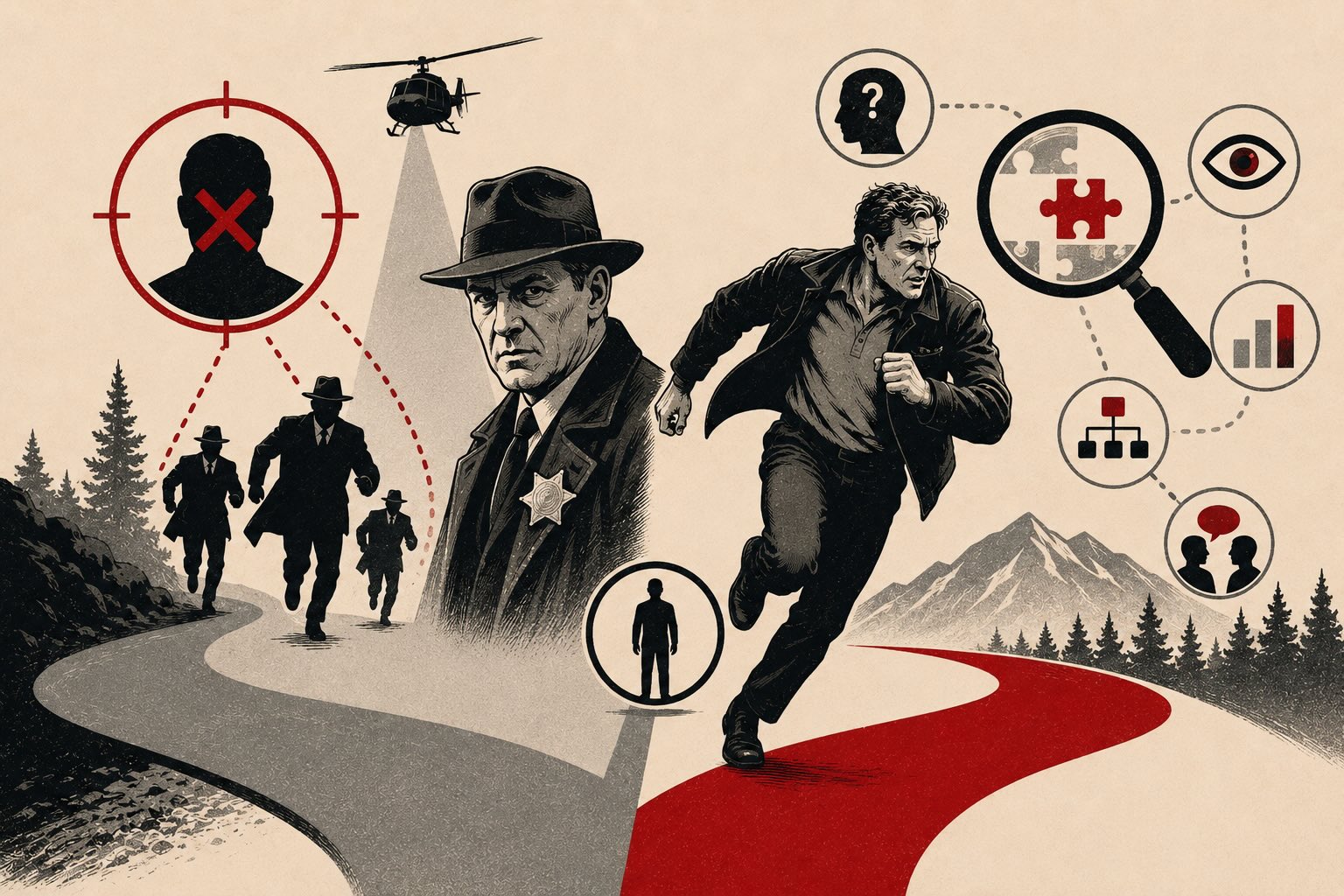
The most expensive recurring problems survive because organisations become better at pursuing the accepted explanation instead of questioning whether it was ever right.
The 1993 film The Fugitive is ostensibly a thriller about Dr Richard Kimble, wrongly convicted of murdering his wife, escaping custody and attempting to prove his innocence while being pursued by U.S. Marshal Samuel Gerard.
But beneath the chase is something highly relevant to CEOs dealing with karamawari: what happens when capable people relentlessly solve the wrong problem?
Nobody in The Fugitive is particularly incompetent. In fact, Gerard and his team are exceptionally competent.
That is precisely what makes the lesson uncomfortable.
Competence Can Accelerate Karamawari
Gerard has a clearly defined problem: find an escaped convicted murderer.
He organises resources, coordinates his team, follows evidence and pursues Kimble with extraordinary determination.
From within Gerard's frame of reference, everything makes sense.
Except the frame itself is wrong.
Kimble isn't the underlying problem. He is part of the evidence pointing towards another problem.
Organisations make this mistake constantly.
A recurring customer complaint becomes a customer-service problem. Persistent delays become an operational problem. Cost overruns become a financial-control problem. Poor performance becomes a people problem.
Once the problem has been classified, competent people get to work.
Processes are redesigned. Systems are implemented. People are replaced. Controls are strengthened. Consultants are hired.
And when the problem returns, the natural conclusion is often that the solution wasn't executed strongly enough.
So the organisation tries harder.
That is karamawari: considerable effort producing remarkably little lasting traction.
The First Explanation Has Enormous Power
Kimble's conviction creates an extraordinarily powerful assumption: Kimble killed his wife.
Once that assumption becomes established, subsequent information is interpreted through it.
Businesses do something similar.
Perhaps margins are deteriorating because "sales keeps discounting."
Projects fail because "we lack accountability."
Customers leave because "service levels aren't good enough."
Good people leave because "competitors are paying more."
These explanations may contain some truth. But once they become organisationally accepted, they start determining where attention, money and management effort go.
The dangerous question is therefore not simply:
What is causing this problem?
It is:
What have we already decided is causing this problem, and what evidence would make us reconsider?
That second question is much harder.
Follow the Evidence That Doesn't Fit
One of the most useful lessons from The Fugitive is Kimble's obsession with inconsistencies.
He isn't merely collecting evidence supporting his innocence. He is trying to understand what actually happened.
That distinction matters.
When organisations investigate recurring problems, they frequently collect evidence within an existing hypothesis.
If the hypothesis is poor execution, they examine execution.
If it is inadequate systems, they examine systems.
If it is weak capability, they examine capability.
But recurring problems often reveal themselves through the evidence that doesn't fit the accepted explanation.
Why did the problem survive the new system?
Why did another capable executive encounter exactly the same difficulty?
Why did restructuring improve performance temporarily before the old problem returned?
Why are intelligent people repeatedly making decisions leadership considers irrational?
An anomaly isn't necessarily noise.
Sometimes it is the most valuable clue you have.
Understand Why the Decisions Made Sense
Kimble ultimately needs more than the identity of his wife's killer. He needs to understand the chain of events surrounding the murder and the pharmaceutical conspiracy behind it.
That offers another useful lesson for tackling karamawari.
Finding the decision that produced an undesirable outcome isn't enough.
You need to understand why that decision made sense at the time.
Imagine discovering that regional managers repeatedly concealed emerging problems.
You could conclude that they lacked transparency.
But suppose further investigation revealed that managers who escalated problems early were routinely interrogated, criticised and labelled incapable, while managers who quietly fixed problems were rewarded.
Suddenly concealment looks less like irrational behaviour and more like adaptation to organisational conditions.
Replace the managers without changing those conditions and you may simply teach their successors the same behaviour.
The names change.
The problem doesn't.
Gerard Eventually Changes His Mind
Perhaps the most important leadership lesson comes from Gerard.
His strength isn't simply persistence.
It is eventually becoming willing to revise his interpretation.
As contradictory evidence accumulates, Gerard doesn't protect his original conclusion merely because he has invested enormous effort pursuing it.
That is harder in organisations than it sounds.
By the third attempted fix, careers, budgets and reputations may be attached to the existing explanation.
Acknowledging that the organisation has misunderstood the problem can mean acknowledging that millions of dollars were spent solving something that wasn't actually causing it.
The sunk cost therefore becomes psychological as well as financial.
And that creates an extraordinary temptation to commission version four of essentially the same solution.
Stop Chasing the Fugitive
The Fugitive doesn't provide a complete methodology for eliminating recurring organisational problems. Movies rarely make good operating models.
But it illustrates something fundamental.
Persistence is only valuable when you are pursuing the right problem.
When an expensive problem keeps returning despite competent people, serious investment and multiple credible attempts to eliminate it, another intervention should not automatically be the next move.
Perhaps the recurrence itself is evidence.
Evidence that the organisation's explanation is incomplete.
Evidence that something important has been misclassified.
Evidence that decisions which appear inexplicable make sense under conditions leadership hasn't examined.
And evidence that the organisation may be chasing the visible manifestation while whatever keeps producing it remains comfortably untouched.
For a CEO fed up with paying for the same problem repeatedly, that leads to a far more confronting question:
If your organisation has been chasing the same problem for years without catching it, how certain are you that the thing you are chasing is actually the culprit?


0 Comments