
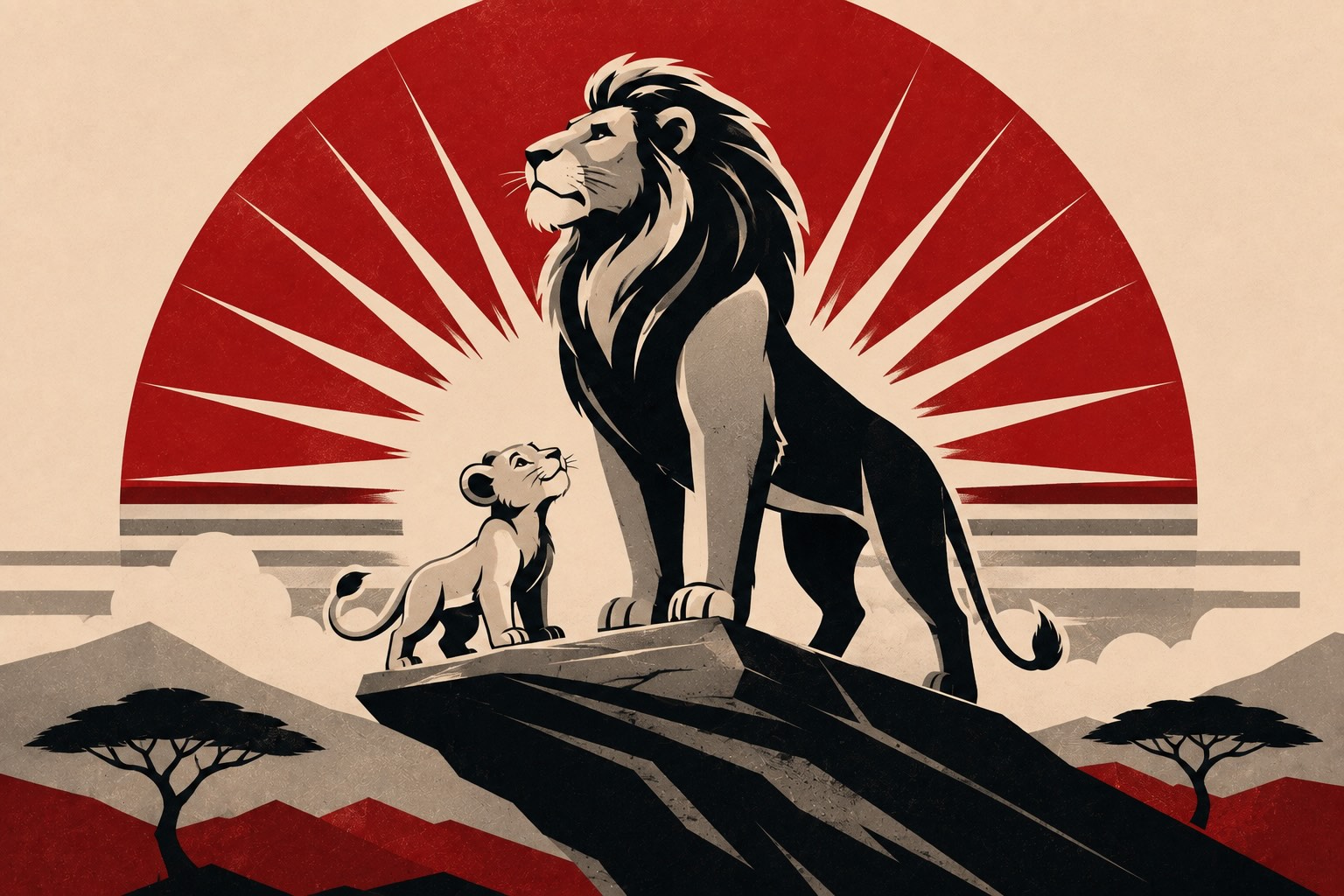
Some recurring problems become catastrophically expensive because leadership removes the person associated with the problem while leaving untouched the conditions that created it.
That is one of the more interesting organisational lessons hidden inside Disney’s 1994 film The Lion King.
The Pride Lands do not deteriorate because nobody responds to problems. There is plenty of action.
Mufasa dies. Simba disappears. Scar takes control. The hyenas gain access to the kingdom. Resources decline. The Pride Lands deteriorate. Eventually Simba returns and Scar is defeated.
The visible problem is removed.
But for CEOs dealing with problems that repeatedly return despite restructures, leadership changes and remediation programs, the more interesting question is what allowed the problem to become so destructive in the first place.
Scar is the obvious problem
Scar makes an irresistible villain because he gives everyone something identifiable to blame.
Organisations like identifiable causes too.
The failed executive.
The difficult employee.
The underperforming supplier.
The incompetent manager.
The troublesome customer.
The outdated system.
Finding something to blame creates clarity. Remove it and the organisation can declare the problem solved.
Sometimes that diagnosis is correct.
But recurring problems should make CEOs suspicious of explanations that depend too heavily on individuals.
If three different leaders have struggled with the same function, perhaps the problem is not the leaders.
If replacing employees does not stop the behaviour, perhaps the behaviour is being produced by something else.
If the same operational failure survives multiple restructures, perhaps moving boxes around the organisation chart cannot remove it.
When the characters change but the story keeps repeating, examine the stage.
The conditions made Scar powerful
Scar does not simply walk into the Pride Lands and take control.
He exploits vulnerabilities already present.
There are grievances. There are outsiders who can be mobilised. Power is highly concentrated. Succession depends heavily on a narrow royal lineage. Scar understands how others will respond and manipulates those assumptions brilliantly.
That is closer to how persistent organisational problems work.
The visible event may be a poor decision, misconduct, project failure, customer loss or operational breakdown.
But underneath it sit conditions.
Incentives.
Decision rights.
Information asymmetry.
Power.
Fear.
Resource constraints.
Unchallenged assumptions.
Conflicting objectives.
These conditions influence what people believe makes sense. Those assumptions influence behaviour. Behaviour shapes decisions. Decisions eventually create the impacts appearing on the CEO dashboard.
Conditions → Assumptions → Behaviours → Decisions → Impacts.
If leadership intervenes only at the impact end of that chain, the generating mechanism can survive.
Simba demonstrates another common response: avoidance
After Mufasa’s death, Simba leaves.
Hakuna Matata offers something enormously appealing: distance from the problem.
Organisations have their own versions.
Defer the difficult decision.
Accept the workaround.
Move the executive.
Create another committee.
Exclude the troublesome product from the transformation.
Renew the legacy system for another three years.
Put another control around the process.
The immediate pressure falls.
That can feel like progress.
But the underlying economics continue accumulating elsewhere.
This is where recurring problems become particularly expensive. The annual cost of tolerating them may appear manageable, while the cumulative cost quietly becomes enormous.
A $2 million problem tolerated for ten years is no longer a $2 million problem.
Especially when its real cost includes management attention, customer friction, duplicated effort, remediation, delayed investment, lost capacity and opportunity cost.
But Rafiki provides the better diagnostic lesson
Rafiki does something different.
He does not solve Simba’s problem for him.
He causes Simba to confront something he has been avoiding.
That distinction matters enormously for leaders.
When recurring problems become expensive, the instinct is often to accelerate towards solutions.
Another transformation.
Another consultant.
Another system.
Another restructure.
Another action plan.
But sometimes the most commercially valuable intervention is slowing down long enough to challenge the organisation’s explanation of the problem.
What happened?
What decisions produced it?
Why did those decisions make sense?
What assumptions supported them?
What conditions made those assumptions reasonable?
And crucially:
Which of those conditions survived our previous fixes?
That last question can explain why millions have been spent without preventing recurrence.
Restoring the Pride Lands is not the same as removing Scar
The ending creates another useful distinction.
Defeating Scar removes the immediate threat. It does not magically restore everything that deteriorated under his leadership.
The Pride Lands need recovery.
Businesses face the same problem.
Removing a root cause does not necessarily reverse the accumulated damage it created.
Customers may have left.
Experienced employees may have resigned.
Systems may have become fragmented.
Trust may have deteriorated.
Market share may have disappeared.
Capital may already have been wasted.
This means the cost of recurring problems is not simply the cost of fixing them.
It is also the cost of repairing what prolonged recurrence damaged.
Waiting for certainty can therefore be expensive.
And sometimes the problem should remain
There is an important qualification.
Not every recurring problem deserves elimination.
CEOs should resist the seductive idea that every imperfection requires a permanent fix.
Suppose a recurring operational problem costs $400,000 annually to manage, while eliminating it requires a $15 million transformation carrying significant implementation risk.
Living with it may be economically rational.
The leadership failure is not tolerating the problem.
It is tolerating it without understanding the economics.
The right question is not simply, “Can we eliminate this?”
It is:
What does recurrence genuinely cost, what would permanent resolution cost, and which creates greater enterprise value?
That turns problem solving into an economic decision rather than an emotional response to frustration.
The circle really does continue
The Lion King repeatedly returns to the idea of cycles.
That makes it particularly appropriate for karamawari.
Organisations have cycles too.
Problem. Response. Improvement. Relief. Recurrence. Response.
Eventually everyone becomes accustomed to the rhythm.
The danger is assuming recurrence means the last solution was poorly executed.
Sometimes it means something deeper was never changed.
And sometimes, after calculating the economics properly, leadership may deliberately decide not to change it at all.
So when the same costly problem returns to your leadership table yet again, are you looking at another failure to solve it, or evidence that you have never identified what keeps bringing it back?


0 Comments