
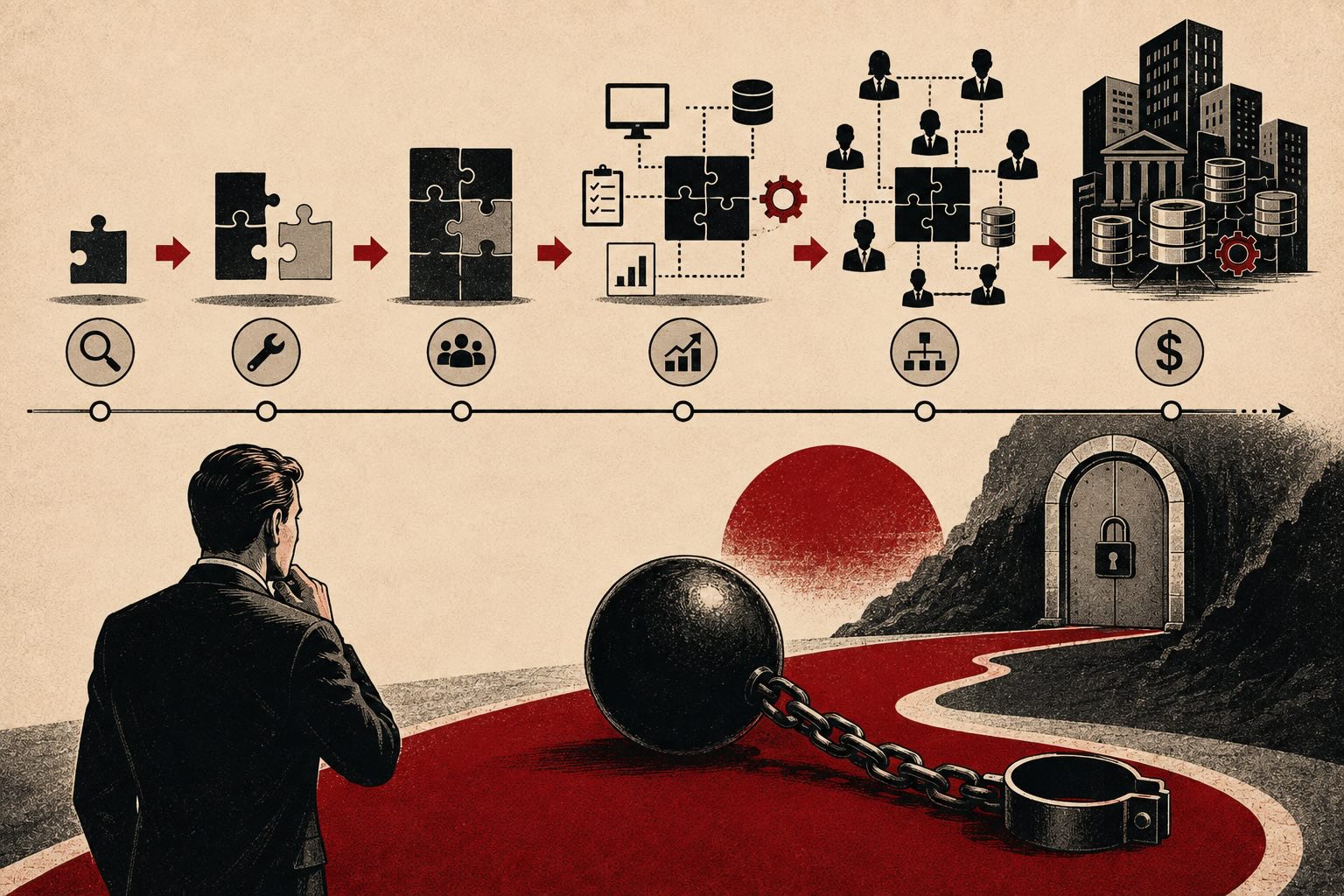
The most expensive moment in a recurring problem is rarely when it first appears; it is when the organisation discovers that yesterday's choices can no longer be cheaply undone.
Most CEOs understand that unresolved problems accumulate cost.
A recurring operational failure creates rework. Customer problems require remediation. Poor systems consume productivity. Weak processes absorb management attention.
But there is another dimension of cost that receives far less attention.
Reversibility.
Early in the life of a problem, organisations usually have choices.
They can change direction.
Challenge an assumption.
Redesign a process.
Reverse a decision.
Correct an incentive.
Address an uncomfortable behaviour.
The consequences are relatively contained.
But every time the organisation chooses to tolerate, work around or temporarily fix the problem, something changes.
The problem becomes embedded.
And reversing it becomes harder.
Problems don't simply get bigger. They become harder to unwind
Imagine a new operating model creates unclear accountability.
Three months after implementation, people are already compensating for it. Decisions are escalating unnecessarily. Work is bouncing between teams.
At this point, changing the model may be uncomfortable.
But it is still relatively reversible.
Wait three years.
Roles have now been recruited around it. Technology has been configured to support it. Performance measures reflect it. Budgets follow it. People have built careers within it. Customers have adapted to it. Other processes depend upon it.
The original problem may be essentially unchanged.
But the cost of correcting it is completely different.
Time has converted a problem into infrastructure.
Workarounds reduce reversibility
Recurring problems rarely survive because organisations do nothing.
Usually, they do plenty.
That is precisely what makes them difficult to see.
People create spreadsheets.
Managers introduce additional approvals.
Teams hire coordinators.
Technology groups build interfaces.
Finance creates reconciliations.
Customer-service teams develop recovery procedures.
Each workaround makes the underlying weakness more tolerable.
But every workaround can also become another dependency that eventually has to be dismantled.
A workaround that costs $50,000 may postpone a structural change costing $500,000.
That can look economically rational.
Until five years of workarounds have created a $5 million ecosystem around the original problem.
The organisation has not avoided the cost.
It has capitalised the problem in disguise.
Successive decisions narrow the escape route
There is a useful way for CEOs and boards to think about this.
Every significant decision creates both an intended outcome and a future set of options.
Some decisions preserve optionality.
Others progressively close doors.
A temporary manual process is relatively reversible.
Building multiple systems around it is less so.
Hiring people to administer those systems makes reversal harder again.
Embedding the resulting responsibilities into organisational structures narrows the options further.
Eventually, leadership confronts a peculiar situation:
Everyone knows the current arrangement is inefficient, yet changing it now appears prohibitively expensive.
The organisation has crossed from:
“Why don't we fix this?”
to:
“We can't afford to change it.”
That transition should concern every board.
Because sometimes the organisation cannot afford to change precisely because it repeatedly decided not to change earlier.
Behaviour can become irreversible too
Not all accumulated cost appears on the balance sheet.
Suppose employees repeatedly raise concerns and nothing meaningful happens.
Initially, restoring confidence may require little more than listening and acting.
After several years, something different occurs.
People stop raising concerns.
Strong employees leave.
Others become cynical.
Managers learn to work around leadership rather than through it.
Silence becomes normal.
Now announcing a “speak-up culture” will not reverse the accumulated experience.
Leadership must overcome evidence employees have personally collected over years.
The original behavioural problem has acquired memory.
This is why cultural problems can become extraordinarily expensive despite appearing financially invisible.
The longer people experience a condition, the more evidence they accumulate that the condition is simply how the organisation works.
Recurring problems create organisational lock-in
This is where organisations can drift into 空回り (karamawari); significant activity without corresponding progress.
A problem appears.
A reasonable intervention contains it.
The pressure subsides.
The underlying conditions remain.
The problem returns.
Another intervention is added.
With every cycle, the organisation becomes more invested in managing the consequences and less capable of removing their source.
Eventually, the sheer complexity surrounding the problem becomes an argument against solving it properly.
That is the trap.
The cost of recurrence is not merely the sum of repeated failures. It includes the declining ability to choose a different future.
Measure the cost of waiting
When a recurring problem reaches the executive table, leaders understandably ask:
“What will fixing this cost?”
Perhaps the answer is $2 million.
Perhaps it requires organisational disruption, difficult conversations or changes to systems that people have spent years building.
The proposed intervention can therefore look expensive.
But the comparison is incomplete.
The alternative is not zero.
The alternative is another year of the existing problem plus another year of reduced reversibility.
More dependencies.
More workarounds.
More sunk investment.
More people adapting their behaviour around the problem.
More customers learning to compensate for it.
More strategic choices constrained by it.
That means delaying action can increase not only the eventual bill, but also the difficulty of ever solving the problem at all.
The cheapest intervention may be the earliest one
CEOs and boards dealing with persistent problems should therefore add another question to the usual discussion of impact, urgency and investment:
How reversible is this today, and what becomes harder to reverse if we wait?
That question changes the economics.
A problem that appears tolerable today may deserve attention precisely because it remains cheap to change.
Conversely, a recurring problem surrounded by years of processes, systems, incentives and behaviours may require leadership to recognise that yesterday's reluctance to absorb disruption has created today's far larger bill.
The goal should not be to intervene dramatically whenever something goes wrong.
It is to recognise when apparently inexpensive tolerance is quietly eliminating future choices.
Because problems do not become dangerous only when their consequences increase.
They become dangerous when the organisation loses the freedom to remove them.
Which recurring problem in your organisation still looks cheaper to tolerate today, but is quietly becoming too embedded to afford to solve tomorrow?


0 Comments