
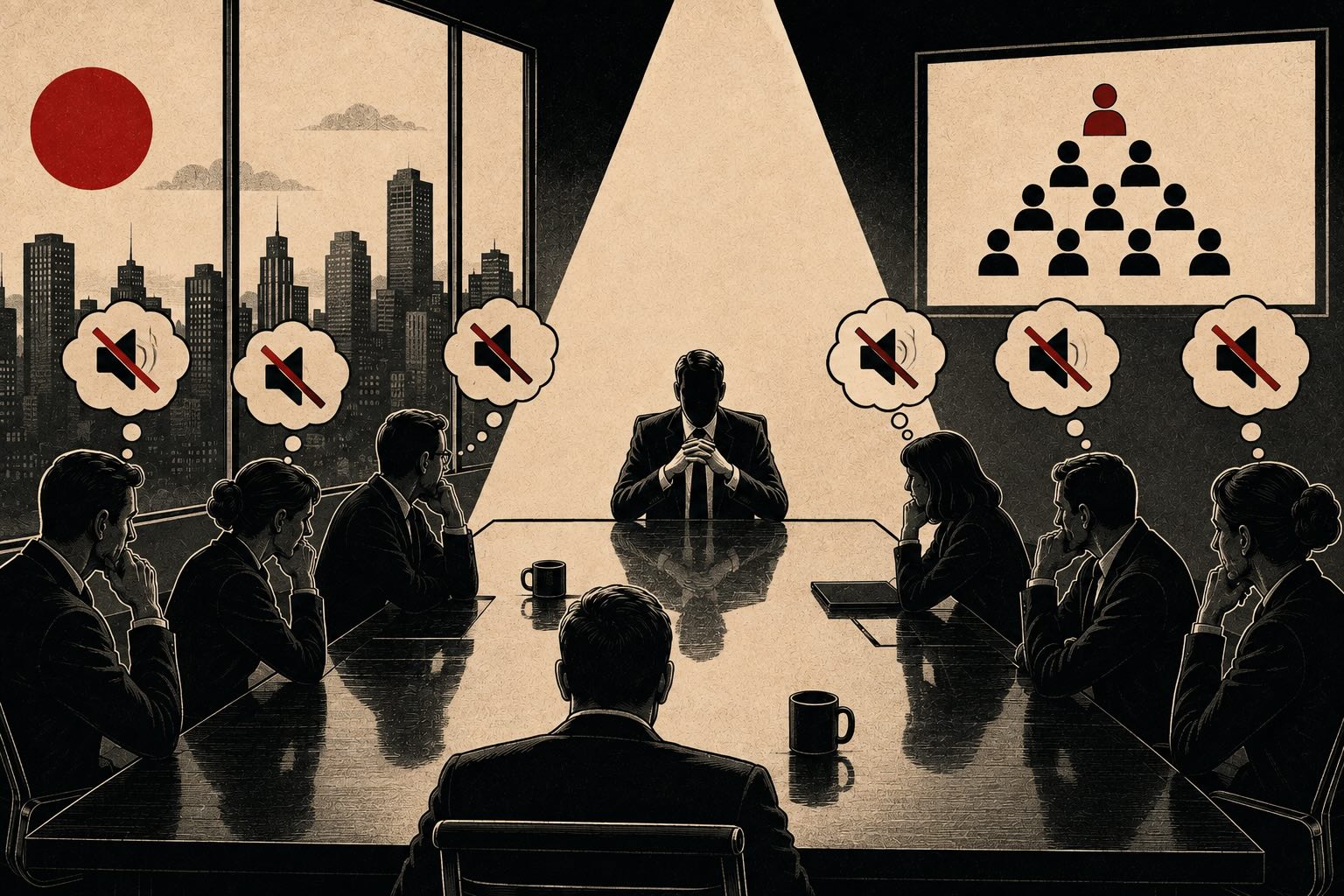
One of the most dangerous sounds around an executive table is nothing at all.
A proposal is presented.
The CEO explains the reasoning. The numbers appear credible. The recommendation seems sensible.
“Any concerns?”
Nobody speaks.
A few people nod.
The meeting moves on.
The minutes record the decision. Leadership leaves believing there was broad agreement.
But what exactly did the silence mean?
Perhaps everyone genuinely agreed.
Or perhaps someone saw a flaw but didn't believe challenging it would change anything.
Someone else had doubts but didn't want to be labelled negative.
Another executive remembered what happened to the last person who challenged the CEO.
And somebody simply decided that this was not a hill worth dying on.
The observable behaviour is identical.
Silence.
The interpretations could not be more different.
Agreement and the absence of disagreement are not the same thing
This distinction matters because organisations make decisions based not only on information, but on assumptions about what other people's behaviour means.
When nobody objects, leaders can infer:
“We have alignment.”
That interpretation then becomes part of the evidence supporting the decision.
But silence is unusually ambiguous.
It can mean agreement, uncertainty, resignation, fear, fatigue, deference, political calculation or simply that the person with the strongest objection has learned to keep it to themselves.
The mistake is not accepting silence.
It is assigning meaning to silence without testing it.
And when this happens repeatedly, the consequences can extend far beyond one poor decision.
Today's silence can become tomorrow's recurring problem
Imagine a major transformation that repeatedly misses milestones.
Each time, the executive team responds.
Governance is strengthened.
Reporting increases.
Accountability is clarified.
Programme leadership changes.
More resources are allocated.
Yet the problem keeps returning.
Leadership concludes that execution remains weak.
But suppose several people knew from the beginning that the timetable was unrealistic.
Operations knew critical dependencies had been underestimated.
Technology knew legacy complexity would create delays.
Finance questioned whether the benefits assumptions were credible.
Nobody challenged strongly enough for those concerns to alter the decision.
The organisation now appears to have a recurring execution problem.
It may actually have a recurring challenge problem.
That is a very different diagnosis.
The conditions that create silence matter
People rarely decide whether to speak solely on the merits of what they know.
They also read the conditions around them.
How does the CEO respond when challenged?
Are dissenters genuinely listened to or merely tolerated?
Does disagreement affect someone's reputation?
Are meetings designed to examine decisions or endorse decisions largely made beforehand?
Does hierarchy determine whose evidence carries weight?
Is speed valued so highly that further questioning feels obstructive?
Does the organisation reward people who identify uncomfortable risks early, or people who make difficult initiatives appear under control?
These conditions influence behaviour.
Behaviour then influences decisions.
Decisions produce results.
If the conditions remain unchanged, the organisation can keep producing remarkably similar problems while repeatedly treating each occurrence as an isolated event.
That is 空回り (karamawari): considerable effort without corresponding progress.
More communication may solve nothing
When leaders eventually recognise that employees are not speaking up, the response is often another initiative.
A survey.
A town hall.
A leadership programme.
A psychological-safety workshop.
An anonymous feedback channel.
Each may have value.
But asking people to speak more openly without examining why silence made sense to them risks treating the symptom again.
If someone believes challenging a senior executive damages careers, another communication channel changes very little.
If previous concerns disappeared into a void, asking for more feedback doesn't restore confidence.
If meetings punish uncertainty but reward confidence, people quickly learn which behaviour succeeds.
The sharper diagnostic question is therefore not:
“Why didn't they speak up?”
It is:
“What made staying silent the rational choice?”
That question moves attention away from judging individuals and towards understanding the environment shaping their behaviour.
Boards are vulnerable too
This is not simply a management problem.
Boards can create exactly the same dynamic.
A dominant Chair, highly regarded CEO, compressed agenda or desire to demonstrate unity can subtly reduce challenge.
Nobody needs to explicitly suppress dissent.
People read the room.
Over time, absence of disagreement can become evidence that governance is working well.
The paradox is uncomfortable: the more consistently harmonious the boardroom appears, the more valuable it may be to understand what happens to dissent before it reaches the table.
Healthy governance is not measured by how little disagreement exists.
It is measured partly by whether important disagreement can survive long enough to improve the decision.
Make disagreement useful before demanding more of it
CEOs fed up with recurring problems should therefore examine the decisions preceding them, particularly decisions that appeared to have overwhelming support.
Who knew something that ultimately proved important?
When did they know it?
Was it raised?
If not, why not?
If it was raised, what happened next?
And perhaps most revealingly: what did people learn from that experience about whether speaking up was worth doing again?
Those questions can expose something conventional root-cause analysis misses.
The recurring problem may not begin where the failure becomes visible.
It may begin months earlier, in a meeting where somebody noticed something important, looked around the room, calculated the consequences of saying it — and remained silent.
The organisation then spends millions fixing the consequences of a decision that might have been challenged for free.
For CEOs and boards, that should make silence worth investigating.
Because silence is not evidence that nobody sees the problem.
Sometimes it is evidence that the organisation has created conditions in which seeing the problem and saying so have become two very different things.
How many of your recurring problems might disappear if the people who saw them coming believed that disagreement was genuinely more valuable than agreement?


0 Comments