
One of the strangest ways organisations lose control is by responding to every failure with more mechanisms designed to create control.
Something goes wrong.
A project overruns.
A risk materialises.
A customer is badly affected.
A decision is made without sufficient scrutiny.
Leadership responds.
A committee is established. Reporting expands. Approval thresholds tighten. Another review is introduced. Another risk framework appears.
Each response is understandable.
Together, however, they can create something nobody intended: an organisation with extraordinary amounts of governance and surprisingly little strategic grip.
Every Layer Makes Sense on Its Own
This is what makes the problem difficult.
Nobody walks into an executive meeting proposing unnecessary bureaucracy.
The new committee exists because something was missed.
The additional approval exists because someone made a poor decision.
The new report exists because leadership lacked visibility.
The escalation requirement exists because an issue reached executives too late.
Viewed individually, every intervention has logic behind it.
But organisations rarely examine their cumulative effect.
Five years later, a decision that once required two people may require seven approvals, three committees, a risk assessment and twelve pages of supporting documentation.
The organisation has responded to individual failures without asking what the accumulated response is doing to the system.
Governance Can Create Distance From Reality
Good governance should bring decision-makers closer to reality.
Poor governance can do the opposite.
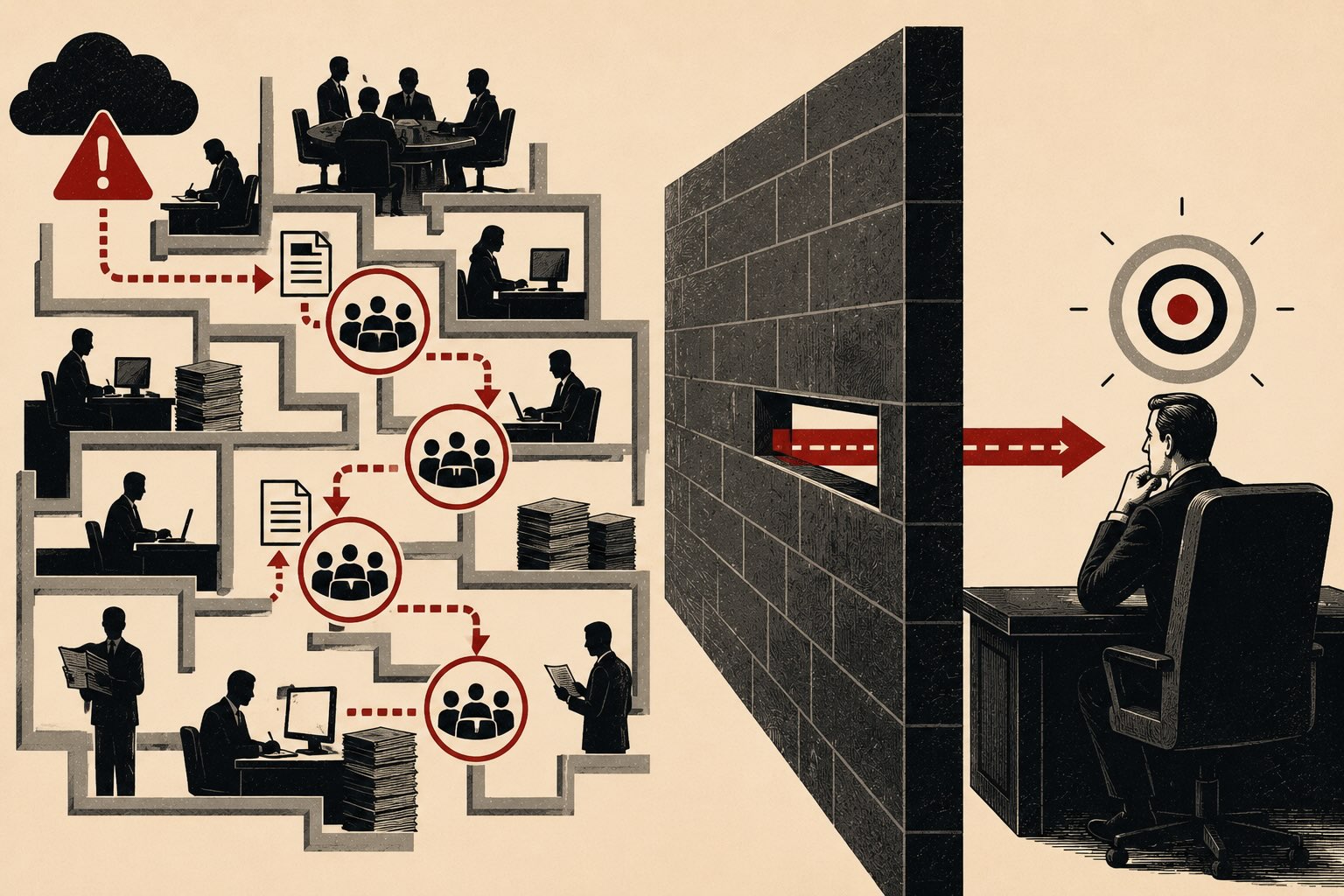
Imagine an operational problem emerging three levels below the executive team.
The person closest to it understands the situation intimately.
But the information must travel.
It enters a report.
The report goes to management.
Management adds context.
The issue enters a governance pack.
Language becomes more formal.
Uncertainty gets compressed.
Someone requests additional analysis.
Another committee reviews it.
By the time the problem reaches senior leadership, the information may be polished, categorised, quantified and beautifully presented.
It may also be several weeks old.
The CEO receives better documentation but worse proximity to reality.
People Learn What Happens When They Raise Problems
Governance also changes behaviour.
Suppose raising a concern triggers three meetings, extensive documentation, questioning from multiple functions and weeks of follow-up.
People notice.
They begin making rational calculations.
Is this really serious enough to escalate?
Can we resolve it ourselves?
Do we have enough evidence?
Perhaps we should wait another week.
Nobody has instructed them to hide problems.
The system has simply increased the cost of surfacing them.
Weak signals therefore remain local.
People compensate.
Workarounds emerge.
Reports describe symptoms rather than uncertainty.
Eventually the weak signal becomes strong enough that escalation is unavoidable.
Leadership then asks the obvious question:
Why didn't we know about this earlier?
And So Another Layer Appears
This is where governance becomes Karamawari.
空回り, karamawari, describes effort without meaningful forward progress.
A problem reaches leadership too late.
Leadership concludes visibility was insufficient.
More reporting is introduced.
Reporting increases workload.
People become more selective about what they escalate.
Information moves more slowly.
Leadership receives problems later.
Another failure occurs.
More governance follows.
Every cycle appears to strengthen control while potentially weakening the organisation's ability to surface reality quickly.
The wheel is spinning faster.
Traction is declining.
More Gates Can Also Mean Less Accountability
There is another paradox.
Governance intended to strengthen accountability can distribute it so widely that nobody feels they truly own the decision.
When six committees, four functions and eight executives have reviewed something, who actually decided?
Everyone participated.
Everyone complied.
Everyone can demonstrate that the correct process was followed.
Yet ownership becomes strangely difficult to locate.
The organisation has created accountability for completing the governance process rather than accountability for producing the outcome.
That distinction becomes painfully visible when something fails.
The investigation discovers that every required gate was passed.
The paperwork is complete.
The problem happened anyway.
Good Governance Should Reduce Friction to Truth
None of this means governance is undesirable.
CEOs need governance.
Boards need assurance.
Material decisions deserve challenge.
Risks require oversight.
Authority needs boundaries.
But the objective should not be to maximise governance.
It should be to create the minimum governance necessary to maximise clarity, challenge, accountability and visibility.
That requires different questions.
How quickly can bad news travel?
How many times is information reformatted before reaching someone who can act?
Can people escalate uncertainty, or only proven problems?
Who actually owns the decision?
Which approvals genuinely improve decision quality?
Which exist because of something that happened five years ago?
What governance would we remove if we were designing the organisation today?
Those questions expose accumulated bureaucracy that conventional governance reviews can miss.
Strategic Grip Comes From Proximity
CEOs frustrated by recurring problems should pay particular attention to the distance between themselves and the people closest to the problem.
A beautifully governed organisation can still repeatedly surprise its leadership.
That should be a warning.
The answer may not be another dashboard, committee, assurance process or reporting requirement.
It may be reducing the organisational distance that prevents uncomfortable reality travelling quickly enough.
Because control does not come from the number of gates a decision passes through.
It comes from leaders seeing reality early enough to do something about it.
If your organisation keeps adding governance every time leadership is surprised, could the governance intended to give you control now be the very thing preventing you from seeing what you need to control?


0 Comments