
Some recurring problems survive not because leaders haven't pushed hard enough, but because every additional push gives the organisation another reason to push back.
Aesop understood this more than 2,000 years ago.
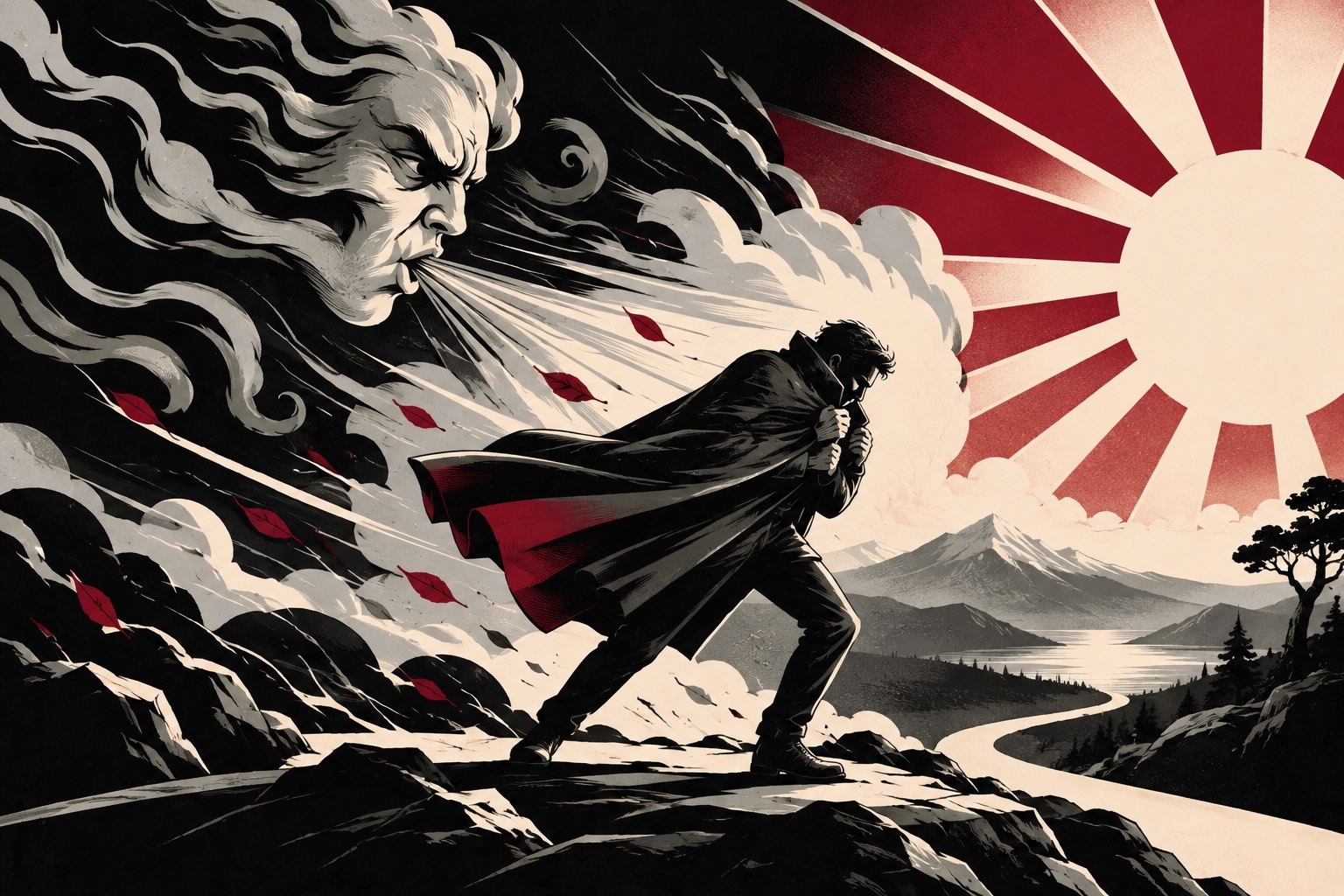
In The North Wind and the Sun, the two argue over who is stronger.
They see a traveller wearing a cloak and agree that whoever can make him remove it will prove their strength.
The North Wind goes first.
It blows.
The traveller grips his cloak.
The wind blows harder.
The traveller pulls the cloak tighter.
More force produces more resistance.
Eventually the North Wind gives up.
Then the Sun shines.
As the traveller becomes warmer, he removes the cloak himself.
The Sun achieves through changing the conditions what the Wind couldn't achieve through escalating force.
There is a remarkably modern leadership lesson hiding inside that ancient story.
The North Wind is alive and well in business
A transformation is behind schedule.
Leadership increases reporting.
Performance doesn't improve.
More meetings are introduced.
Progress remains slow.
Escalations increase.
Executives become more involved.
Deadlines become less negotiable.
People become cautious about what they report.
Decision-making slows further.
So leadership applies even more pressure.
Nobody involved is necessarily behaving irrationally.
The leadership team sees insufficient progress and concludes greater accountability is required.
Employees experience increasing scrutiny and respond by protecting themselves.
Both responses make sense.
Together, they create a loop.
Pressure creates behaviour that appears to justify more pressure.
Resistance is information
We often describe resistance as though it were a character flaw.
People are resistant to change.
Managers aren't accountable enough.
Teams lack urgency.
Employees need to get on board.
Sometimes that's true.
But resistance can also be a perfectly rational response to the conditions surrounding people.
Suppose employees have experienced five transformations in six years.
Each arrived with enormous enthusiasm.
Priorities changed.
Leaders moved.
Programmes disappeared.
People who invested heavily in the last transformation discovered that yesterday's urgent priority was suddenly irrelevant.
Then transformation number six arrives.
Leadership sees hesitation.
Employees see history.
Calling that resistance risks misdiagnosing the problem.
Their behaviour may actually be organisational learning.
They have learned to wait.
Force can create the evidence used to justify force
This is where recurring problems become particularly interesting.
Imagine a leadership team concerned that managers aren't taking enough ownership.
It introduces additional approvals to ensure important decisions are properly scrutinised.
Managers now have less authority.
So they escalate more decisions.
Leadership observes the increase in escalation and concludes managers aren't demonstrating sufficient ownership.
More controls are introduced.
Managers become even more dependent on senior approval.
Eventually leadership has compelling evidence for its original belief.
"See? They won't make decisions."
Except the intervention helped create the behaviour being criticised.
The North Wind is blowing harder and wondering why everyone keeps holding onto their cloak.
Pressure changes what people optimise for
Pressure isn't inherently bad.
Deadlines matter.
Standards matter.
Accountability matters.
Sometimes organisations genuinely need greater urgency.
The problem arises when leaders assume the response to insufficient movement must always be additional force.
Under enough pressure, people begin optimising for survival rather than outcome.
A red project becomes amber.
A difficult conversation gets postponed.
An ambitious forecast survives another month.
Bad news travels more slowly.
Teams become skilled at satisfying governance rather than solving the underlying problem.
The dashboard can improve while reality deteriorates.
Leadership sees compliance.
The organisation experiences protection.
Try changing the conditions
The Sun didn't persuade the traveller to remove his cloak.
It didn't threaten him.
It didn't establish a cloak-removal KPI.
It changed the conditions until removing the cloak became the traveller's rational choice.
That is a powerful way to think about organisational change.
Instead of asking:
"How do we make people do this?"
Ask:
"What currently makes the existing behaviour reasonable?"
Perhaps managers escalate because decision rights are unclear.
Perhaps employees remain silent because previous challenges were punished.
Perhaps teams bypass governance because the formal process takes three weeks and the customer needs an answer tomorrow.
Perhaps executives defend unrealistic forecasts because revising one attracts more scrutiny than missing it later.
Perhaps people resist the transformation because experience tells them it will disappear before they need to change.
Once you understand the conditions, resistance can stop looking like the problem.
It becomes evidence about the problem.
Stop fighting the cloak
CEOs dealing with recurring problems understandably become frustrated.
The organisation has already tried.
Money has been spent.
Commitments have been made.
The board wants answers.
Another failure creates an understandable temptation to increase pressure.
Sometimes that's exactly what is needed.
But before turning up the wind, examine what happened the last time you did.
Did behaviour genuinely change?
Or did people become better at appearing compliant?
Did information improve?
Or did bad news become harder to surface?
Did accountability increase?
Or did defensiveness?
Did the problem disappear?
Or did the organisation simply become better at containing it?
Because there is a profound difference between overcoming resistance and understanding why resistance exists.
The North Wind believed strength meant applying enough force to overpower the traveller.
The Sun demonstrated something much more powerful: change the conditions, and the behaviour can change without being forced.
So if every attempt to force change in your organisation creates more resistance, what if the resistance isn't telling you that your people need more pressure, but that your conditions need to change?


0 Comments