
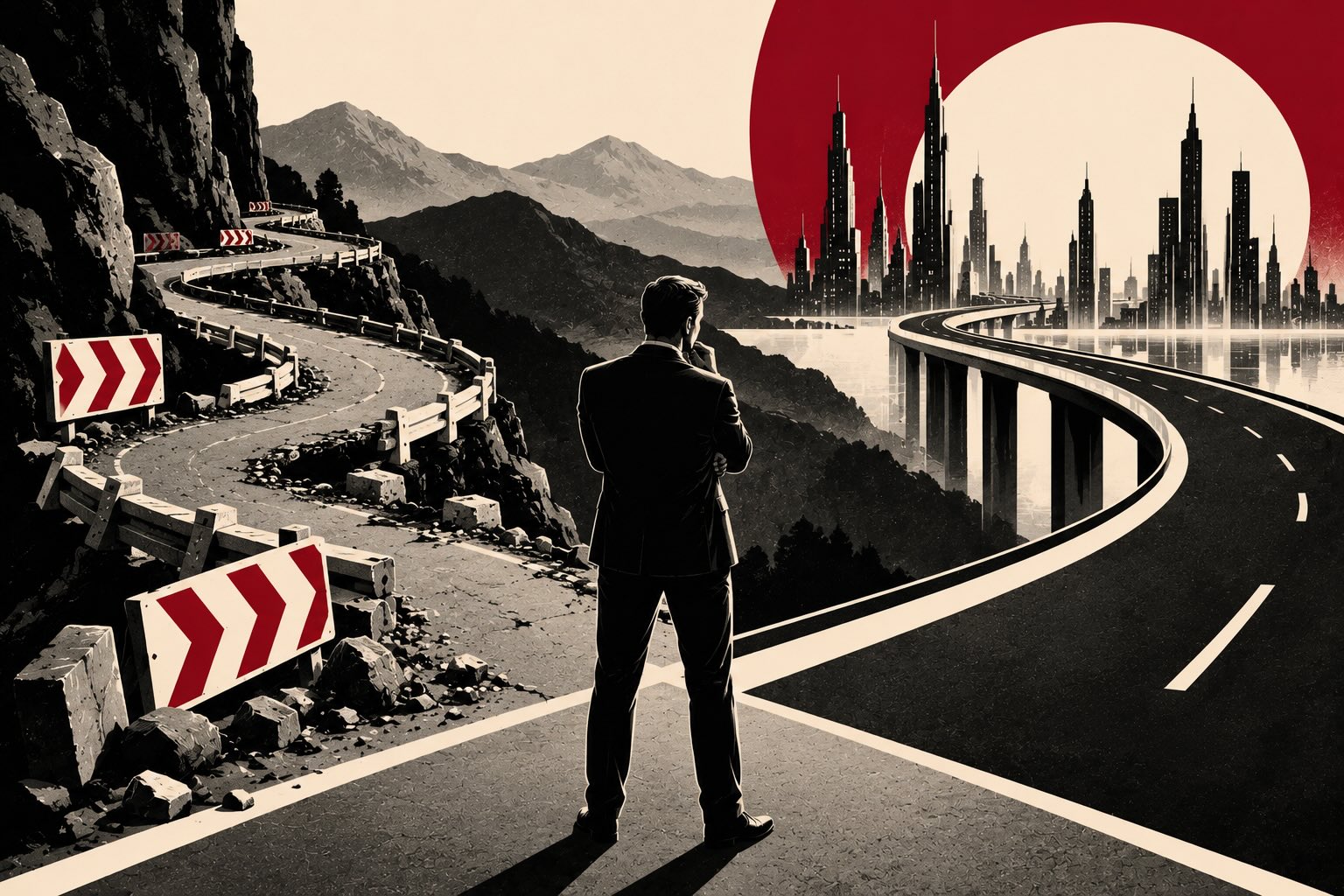
Some recurring problems survive not because your organisation keeps choosing the wrong solution, but because it keeps solving a problem the world has already moved beyond.
Clayton Christensen’s The Innovator’s Dilemma contains an uncomfortable lesson for CEOs.
Well-managed companies can fail precisely because they are well managed.
They listen to important customers. They invest where returns appear strongest. They improve existing products. They allocate capital rationally.
And then the basis of competition changes.
That idea has enormous relevance to karamawari (空回り), the Japanese expression that evokes spinning without engaging: considerable effort producing surprisingly little traction.
Because sometimes the recurring problem isn't inside the solution.
It is inside the organisation's definition of the problem.
Yesterday's success can become today's assumption
Successful organisations accumulate beliefs about how their world works.
Customers value this.
Margins come from that.
Quality means this.
Our competitors are those companies.
Our advantage is this capability.
Those assumptions may be entirely reasonable because history has repeatedly validated them.
Christensen showed why that can become dangerous.
Disruptive innovations often begin by appearing inferior according to the measures established organisations use to judge performance. They may initially serve smaller, less attractive markets.
The rational response can therefore be to ignore them.
Until customers begin valuing something different.
The organisation hasn't necessarily become less capable.
Its capability has remained attached to yesterday's definition of value.
Recurring problems can be strategic signals
Now consider a recurring problem inside your business.
Margins keep deteriorating.
Customers keep leaving.
Sales cycles keep lengthening.
A product continually misses forecasts.
Another cost-reduction programme delivers temporary improvement before costs creep upwards again.
Leadership naturally asks how to improve performance.
But what if performance isn't the real problem?
Perhaps customers' expectations have changed.
Perhaps the economics of the market have shifted.
Perhaps technology has removed an old constraint.
Perhaps something customers once valued enough to pay for has become irrelevant.
If so, improving execution against the existing model may produce the worst kind of karamawari.
You become increasingly efficient at preserving something becoming increasingly irrelevant.
Good management can keep the wheel spinning
This is where The Innovator's Dilemma becomes particularly uncomfortable.
When results deteriorate, capable leadership teams rarely do nothing.
They act.
They improve the product.
Reduce costs.
Increase sales targets.
Reorganise teams.
Introduce new technology.
Launch customer initiatives.
Strengthen accountability.
Every intervention can make sense.
And some may work.
For a while.
But recurring problems contain information. If the same commercial outcome repeatedly returns after credible interventions, perhaps the organisation should stop treating recurrence as evidence that the solution needs improving.
It may be evidence that the original problem needs redefining.
That requires a different leadership question.
Not:
"How do we become better at doing this?"
But:
"Does this still need to be done?"
Your best customers can reinforce the trap
Christensen also demonstrated something deeply counterintuitive: listening closely to your best customers can sometimes reinforce the existing trajectory.
That doesn't mean ignoring customers.
It means recognising that current customers naturally describe their needs through their experience of the current market.
They may ask for something faster, more powerful, more reliable or more sophisticated.
So the organisation keeps improving.
But disruption can emerge somewhere else, solving a different problem for different customers using different economics.
This creates a powerful Karamawari trap.
The organisation receives continuous confirmation that its existing direction is sensible.
Customers validate it.
Metrics validate it.
Investment cases validate it.
Past success validates it.
Yet the conditions surrounding the organisation are changing.
The wheel is spinning beautifully.
It simply isn't connected to the road anymore.
Ask what survived the last solution
When a recurring problem returns, CEOs understandably want another answer.
But before approving another transformation, restructure or technology investment, investigate what remained unchanged.
Did the product change while your definition of customer value stayed the same?
Did the operating model change while the economics remained broken?
Did the sales strategy change while customer behaviour had fundamentally shifted?
Did costs fall while the underlying reason customers were leaving remained untouched?
Did you improve execution without questioning whether you were executing the right strategy?
This is where recurrence becomes useful.
A problem returning for the fourth time isn't merely frustrating.
It is evidence.
Something important survived solutions one, two and three.
Your job is to discover what.
Sometimes the organisation must stop improving
One of the hardest things for successful executives to question is something their organisation is genuinely good at.
Weaknesses invite scrutiny.
Strengths earn protection.
Yet Christensen's work reminds us that capabilities, processes and commercial logic developed for one environment do not automatically remain valuable when that environment changes.
That is why karamawari can be particularly dangerous inside successful businesses.
There may be no incompetence.
No laziness.
No obvious failure of leadership.
Everyone may be working exceptionally hard and making perfectly defensible decisions.
But enormous capability applied to an outdated problem is still wasted capability.
Sometimes leadership requires improving the solution.
Sometimes it requires finding a completely different solution.
And occasionally it requires the courage to recognise that the problem you have spent years becoming brilliant at solving is no longer the problem that matters.
So when that expensive problem returns yet again, perhaps the most important question isn't "Why haven't we finally solved it?"
What if you have solved it repeatedly, and the real recurring problem is that your organisation has never stopped to ask whether it is still solving the right problem?


0 Comments