
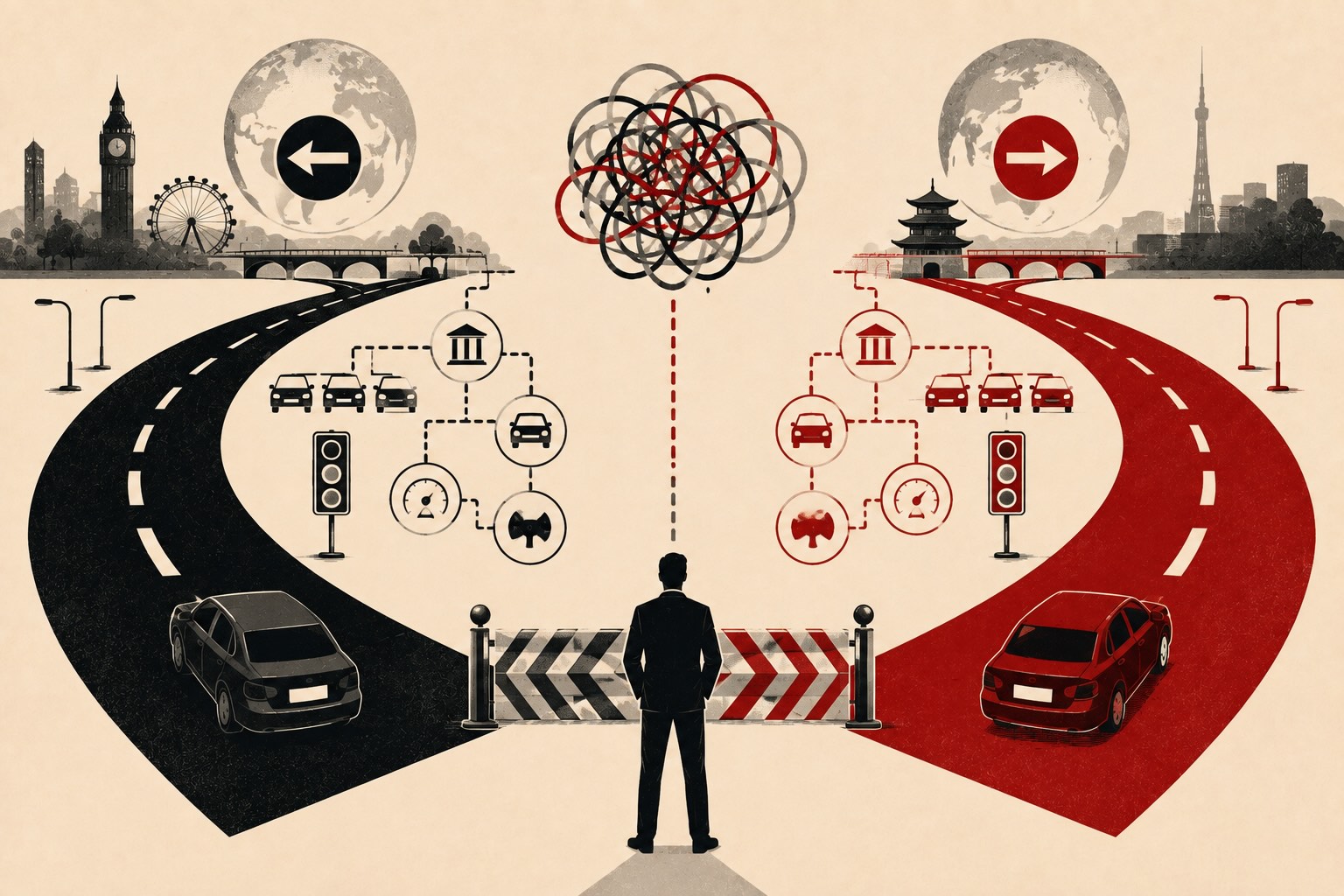
Some recurring problems survive not because nobody knows how to solve them, but because the organisation has built so much around an old decision that changing it now feels more dangerous than living with its consequences.
Consider something as ordinary as which side of the road we drive on.
There is nothing inherently superior about driving on the left or the right. What matters is that everyone agrees.
Once that convention is established, however, something interesting happens.
An entire ecosystem begins organising itself around the decision.
And that has an uncomfortable lesson for CEOs dealing with costly recurring problems.
A small decision can create a very large system
Imagine a country deciding from scratch which side of the road people should drive on.
Left or right?
Either can work.
But once the decision is made, thousands of subsequent decisions begin depending upon it.
Roads are designed accordingly. Intersections are configured around it. Signs are positioned for it. Vehicles are manufactured for it. Traffic lights accommodate it. Driver training reinforces it. Laws codify it. Habits develop around it.
Eventually, "drive on the left" stops looking like a decision.
It becomes a condition.
That distinction matters.
Organisations undergo the same transformation.
A decision made years ago about pricing, organisational structure, technology, approval authorities, customer segmentation, incentives or risk may initially have been perfectly reasonable.
But other decisions gradually accumulate around it.
Processes adapt.
Systems are configured.
Roles are created.
KPIs reinforce it.
People learn how to succeed within it.
Eventually, the original decision disappears beneath everything built upon it.
Yesterday's decision becomes today's constraint
This is where recurring problems become particularly difficult.
Leadership sees the current problem and naturally asks:
How do we fix it?
But the visible problem may be several layers removed from the decision that created the conditions producing it.
Suppose an organisation historically gave individual business units substantial autonomy.
At the time, that might have encouraged speed, entrepreneurship and accountability.
Over years, each business unit develops its own systems, processes, suppliers, terminology, data structures and priorities.
Then the company wants customers to experience one seamless organisation.
Suddenly, integration problems appear everywhere.
Leadership responds with coordination committees, integration platforms, governance forums, reporting requirements and transformation programmes.
Each intervention may help.
But none changes the underlying condition.
The organisation is trying to create enterprise integration on top of an ecosystem designed for local autonomy.
It is effectively trying to drive on the left and right simultaneously.
The interfaces become expensive
Countries with different driving conventions can coexist perfectly well.
The difficulty appears where the systems meet.
At borders between jurisdictions using opposite conventions, the transition must be carefully engineered. Drivers need to move safely from one system to another.
Organisations have borders too.
Sales hands work to Operations.
Operations interacts with Finance.
Technology supports the business.
Risk constrains decisions.
Corporate functions interact with business units.
Different systems, assumptions and incentives collide at these boundaries.
So organisations build bridges between them.
More meetings.
More reconciliations.
More integrations.
More approvals.
More coordination roles.
More spreadsheets.
More governance.
Each one may be entirely rational.
Collectively, however, they can become an enormous tax on the organisation.
The business is no longer paying primarily to create value.
It is increasingly paying to manage incompatibility.
This is where Karamawari takes hold
Karamawari (空回り) describes significant effort that produces little corresponding forward movement.
Few things create Karamawari more effectively than attempting to solve recurring problems while preserving the conditions generating them.
People are not necessarily incompetent.
The solutions are not necessarily bad.
Leadership may not even have made a mistake.
The original decision may have been exactly right for the organisation that existed ten years ago.
The problem is that its consequences became embedded.
That creates a dangerous economic equation.
Changing the underlying condition becomes increasingly expensive.
But preserving it creates an accumulating stream of recurring costs.
Most organisations see the first number clearly.
The transformation required to change architecture, incentives, structures or operating models receives a business case.
The second number is much harder to see.
It is scattered across rework, duplicated systems, management attention, customer recovery, additional controls, manual reconciliation, delays, exceptions and repeated remediation.
The cost of changing the road system appears enormous.
The cost of directing traffic around the incompatibility forever rarely appears in one place.
The recurring problem may actually be a debt repayment
This changes how CEOs should think about recurrence.
A problem that repeatedly appears at organisational boundaries may not be a series of unrelated failures.
It may be the organisation continually paying interest on a decision embedded deep within its operating model.
That does not automatically mean the decision should be reversed.
Sometimes managing the incompatibility genuinely is cheaper than rebuilding the ecosystem.
But that should be a conscious economic choice, not an accidental consequence of treating every recurrence as another isolated problem.
The leadership question therefore changes.
Instead of asking only, "How much will it cost to fix this problem?", ask:
What underlying condition are we preserving, what does preserving it cost us every year, and at what point does living with the incompatibility become more expensive than changing the system that keeps creating it?
Because sometimes the most expensive decision in an organisation is not the wrong decision.
It is the decision that was once right, became embedded everywhere, and has never been reconsidered.
And if your organisation keeps paying to manage the same incompatibility year after year, are you really avoiding the cost of change, or simply paying for that change indefinitely without ever receiving it?


0 Comments