
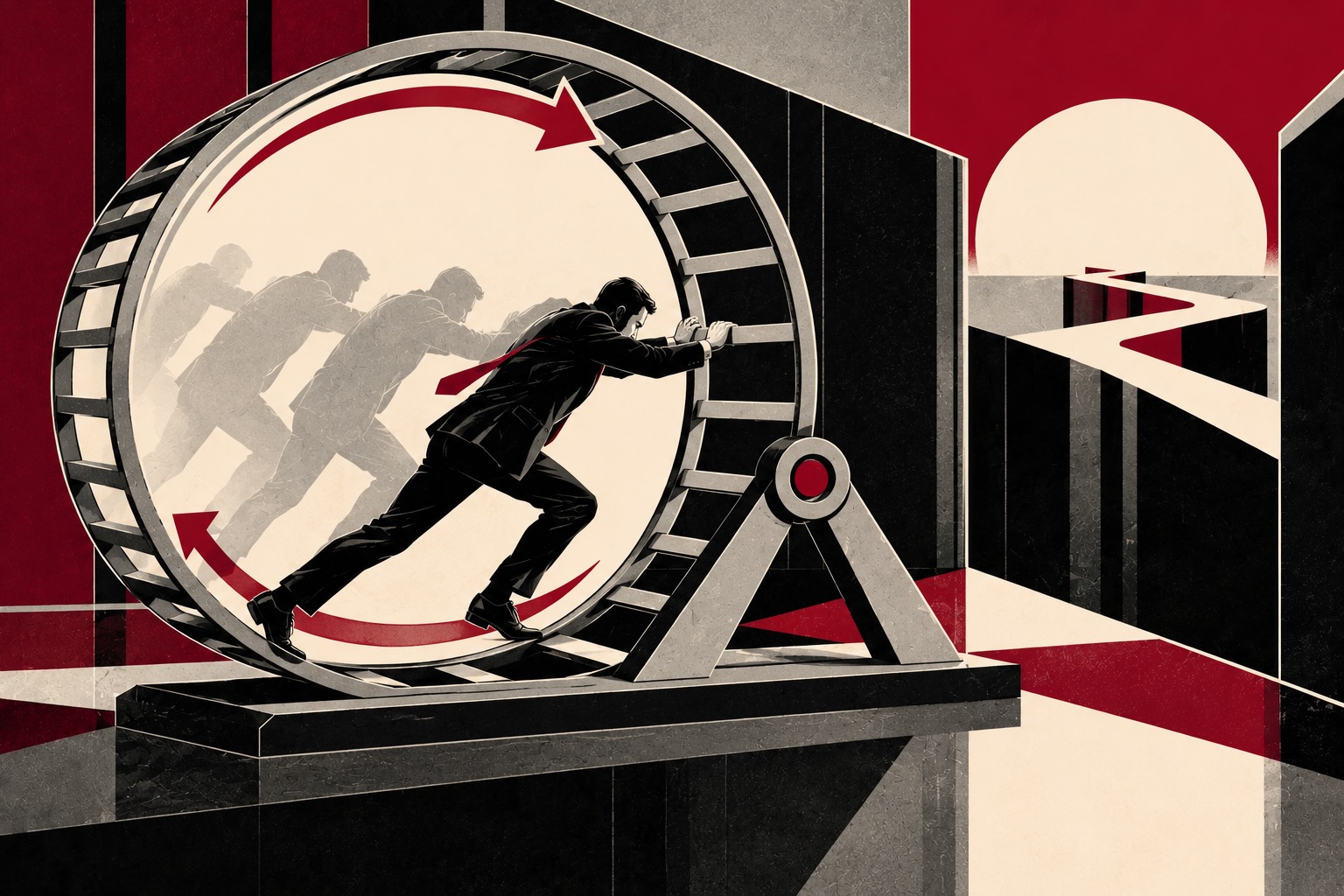
If your organisation keeps solving the same problem, the uncomfortable question is no longer why the solution failed, but why the organisation keeps recreating something it already knows how to fix.
Simon Reynolds’ Why People Fail focuses largely on personal performance. He explores the behaviours and patterns that prevent capable people from achieving what they want: unclear goals, procrastination, distraction, weak discipline, fear, poor habits and failing to learn effectively from mistakes.
But there is a fascinating organisational parallel.
Companies develop habits too.
And when those habits repeatedly recreate expensive problems, leaders can find themselves experiencing karamawari (空回り): spinning without engaging, or considerable effort producing surprisingly little traction.
Organisations have habits too
Consider a problem that has appeared three or four times.
Perhaps projects continually miss deadlines.
Customer complaints keep returning.
Costs fall after efficiency programmes, then creep upwards again.
Controls are strengthened, yet employees find new ways around them.
The natural response is to focus on the latest manifestation.
Another recovery plan.
Another process redesign.
Another training programme.
Another control.
Another restructure.
But Reynolds’ focus on repeated behaviours suggests a different question:
What pattern is producing the outcome?
An organisation can replace people, technology and processes while preserving the organisational habits that made the original problem possible.
That is why some problems seem almost indestructible.
Failure can become a loop
Imagine senior management complains that employees aren't taking enough accountability.
Leadership responds by increasing oversight.
More approvals are introduced. Reporting increases. Decisions are escalated.
That seems reasonable.
But employees quickly learn that making decisions independently carries greater personal risk than escalating them.
So they escalate more.
Senior leaders become overwhelmed by decisions.
Things slow down.
Leadership concludes that employees lack accountability.
More oversight follows.
The organisation has created a loop.
And the fascinating part is that everyone inside it may be behaving rationally.
This is where karamawari becomes useful.
The organisation isn't failing because nobody is trying.
It is failing because effort is being applied inside conditions that keep reproducing the behaviour leadership is trying to eliminate.
Stop confusing motivation with conditions
One danger when problems recur is assuming people need to try harder.
Reynolds places considerable emphasis on personal drive, discipline and action. Those things matter.
But organisations introduce another variable: conditions.
A capable employee can behave cautiously when authority is unclear.
A collaborative manager can protect information when incentives reward local performance.
A responsible employee can bypass a control when following it makes serving the customer almost impossible.
A project manager can repeatedly escalate when every previous independent decision has been second-guessed.
Behaviour that looks dysfunctional from the executive floor may be entirely logical from somewhere else in the organisation.
Before trying to change behaviour, ask:
What makes this behaviour make sense?
That question can reveal more than another round of training ever will.
Recurrence is feedback
One of the most valuable ways CEOs can think about repeated failure is to stop treating recurrence purely as bad news.
It is also evidence.
If you change the process and the problem returns, you have learned something.
The process wasn't sufficient.
If you replace the technology and the problem returns, perhaps technology wasn't the primary cause.
If you restructure the team and the problem returns, perhaps the boxes on the organisational chart weren't driving it.
If you replace the leader and the problem returns, perhaps the individual wasn't the problem either.
Every recurrence eliminates possibilities.
Yet organisations frequently respond by doing another variation of what they did before.
The previous transformation becomes Transformation 2.0.
The control receives another control.
The dashboard receives another metric.
The meeting receives another meeting.
Activity increases.
Traction doesn't.
Ask what didn't change
After a recurring problem returns, leadership teams naturally ask:
What should we change this time?
Try reversing the question:
What didn't we change last time?
Perhaps the assumptions remained.
Perhaps incentives remained.
Perhaps decision rights remained ambiguous.
Perhaps information still couldn't reach the people able to act.
Perhaps challenging senior leaders remained dangerous.
Perhaps heroic employees continued compensating for weaknesses in the operating model.
Perhaps the organisation changed almost everything surrounding the problem except the condition that kept recreating it.
Now recurrence becomes diagnostically useful.
You are no longer simply studying another incident.
You are comparing incidents and searching for what survived between them.
The cost isn't just another remediation
For CEOs, this matters commercially.
The cost of recurrence isn't simply the invoice for fixing the problem again.
It is management attention.
Lost capacity.
Delayed strategy.
Customer recovery.
Employee frustration.
Operational disruption.
Additional controls.
Technology investment.
Consultants.
Rework.
And opportunity cost.
Worse, repeated unsuccessful interventions can gradually teach employees something dangerous:
This problem never really goes away.
Once that belief becomes embedded, workarounds become normal. Expectations fall. People stop escalating what everyone already knows.
The organisation becomes exceptionally capable at living with something it should have eliminated.
Break the pattern, not just the problem
The organisational lesson we can take from Why People Fail is not that recurring business problems can be reduced to individual habits.
They cannot.
It is that repeated outcomes deserve investigation as patterns, not isolated events.
When something returns, reconstruct what happened.
Examine the conditions.
Surface the assumptions.
Understand the behaviours those assumptions produced.
Follow them into the decisions people made.
Then examine the impacts.
And compare that chain with the previous occurrence.
The objective isn't to find someone to blame.
It is to discover what the organisation keeps preserving while everything else changes.
Because after the fourth transformation, fifth remediation programme and sixth executive intervention, trying harder can become extraordinarily expensive evidence that you are still looking in the wrong place.
So if your organisation keeps experiencing the same costly problem, what if the habit you most urgently need to break isn't the behaviour causing the problem, but leadership's habit of repeatedly solving what the problem looks like instead of discovering what keeps bringing it back?


0 Comments